
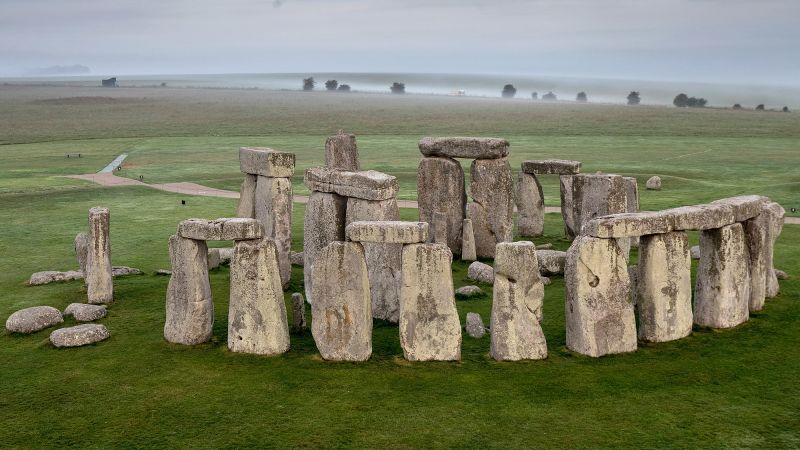
New discovery may have been Stonehenge prototype
Ancient Alignment Discovery in Southwest England
Sandego.net – Archaeologists in southwest England have uncovered a 5,000-year-old structure that could represent an early version of the iconic Stonehenge monument, according to findings shared by Wessex Archaeology, a British firm specializing in archaeological research. This site, located in Bulford, Wiltshire, is just 5 kilometers (3.1 miles) away from the famous Stonehenge, and its discovery has sparked fresh speculation about the origins of one of the world’s most enigmatic prehistoric sites.
“The sun was incredibly important to these prehistoric communities, and they could plot and record its midsummer rising to a high degree of accuracy,” said Phil Harding, a lead archaeologist on the project.
The structure, composed of two wooden poles positioned 120 meters (394 feet) apart, was designed to align with the sun’s movement during key seasonal events. This configuration mirrors the astronomical orientation of Stonehenge’s stones, which mark the summer solstice sunrise and winter solstice sunset. The alignment suggests a sophisticated understanding of celestial patterns among early Neolithic inhabitants, challenging previous assumptions about their technological capabilities.
Reconstructing the Past with Radiocarbon Dating
Phil Harding’s team employed radiocarbon dating to confirm the age of the wooden poles, which were found in pits dating back approximately 5,000 years. This timeframe coincides with the construction of the earliest earthworks at Stonehenge, though the famous stone arrangements were erected around 500 years later. The discovery at Bulford raises intriguing questions about the evolution of ceremonial practices and the development of monumental architecture in the region.
Harding emphasized the significance of this find, calling it “one of the greatest discoveries of my career.” He noted that the structure’s early date provides crucial insight into the prehistoric people’s relationship with the natural world. “This evidence indicates that the alignment of the sun with the horizon was not a later innovation but a foundational element in the design of these ancient sites,” he explained. The site’s proximity to Stonehenge further underscores its potential role in the broader network of Neolithic monuments.
Skyscape Archaeology and Celestial Precision
Fabio Silva, a skyscape archaeologist involved in the project, used digital reconstructions of the ancient sky, landscape, and horizon to verify the structure’s alignment with solstices. His analysis revealed that the poles would have tracked the sun’s path with remarkable accuracy, likely serving as a tool for seasonal celebrations or rituals. “This discovery helps us understand Stonehenge not as a singular creation, but as part of a much longer conversation between people, the land, and the sky,” Silva stated in the statement.
Experts believe the Bulford structure may have functioned as a precursor to Stonehenge, offering a glimpse into the early stages of what would become a monumental site. The use of wooden poles instead of the massive stones of Stonehenge highlights the evolution of materials and engineering over time. “It’s fascinating to see how these ancient builders adapted their methods,” said Silva. “The transition from temporary wooden markers to enduring stone structures reflects a growing cultural and spiritual significance of celestial events.”
Artifacts and Cultural Significance
Alongside the wooden poles, archaeologists uncovered a range of artifacts, including pottery fragments, animal bones, charcoal remnants, and worked flints. These items suggest that the site was not only a functional astronomical tool but also a gathering place for communal activities. Notably, one of the finds was an “extremely rare disc-shaped knife,” which may have been placed intentionally to symbolize the sun disc—a concept central to the site’s purpose.
The presence of such artifacts implies that the community around Bulford was actively engaged in both daily life and ritualistic practices. “The discovery indicates that this area was a hub of activity, with people living, working, and celebrating in close proximity to the monument,” said Silva. The knife, in particular, has sparked debates about its symbolic role. “It’s possible that the disc shape represented the sun’s power or served as a votive object for the solstice ceremonies,” he added.
Expert Perspectives and Broader Implications
Susan Greaney, a lecturer in archaeology at the University of Exeter, praised the findings as “intriguing” but noted that full details of the research have yet to be published. “The possible alignment at Bulford is part of a significant middle Neolithic settlement,” she explained. “It shows how vital the eastern part of the Stonehenge landscape was, with people both inhabiting and constructing monuments on the far side of the River Avon.”
Greaney’s comments highlight the interconnectedness of the region’s prehistoric sites. “This discovery bridges the gap between early agricultural communities and the later construction of Stonehenge,” she said. “It’s a reminder that these monuments were not built in isolation but were part of a larger cultural framework.” The site’s location and date suggest that the rituals and structures associated with solstices developed gradually, with Bulford playing a pivotal role in this process.
Revisiting the Timeline of Stonehenge’s Development
The findings at Bulford challenge the traditional timeline of Stonehenge’s construction. While the first earthworks at the site were built around 5,000 years ago, the stone structures came later, roughly 500 years after the wooden poles. This timeline reveals a progression from simpler, temporary markers to more permanent and elaborate monuments, raising questions about the motivations behind such transformations.
Harding speculated that the shift from wooden to stone may have been driven by the need for greater durability or a symbolic emphasis on permanence. “The original structure was functional, but the later stones may have carried deeper cultural or religious meanings,” he said. The disc-shaped knife, for instance, could symbolize the sun’s role in agricultural cycles or spiritual beliefs, suggesting that the site was not just a calendar but a sacred space.
Further research is needed to fully understand the site’s purpose and its connection to Stonehenge. However, the discovery has already sparked renewed interest in the Neolithic period’s astronomical practices. “This structure provides a rare window into how early people interacted with the cosmos,” said Greaney. “It’s a key piece in the puzzle of Stonehenge’s origins.”
The Bulford site also underscores the importance of regional cooperation in prehistoric societies. Its location near Stonehenge indicates that the area was a focal point for activity, with multiple generations contributing to its development. “The alignment of this structure with Stonehenge suggests a shared knowledge or tradition across the landscape,” said Silva. “It’s not just about the monument itself but the collective effort to mark time and space.”
As archaeologists continue to explore the site, they hope to uncover more about the daily lives and beliefs of its builders. The combination of scientific techniques like radiocarbon dating and skyscape archaeology has allowed for a more precise understanding of the past, bridging the gap between ancient practices and modern analysis. “This discovery is a testament to human ingenuity and the timeless fascination with the stars,” Harding concluded. “It’s a reminder that even 5,000 years ago, people were deeply connected to the rhythms of the natural world.”