Indigenous Taiwanese Sailers Replicate Ancient Ocean Journey in Paddle Voyage
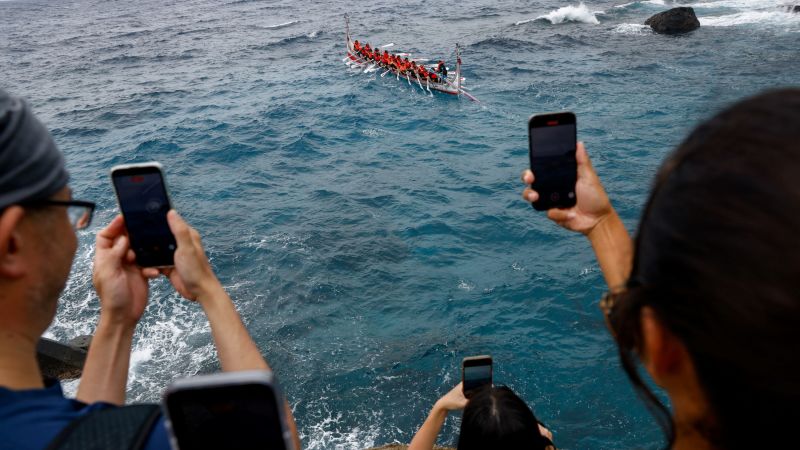
Sandego.net – On a serene Monday morning, a group of indigenous Taiwanese seafarers embarked on an extraordinary 111-mile expedition, using only a traditional wooden canoe and celestial navigation to reach the Philippines. This act of reenacting a historic sea voyage underscores the remarkable legacy of human migration across the Pacific, a feat that has long connected Taiwan to distant lands. The group, composed of 60 Tao people from Orchid Island, paddled against strong currents, demonstrating the resilience and skill of their ancestors who once traversed the vast ocean in primitive vessels.
Ancient Roots and Modern Journey
Indigenous Taiwanese communities, though a minority in today’s population, are believed to hold the genetic and cultural legacy of early Pacific navigators. Their migration is thought to have begun over 4,000 years ago, linking them to the Austronesian peoples who settled in regions as far-flung as Hawaii and Madagascar. This shared heritage is evident in linguistic patterns and the ability to navigate using the stars—a skill that allowed early voyagers to reach isolated islands with astonishing precision.
Upon arrival on Batan Island, the Tao participants were greeted with a vibrant display of Ivatan traditions, including drum and dance performances. This moment of cultural exchange highlighted the enduring ties between the two groups, whose ancestors may have crossed the ocean together in the distant past. “This is not only a significant day for the Pacific Ocean but also a day of commemoration for the Austronesian people,” said Maraos, chairperson of the Indigenous Peoples Cultural Foundation (IPCF). Maraos, like many Tao individuals, uses a single name as part of their cultural identity.
Reviving a Forgotten Path
The 111-mile journey aimed to revive a maritime route that had not been used for over three centuries. Early navigators of the Bashi Channel, lacking modern maps, relied on rudimentary boats and celestial navigation to make their way across the ocean. This ancient path, now reimagined, symbolizes the ingenuity of the Tao people and their role in shaping the broader story of human migration. The voyage also served as a tribute to the resilience of those who braved the unknown to settle new lands.
More than 200 individuals from six tribal communities collaborated to build the canoe, which was named “Ovayan,” or “Golden Friendship.” Using time-honored techniques, they bound specially cut wood without nails, creating a vessel that honored traditional craftsmanship. “If the surface is uneven, with slight bumps here and there, the resistance from the sea will be much greater,” explained Hsieh Chen-Hsiung, a shipbuilder, in a promotional video. His words emphasize the importance of precision in constructing a boat capable of enduring the harsh conditions of the open ocean.
Archaeological and Genetic Evidence
The Great Pacific Migration, a pivotal chapter in human history, is now being revisited through a combination of archaeological findings and genetic studies. Peter Bellwood, an Emeritus Professor of Archaeology at Australian National University, posits that the journey began in Taiwan around 5,000 years ago before spreading to the Philippines and beyond. “Then, it spread into the Philippines, and then onwards,” he added, citing evidence such as DNA traces and ancient artifacts to support this theory.
Bellwood noted that these early voyagers carried essential food sources, including yams and taro, alongside livestock, which were crucial for survival on remote islands. “Without those animals and plants, they couldn’t survive in small islands,” he explained. Women were also vital members of these expeditions, as they contributed to navigation and maintained knowledge of the stars. This combination of skills allowed Austronesian groups to chart courses across the Pacific, connecting distant regions through shared cultural practices.
Linguistic Connections Across the Ocean
Victoria Chen, a senior lecturer at Victoria University of Wellington in New Zealand, highlighted Taiwan’s role as the first identifiable hub of Austronesian language diffusion. Many of these languages, such as Bahasa Indonesian, Māori, and Hawaiian, share common roots, with words like “five” appearing as “lima,” “rima,” and “ʻelima” respectively. However, Taiwan itself holds a greater diversity of Austronesian dialects, featuring more complex grammatical structures and extensive vocabularies. “The high-level diversity suggests that Taiwan was the original dispersal of the family,” Chen stated, underscoring the island’s significance in linguistic history.
Despite its widespread acceptance among scientists, the “Out of Taiwan” theory has faced recent scrutiny from mainland China scholars. These researchers argue that the origins of Austronesian peoples may lie in southern China rather than Taiwan. Taipei views this challenge as an attempt to bolster Beijing’s territorial claims over the island, which it asserts as its own despite historical control changes. The debate reflects the broader tension between indigenous identity and mainland narratives in shaping the region’s past.
The Tao People and Their Legacy
The Tao people, one of Taiwan’s smaller indigenous groups, have a population of just 5,120, according to government records. This accounts for only 3% of the island’s 23 million residents, most of whom are descendants of Han Chinese migrants from the mainland. Yet, the Tao’s historical role in the Great Pacific Migration remains foundational. Their ancestral voyages not only expanded human habitation across the Pacific but also established a network of cultural and genetic connections that endure today.
Historians and anthropologists emphasize the Tao’s pioneering spirit, which enabled them to navigate vast distances using the stars and simple vessels. The recent reenactment, supported by the Taiwanese government, brings renewed attention to this legacy. By replicating the journey, participants connect the past with the present, celebrating the ingenuity of their forebears while rekindling pride in their heritage. The voyage also serves as a reminder of the challenges faced by early navigators, including unpredictable weather and the need for precise boat construction.
As the canoe reached its destination, the Tao group’s achievement became a symbol of resilience and cultural continuity. Their journey, though physically demanding, echoes the stories of those who first set sail from Taiwan to explore and settle new lands. The event sparked discussions about the importance of preserving indigenous traditions in the face of modernization and external narratives. “This voyage is a bridge between ancient knowledge and contemporary understanding,” said a spokesperson for the IPCF, highlighting the event’s role in educating the public about the island’s deep historical ties to the Pacific.