
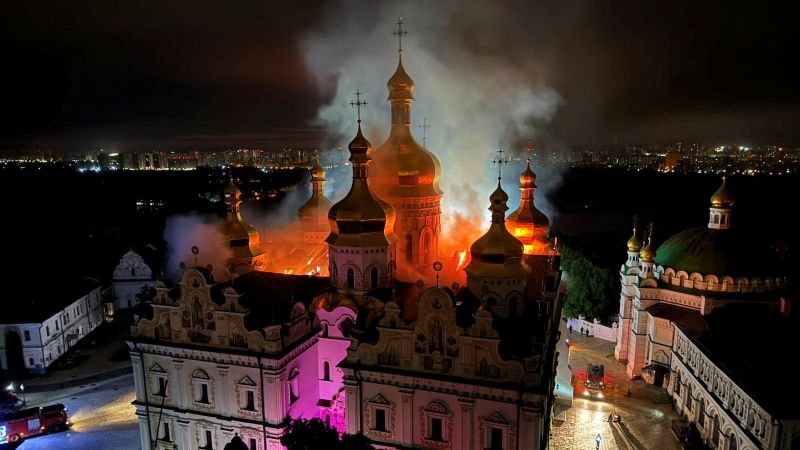
Ukraine’s Historic Kyiv Pechersk Lavra Monastery Set Aflame After Major Russian Strike
Sandego.net – In the early hours of Monday, a historic monastery complex in Kyiv, Ukraine, faced a devastating fire following a significant Russian assault that claimed at least four lives and injured over a dozen residents of the capital. The attack, which targeted the UNESCO-listed Kyiv Pechersk Lavra, a site revered for its spiritual and cultural significance, left firefighters scrambling to contain the blaze beneath the iconic towers and domes of its Dormition Cathedral. Images shared by local authorities revealed extensive damage to the roof of the cathedral, with flames licking at the ancient structure that has stood for nearly a millennium.
A Legacy Under Threat
The Kyiv Pechersk Lavra, one of Ukraine’s most cherished landmarks, was established in the 11th century and features a network of underground and surface churches. Over centuries, it has served as a sanctuary for religious relics, including those of saints, and is considered a masterpiece of Ukrainian architecture by UNESCO. The monastery’s inclusion on the World Heritage in Danger list in 2023 highlighted concerns about its vulnerability to destruction from Russian offensives. Now, the latest attack has deepened fears of its fate, with officials emphasizing the symbolic weight of the assault.
According to Ukraine’s emergency services, the fire scorched 800 square meters of the cathedral’s roof and damaged surrounding structures. While efforts to extinguish the flames continued by daybreak, the extent of the destruction remains under assessment. “Another Russian crime against humanity, against history, against Christianity,” stated Metropolitan Epiphanius of Kyiv and All Ukraine in a heartfelt plea for prayers to save the shrine. His words underscore the cultural and religious devastation wrought by the attack.
Escalating Conflict in Kyiv
The overnight assault saw Russia deploy 611 long-range strike UAVs and 70 missiles, as reported by Ukraine’s Air Force. A CNN journalist on the ground described hearing multiple explosions during the attack, which disrupted the city’s peace. The strike reportedly left approximately 140,000 households in the northern region of Kyiv without power, according to Mayor Vitaliy Klitschko. Beyond the immediate destruction, the attack has raised questions about the strategic value of Kyiv as a target.
Meanwhile, the National Cultural, Art, and Museum Complex also experienced a fire, affecting 1,000 square meters of its premises. This has further compounded the losses in the capital, which has become a focal point of the ongoing conflict. Tymur Tkachenko, head of Kyiv’s city military administration, confirmed that the assault resulted in at least four fatalities and over 20 injuries, highlighting the human toll of the attack.
Russia’s Defense Ministry issued a statement Monday, justifying the strikes as part of its campaign against “targets within the defense-industrial complex” in Kyiv, Kharkiv, and Dnipropetrovsk. The ministry’s narrative contrasts sharply with the devastation witnessed in the heart of Kyiv, where the attack has left both physical and symbolic scars. Ukrainian President Volodymyr Zelensky, speaking on X, condemned the assault as “one of Russia’s most serious crimes against Christian culture to date.” He called for a decisive response from the G7 nations ahead of their summit in Évian, France, stressing the need for increased pressure on Moscow.
International Response and Strategic Implications
Following the attack, European Commission President Ursula von der Leyen echoed Zelensky’s concerns on X, criticizing Russia’s “heavy attacks” and vowing to facilitate dialogue among global leaders. “Today, G7 leaders meet in Évian. We will discuss the next steps to increase pressure on Russia, bring Putin to the negotiating table, and end this senseless killing,” she wrote. This international reaction reflects growing unease over Russia’s escalating tactics, which target not only military infrastructure but also cultural and religious sites.
Zelensky’s call for a swift response comes as the war enters its fifth year. The president had recently discussed potential strategies for ending the conflict with U.S. President Donald Trump, who also engaged with Russian President Vladimir Putin on Sunday. Trump’s meetings with both leaders have been framed as critical to shaping a unified approach to the war. In a post on X, Zelensky expressed hope that Trump’s involvement would lead to a breakthrough, stating, “All Ukrainians have one wish for President Trump: that we may finally achieve peace, and achieve this success together with the US and all our partners.”
The fire at Kyiv Pechersk Lavra has drawn global attention to the intersection of war and heritage. UNESCO, which recognizes the site as a World Heritage landmark, has long warned of the threat posed by Russian advances. The destruction of such a symbolically rich location is seen as a deliberate act to erode Ukraine’s cultural identity. “This is how Russia shows the world its intention to continue the war,” Zelensky wrote, underscoring the existential stakes for the nation.
While the focus remains on Kyiv, the broader conflict continues to unfold elsewhere. In Kharkiv, a northeastern city, Russian bombardment has already claimed at least five lives and injured five others, according to Interior Minister Ihor Klymenko. These casualties add to the mounting toll of the war, which has seen cities across Ukraine become battlegrounds. The coordinated attacks on Kyiv and Kharkiv suggest a strategic shift, with Russia targeting key urban centers to weaken Ukraine’s resolve.
The scale of the destruction in Kyiv raises urgent questions about the resilience of the city’s infrastructure and its ability to recover. Firefighters have worked tirelessly to prevent further damage, but the images of flames consuming centuries-old structures have sent shockwaves through the nation. For many Ukrainians, the Lavra represents not just a place of worship but a living testament to their history and faith. Its survival is now a matter of national pride and international concern.
As the G7 summit approaches, the attack on Kyiv serves as a stark reminder of the challenges facing Ukraine. Zelensky’s plea for support highlights the need for stronger alliances and more robust defenses. The damage to the Lavra, combined with the destruction of other cultural sites, has intensified calls for action against Russian aggression. With the war’s fifth anniversary looming, the international community faces a pivotal moment in determining the future of the conflict.
In the aftermath of the assault, the Kyiv Pechersk Lavra stands as a symbol of both resilience and vulnerability. While its fate remains uncertain, the fire has galvanized Ukrainian citizens and global allies alike. The attack underscores the broader struggle to protect cultural heritage in the face of war, as well as the growing urgency for a decisive international response. As the flames recede, the question remains: how will the world respond to this latest act of destruction?
Historical and Cultural Significance
The Kyiv Pechersk Lavra, often referred to as the “Mother of all monasteries,” has long been a spiritual hub for Ukrainians. Its underground caves, where relics of saints have been preserved for centuries, are among its most sacred features. The monastery’s survival has been a testament to Ukrainian endurance, but the latest attack threatens to undo years of efforts to safeguard its legacy. UNESCO’s designation of the site as a World Heritage in Danger in 2023 was a warning of this risk, and now, the reality of its vulnerability has become clear.
The attack on the Lavra is part of a pattern of strikes targeting Ukraine’s cultural and religious institutions. These acts are not only meant to destroy physical landmarks but also to undermine the nation’s cultural identity and morale. The monastery’s history, stretching back nearly 1,000 years, makes it a powerful symbol of Ukraine’s heritage. Its destruction would mark a significant blow to the country’s narrative, erasing a piece of its past in the process of war.
As the international community weighs its response, the assault on Kyiv has reignited discussions about the role of cultural preservation in warfare. The G7 summit in Évian, France, now serves as a platform for addressing this issue. With the threat of further attacks looming, the need for decisive action has never been greater. The flames that consumed the Lavra are a vivid reminder of the stakes involved in this ongoing conflict.
Amid the chaos, the resilience of Ukraine’s people shines through. Despite the destruction, efforts to rebuild and preserve are already underway. The fire at the Lavra has sparked a wave of support from both domestic and international audiences, reinforcing the belief that cultural heritage must be protected. As the world watches, the monastery’s fate becomes a focal point of the broader struggle for Ukraine’s survival and dignity in the face of relentless aggression.