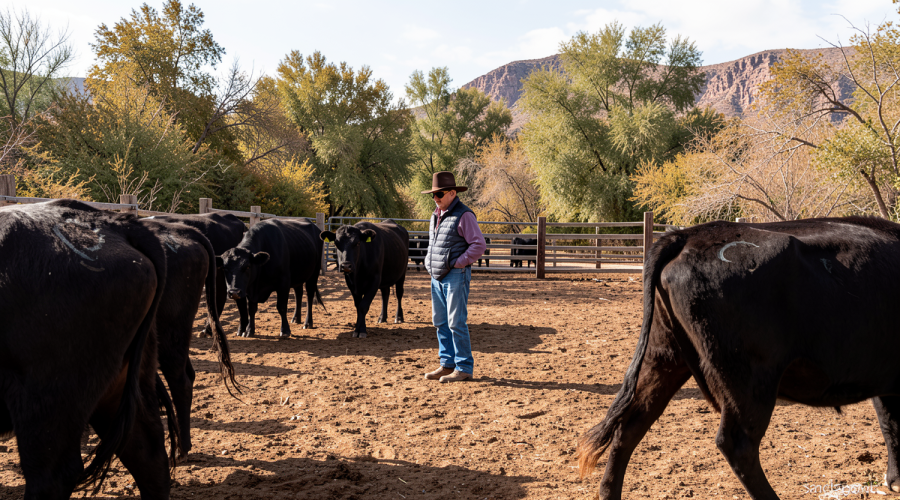
US-Mexico Cattle Border Reopens After Screwworm Closure
Sandego.net – For the first time since July 2025, the US Mexico cattle border will swing open again on Monday near Douglas, Arizona. The US Department of Agriculture approved the move to restart cross-border livestock shipments that have been frozen, intermittently, since November 2024. The original shutdown was triggered by New World screwworm, a parasitic fly whose larvae can consume living cattle over days or weeks. Yet the reopening has reignited a far older dispute inside American agriculture: whether shielding domestic ranchers from foreign competition should outweigh keeping beef affordable at the grocery counter.
The Fly Behind the Fence
New World screwworm (Cochliomyia hominivorax) deposits eggs in wounds or natural openings on livestock. Once hatched, the larvae feed on tissue and can kill an animal over a period of days or weeks. Outbreaks across South America have repeatedly forced neighboring nations to seal their borders. The 2024–2025 episode pushed the parasite into Mexican states close enough to the US that Washington halted cattle imports outright. Although the fly remains the stated justification for the closure, economic and political forces now shape the debate far more than entomology does.
Mexican Ranchers: Families on the Line
On the Mexican side, the year-long shutdown has been an existential threat. Alvaro Bustillos, who heads the rancher’s union in Chihuahua, says the closure nearly destroyed his operation.
“I had to fire people. It took me years to build my team. It took me years to build relationships. This is not only about the cattle trade. This is about families bonded together.”
Bustillos is cautiously optimistic that a successful reopening in Sonora — chosen for its high industry standards and absence of screwworm cases — could eventually extend to his own region. Mexican producers have endured more than a year of financial hemorrhage, and the prospect of resumed cross-border sales offers a lifeline.
American Ranchers: Bleeding on Both Sides
US cattle producers tell a different story. Johnny Mestas, a 74-year-old cattleman working the arid San Luis Valley of southern Colorado, has survived two heart attacks over decades of farming. He describes the profession with wry resignation:
“Not everybody is meant to be a farmer. You’ve got to be half-crazy. There’s three elements you fight: the market, the weather and your neighbors.”
Even Mestas, who has thrived during the current price spike, is wary of reopening the US Mexico cattle border to Mexican animals. His concern is not only screwworm; it is economics. With domestic cattle prices at historic highs, many American producers who do not depend on Mexican livestock fear that reintroducing cheaper foreign animals will depress the market they have finally benefited from.
“These past few years, I actually made money! Years and years, it was basically always break-even.”
Bill Bullard, CEO of R-CALF — a national association of independent cattle and sheep farmers — frames the issue more broadly. A former South Dakota rancher, Bullard argues that the screwworm closure is merely one symptom of a deeper structural problem: decades of growing reliance on foreign beef have hollowed out domestic production.
“In just over a generation’s time, we wiped out half (of) our cattle producers in this country. It’s because we have been growing our dependence on foreign sources, displacing our domestic production in the United States. It is a threat to national security.”
Sonora’s Surprise Case and the USDA’s Course
Days before the scheduled reopening, Sonora reported its first screwworm infestation since the outbreak began. The single case did not, however, alter Washington’s timetable. The Department of Agriculture confirmed on Thursday that it will proceed with the Douglas reopening as planned, treating the isolated detection as manageable within existing quarantine protocols.
Beef Prices, Argentine Imports, and the 2026 Midterms
The political dimension cannot be separated from the agricultural one. American consumers have faced sharply elevated beef prices for more than two years, making meat costs a salient campaign issue ahead of the November 2026 midterms. The administration has already taken one aggressive step to cool prices: quadrupling low-tariff imports of Argentine beef. On Friday, the president announced a further measure — importing 300,000 metric tons of beef — explicitly to reduce prices for Americans while giving space for domestic producers to adjust. Whether that combination of foreign supply and reopened cross-border channels will actually lower the price at the register, or simply deepen the rift between ranchers and consumers, remains the central question as the US Mexico cattle border swings open once more.
Frequently Asked Questions
When exactly does the US Mexico cattle border reopen?
The reopening takes effect Monday at the Douglas, Arizona crossing. The US Department of Agriculture approved the move despite a single screwworm detection reported in Sonora days earlier.
Why was the border closed in the first place?
The closure began in November 2024 after New World screwworm was detected in Mexican states near the US border. The fly’s larvae can kill untreated livestock, prompting Washington to halt all cattle imports as a precaution.
Will the reopening lower beef prices for consumers?
Officials say resumed cross-border movement, combined with expanded Argentine beef imports, is intended to ease price pressure. Rancher groups caution that the effect will depend on volume, quarantine compliance, and broader market conditions.
What happens if screwworm reappears after the reopening?
Existing quarantine and inspection protocols remain in force at the Douglas crossing. A confirmed new outbreak would trigger the same closure mechanisms that shut the border in 2024, though the USDA has indicated it will treat isolated detections as manageable without a full shutdown.