Serbian Leader Vucic Announces Resignation Amid Student-Driven Protests
Sandego.net – In a bold political maneuver, Serbian President Aleksandar Vucic has declared his intention to step down within the coming weeks, triggering the possibility of early presidential and parliamentary elections. This decision comes after 18 months of widespread demonstrations, primarily led by student activists, who have been demanding systemic reforms and accountability over government mismanagement. The unrest, which gained momentum following a tragic incident in November 2024, has shaken the nation’s political landscape and forced Vucic to reconsider his long-standing grip on power.
The Catalyst: A Tragic Collapse
The protests were ignited by a devastating collapse of an awning at a railway station in the northern city of Novi Sad, resulting in the deaths of 16 individuals. While the immediate cause was a structural failure, the tragedy was swiftly interpreted as a symbol of broader governance failures. Student groups, along with opposition factions and civil society organizations, have accused the government of negligence in construction projects, linking the disaster to systemic corruption and poor oversight. This incident has become a rallying point for public discontent, with demonstrators demanding transparency and a reevaluation of leadership.
Vucic’s Response: A Strategic Retreat
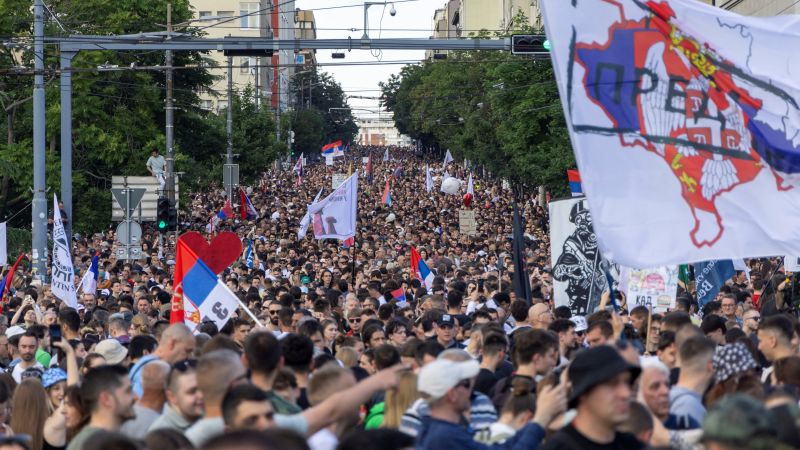
Speaking to his supporters at a pro-government rally in Belgrade, Vucic made it clear his resignation would not mark the end of his political dominance. “I will be president for only a couple more weeks, and then I will resign,” he stated, emphasizing his commitment to the transition process. However, he did not specify an exact timeline for his departure or the dissolution of parliament, which is required for early elections. The president’s second term was set to conclude in mid-2027, but his decision to resign earlier appears to be a calculated move to reshape the political future.
“I will be president for only a couple more weeks, and then I will resign,” Vucic told throngs of his supporters at a pro-government rally in the capital, Belgrade.
Vucic’s announcement signals a shift in his approach to maintaining influence. While stepping down from the presidency, he aims to ensure his Serbian Progressive Party (SNS) remains a dominant force in the upcoming elections. He has proposed naming his party’s electoral list “United Serbia,” a branding strategy intended to broaden support and consolidate power. Analysts suggest this is part of a larger plan to retain control, even as he transitions roles.
A Legacy in Transition
Despite the resignation, Vucic’s political career shows no signs of slowing. His party’s victory in the early parliamentary elections could position him as prime minister, allowing him to continue steering the nation’s policies. This scenario underscores a long-standing pattern in Serbian politics: no matter the title, Vucic has consistently influenced the country’s direction. His move to resign rather than face a potential challenge is seen as a way to preserve his legacy and secure a leadership role in the new government.
“This is not at all the end of Vucic,” said Radivoje Grujic, a Warsaw-based analyst. “He already has a plan, one that definitely does not mean he’s going to go into political retirement — quite the opposite.”
The protests, the most sustained since the 2000 overthrow of Slobodan Milosevic, have grown into a powerful movement. Students in Novi Sad recently held a memorial event for the victims, calling for snap elections to replace the current administration. Another rally is planned for Sunday in Kraljevo, a town in south-central Serbia, where activists will continue to demand change. The movement has gained traction, with its support base surpassing that of Vucic’s own party in some regions.
Political Maneuvers and Public Perception
Vucic’s resignation pledge comes amid accusations of colluding with foreign powers, a claim he has directed at anti-government protesters. During the Belgrade rally, he addressed his backers, many of whom had traveled from across the country, stating that the demonstrators sought to dismantle the nation’s institutions. “For the thousand and first time, we are offering you our hand. We forgive everything you have done, but we are not naive, and we will not forget what has been done to the country in the last year,” he asserted. Critics argue this rhetoric aims to deflect blame and rally loyalists.
Meanwhile, opposition figures and activists have criticized Vucic’s leadership, highlighting issues such as corruption, organized crime ties, and media control. They view his resignation as a tactic to preempt a potential defeat, but remain skeptical of his sincerity. “By resigning and with early presidential and parliamentary elections, Vucic is trying to preempt his inevitable fall, because of protests and because of the student movement, which has more support than he does,” said Savo Manojlovic, head of the student-led Move-Change movement.
EU Aspirations and Domestic Challenges
As Serbia pursues its goal of EU membership, the government faces mounting pressure to improve its governance. The European Union has long emphasized the need for stronger rule of law, fair electoral processes, and anti-corruption measures. Vucic’s resignation could be a step toward meeting these criteria, but it also raises questions about his commitment to reform. His recent pledge to tackle corruption and improve social welfare programs, such as pensions and healthcare, may be seen as an attempt to win public favor ahead of the elections.
Yet, the challenges extend beyond domestic reforms. Serbia’s strategic ties with Russia and China, which Vucic has maintained throughout his tenure, complicate its path to EU integration. While he has supported economic partnerships with these nations, his government has also faced criticism for aligning too closely with their interests at the expense of Western values. The protests, however, have increasingly highlighted a growing demand for political change, with students and civil society groups advocating for a more transparent and accountable regime.
Future Prospects and Electoral Strategy
Vucic’s resignation announcement has sparked speculation about his next moves. If his party secures a parliamentary majority, he could return as prime minister, ensuring continuity in his policies. This strategy reflects his ability to adapt and retain power, even as his position as president changes. Analysts note that his focus on placing an ally in the presidential race underscores his intent to maintain control across all branches of government.
While the immediate impact of the protests is clear, their long-term effects remain uncertain. The student-led movement has grown into a significant force, challenging the status quo and pushing for a new political era. Vucic’s decision to resign may be a signal of his willingness to reform, but it also raises concerns about whether he will genuinely relinquish power or use the transition to strengthen his influence. The upcoming elections will serve as a critical test of his ability to balance his ambitions with the demands of the public.
As Serbia navigates this pivotal moment, the nation’s trajectory will depend on the outcomes of the early elections. Vucic’s resignation, while a major development, is part of a broader effort to reshape the political landscape. Whether this marks the beginning of his retirement or a new phase of dominance remains to be seen, but one thing is certain: the protests have forced a reckoning, and the stage is set for a dramatic shift in leadership.