Eight-Day Rescue Effort in Venezuela Unveils Hope Amid Earthquake Devastation
Sandego.net – In a dramatic turn of events, rescue teams have been working around the clock to extract a survivor trapped beneath the ruins of a nine-story building in La Guaira, Venezuela, eight days after a series of catastrophic earthquakes struck the nation. The operation, hailed as a “miraculous” achievement, has kept emergency workers on high alert as they maneuver through the unstable remains of a collapsed shopping mall parking lot to free Hernán Alberto Gil Flores, a 44-year-old security guard who has been confined to a narrow space of rubble for nearly a week.
The Survivor’s Struggle
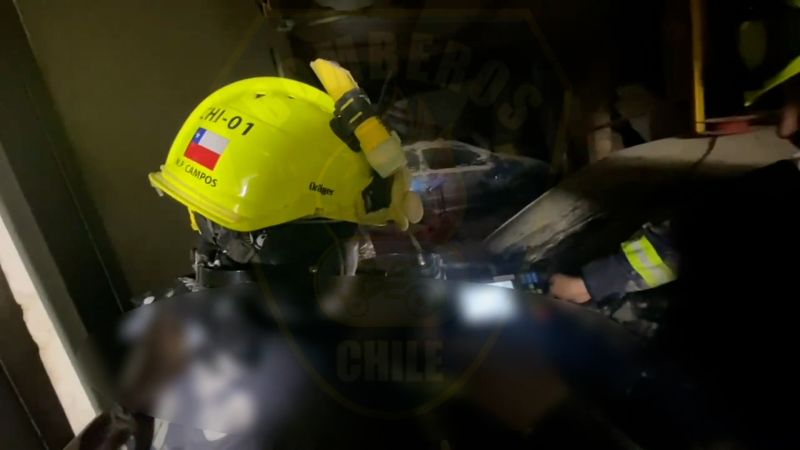
Gil, who had been entombed under 29 feet of debris, was first glimpsed by rescuers through a search camera on Wednesday. The footage, shared by the Chile Fire Department, revealed his fingers fluttering as if waving through a sliver of space between layers of concrete and wreckage. Despite the daunting conditions, his condition has remained stable, with medical teams providing sustenance and hydration via a hose and syringe as they work to clear a path to his rescue. By Thursday, his head and shoulders were partially exposed, a moment captured in video that showcased his resilience and the determination of the rescue teams.
“Only miraculous rescues have been achieved,” said Sebastián Mocorquer, a representative from the United Nations Disaster Assessment and Coordination team, reflecting on the progress made seven days after the initial tremors. The “golden window” for survival, typically a three-day window following an earthquake, has been extended due to the persistent efforts of rescuers to maintain contact with Gil and sustain his life.
International Collaboration in the Rescue
The rescue operation has drawn expertise from over half a dozen nations, including Chile, Costa Rica, and El Salvador, each contributing specialized equipment and personnel to the mission. Teams have faced significant challenges, as the building’s structure remains precarious, with the risk of further collapses complicating their work. The Chile Fire Department emphasized the complexity of the task, noting that the tunnel excavated to reach Gil required constant reinforcement to prevent it from collapsing under the weight of the rubble.
Rescuers from the Costa Rican Red Cross confirmed that the initial detection of life under the debris occurred on Sunday, when they used advanced radar sonar and sound detection tools to locate Gil. Since then, the operation has evolved from a single point of contact to a coordinated effort involving multiple international agencies. Video footage shared by El Salvador’s President Nayib Bukele showed a rescuer speaking directly to Gil, who was seen wearing a mask and squinting through a bloodshot eye. “Are you hurt?” the rescuer asked, to which Gil responded, “No, I’m not hurt. I’m just uncomfortable because of the rocks.” This exchange underscored the emotional toll of the ordeal, as well as the survivor’s ability to remain composed despite the dire circumstances.
Resources and Challenges in the Field
As the rescue teams toiled to stabilize the tunnel, resources became a critical concern. Despite Venezuela’s vast oil reserves, the lack of sufficient fuel and supplies has forced workers to rely on manual tools like pickaxes and shovels, alongside their bare hands, to clear the rubble. This manual effort has been compounded by the relentless heat and the physical demands of working in tight, confined spaces. The National Assembly President, Jorge Rodríguez, who is the brother of the acting president, reported on Wednesday that at least 2,295 people had perished in the earthquakes, a figure that has increased by approximately 350 since the previous day.
However, the true death toll is believed to be even higher. A forensic pathologist, speaking to CNN under anonymity due to fears of retaliation, described the morgue in La Guaira as processing roughly 400 bodies daily. This stark reality highlights the scale of the disaster and the ongoing struggle to account for all victims. While the focus remains on Gil’s rescue, the broader implications of the earthquakes continue to weigh heavily on the country’s infrastructure and population.
The Unyielding Nature of the Rescue
The operation to free Gil has been a testament to the perseverance of rescue workers, who have operated in near-perfect darkness for days. The Chile Fire Department noted that the survival of Gil has been made possible by the relentless effort to maintain communication with him, ensuring he receives vital fluids and medication. This has required not only physical labor but also technical ingenuity, as teams have had to navigate the collapsing structure while keeping the survivor alive.
As the rescue efforts continue, questions linger about the long-term viability of the tunnel and the potential for further collapses. “We report that Hernán Gil remains medically stable,” stated the Costa Rican Red Cross in a Facebook post, adding that the last hours had seen the administration of intravenous serum and hydration solutions. This update came as the teams prepared to fully extricate Gil, a milestone that has brought renewed hope to the community and the global network of rescuers.
The Human Cost of the Disaster
La Guaira, a coastal city heavily impacted by the earthquakes, has become a focal point for both rescue operations and mourning. The destruction of the Galerias Playa Grande shopping mall, where Gil was found, is emblematic of the widespread damage across the region. While the rescue of a single survivor is a cause for celebration, the city’s makeshift morgues and the rising death toll serve as reminders of the human toll exacted by the disasters.
Amid the chaos, the resilience of the community has shone through. Locals have joined the efforts, using whatever tools they could find to assist in clearing debris. The collaboration between local and international teams has been crucial, with experts from different countries sharing knowledge and techniques to tackle the challenges posed by the unstable building. This cross-border cooperation has not only been a lifeline for Gil but also for the families of those who have lost their lives in the earthquakes.
The ongoing efforts to rescue Gil have also highlighted the importance of timely intervention. The “golden window” for survival, a period typically lasting three days after an earthquake, has been extended in this case due to the continuous supply of fluids and the use of advanced detection equipment. This has allowed rescuers to push the limits of what is considered possible, demonstrating the critical role of technology and human determination in disaster response.
As the story unfolds, the focus remains on Gil’s eventual extraction and the broader implications of the earthquakes for Venezuela. The National Assembly President’s announcement of the updated death toll has sparked discussions about the accuracy of casualty figures, with many experts suggesting that the numbers could climb as more bodies are recovered. The resilience of the survivor, however, offers a glimmer of hope in the midst of the tragedy, serving as a powerful reminder of the strength of the human spirit in the face of adversity.
This is a developing story, and further updates are expected as the rescue teams continue their work. The eight-day journey to save Gil has not only tested the limits of emergency response but also underscored the importance of international solidarity in times of crisis. As the sun sets over La Guaira, the teams press on, determined to bring the survivor to safety and to uncover the full extent of the devastation that has reshaped the city and its people.