
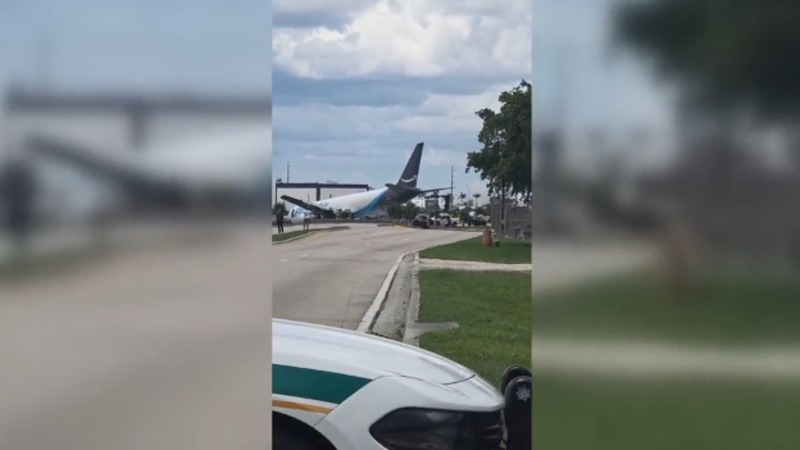
Prime Air 767 Overruns Miami Runway, Strikes Vehicles
Sandego.net – A Prime Air 767 cargo aircraft operating out of San Juan, Puerto Rico, overshot the end of Runway 30 at Miami International Airport on Sunday afternoon and collided with several vehicles parked along a road bordering the airfield. The impact ignited a large fire, drew more than 60 emergency units to the scene, and forced a full ground stop at one of the busiest airports in the southeastern United States.
What Happened on Runway 30
Flight 7598, operated by 21 Air under contract to Amazon’s Prime Air division, touched down at roughly 2 p.m. local time after a flight of about two hours from Luis Muñoz Marín International Airport in San Juan. Rather than slowing within the available pavement, the freighter continued past the runway threshold and struck multiple vehicles positioned beyond the strip’s end. On-scene video shows the jet resting beside a roadway, enveloped in smoke and surrounded by first responders.
Miami-Dade Fire Rescue posted to social media shortly after its first crews reached the crash site:
“Units arrived to find an airplane that had caught on fire as a result of this crash, with heavy flames and smoke showing.”
Over 60 fire apparatus units converged to knock down the blaze and check for casualties. As of the latest available reporting, no confirmed injuries had been announced, although authorities had not yet eliminated the possibility that someone was hurt in the collision.
No Emergency Callout Before Touchdown
Air-traffic-control audio reviewed after the event indicates the pilots never declared an emergency. The approach appears to have been conducted as a routine procedure until the moment the aircraft contacted the runway and began its uncontrolled excursion. The absence of a mayday or emergency callout suggests the crew believed conditions were normal until the overrun became physically unavoidable.
The Federal Aviation Administration confirmed the basic facts in a written statement:
“21 Air Flight 7598 overran the runway after landing at Miami International Airport around 2 p.m. local time. The Boeing 767-300 cargo aircraft departed from Luis Muñoz Marín International Airport in San Juan, Puerto Rico.”
Airport Ground Stop and Operational Fallout
In the immediate aftermath, every runway at Miami International was closed and a ground stop imposed, freezing all departures and arrivals until operations could resume. An airport spokesperson confirmed the shutdown and identified the involved jet as a Prime Air flight. The closure stranded passengers and delayed time-sensitive freight shipments across a wide geographic corridor well into the evening.
The aircraft involved is a 32-year-old Boeing 767-300 converted from passenger service. Prime Air, Amazon’s dedicated cargo airline, uses such converted wide-bodies to move packages, electronics, and other goods between fulfillment centers and airports. 21 Air serves as the operating carrier for many of those routes, supplying pilots, maintenance crews, and regulatory certifications under its own air-carrier certificate. Runway 30 at Miami stretches beyond 9,000 feet—ordinarily ample stopping distance for a 767-300 even under degraded braking—so investigators will need to resolve questions about approach speed, braking effectiveness, wind, or mechanical factors.
Why Overruns Carry Extraordinary Risk
Runway overruns rank among the most consequential categories of commercial-aviation accidents. Once a jet leaves the paved strip, it enters zones designed for service vehicles, drainage infrastructure, and sometimes commercial or residential property. A 767-300 at landing weight can exceed 280,000 pounds; even at reduced speed, that mass translates into devastating impact forces. For cargo operators the stakes compound further, because converted passenger jets carry tens of thousands of pounds of packages and perishables in their main decks, and a hard overrun can rupture cargo holds and scatter contents across the surrounding area.
Frequently Asked Questions
Was anyone injured in the Miami runway overrun? No confirmed injuries had been reported as of the latest available information, though authorities had not yet ruled out the possibility that someone was hurt during the collision.
Which aircraft was involved? A Boeing 767-300 freighter, roughly 32 years old, operated by 21 Air on behalf of Amazon’s Prime Air cargo division. The flight number was 7598.
How long was the airport closed? A full ground stop was imposed immediately after the incident, closing every runway at Miami International. The exact duration of the shutdown was not specified in the available reporting, but the closure extended through the afternoon and into the evening.
Did the crew declare an emergency before landing? No. Air-traffic-control recordings show no emergency callout. The approach appears to have been routine until the aircraft made contact with the runway and began its uncontrolled excursion past the end of the strip.
What is Prime Air? Prime Air is Amazon’s dedicated cargo airline, established to move packages, electronics, and other goods between fulfillment centers and airports using converted wide-body passenger jets. 21 Air provides the operating-carrier functions—pilots, maintenance, and regulatory certifications—under its own air-carrier certificate.