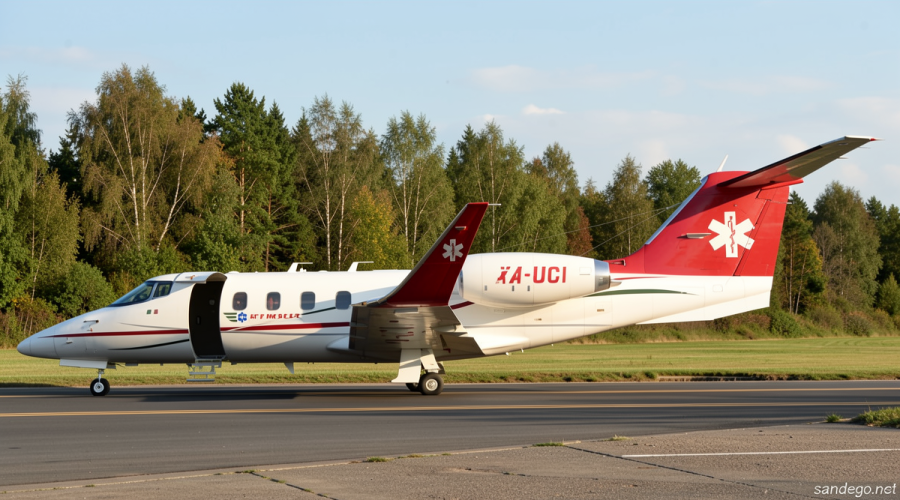
Eight Months Later, the Mystery of Philadelphia’s Medevac Jet Crash Remains Unsolved
Sandego.net – More than 1,500 pages of newly released factual data have sharpened the picture of how a twin-engine Learjet 55 plunged into a residential neighborhood in Northeast Philadelphia on January 31, 2025 — but the central question still hangs unanswered: what made the aircraft lose control roughly sixty seconds after liftoff? The National Transportation Safety Board published the expanded record set on Tuesday, offering investigators’ latest measurements of the jet’s final moments without yet assigning a cause. The board has stated that a definitive determination of causation will come only when the full investigation closes.
The Final Minute
What the data now confirms is a sequence of events that unfolded with terrifying speed. Approximately one minute after departing Northeast Philadelphia Airport, the Learjet banked sharply to the left and entered a steep, accelerating descent. Its rate of fall reached nearly 10,000 feet per minute while airspeed climbed past 275 miles per hour. The aircraft had been carrying roughly 600 gallons of fuel at takeoff and had climbed to an altitude of about 1,500 feet before it came down.
A neighborhood security camera recorded the roar of both engines at full thrust during departure. Moments later, a separate camera mounted at a drive-through restaurant captured the jet’s navigation lights cutting across the night sky at a steep downward angle before impact. The tail struck a shopping-center sign, then the fuselage struck a roadway, carving a crater approximately eight feet deep. The resulting debris field stretched more than a quarter mile in length and roughly 800 feet in width, engulfing multiple vehicles and homes in flame.
Investigators recovered the core of the right-hand engine 665 feet from the primary impact point, lodged inside a second-floor bedroom. An aircraft tire was likewise found in a bedroom, and portions of the landing gear were discovered wedged beneath a parked car.
Who Was Aboard
The jet was operating as a medical evacuation flight under the banner of Jet Rescue Air Ambulance, a division of Med Jets. Its mission was to transport an 11-year-old girl, who had just finished a course of medical treatment, and her mother back to their home in Mexico. All six occupants of the aircraft were killed, along with two people on the ground. At least 19 additional individuals sustained injuries in the blast and fire that followed.
The aircraft was registered in Mexico and commanded by the company’s 46-year-old chief pilot. Both crew members held current training currency and logged thousands of flight hours. Mexican aviation authorities noted that, given the age of the Learjet, a cockpit voice recorder was not mandated — and investigators confirmed the unit had been inoperative for several years regardless.
A Pattern of Past Incidents
The documents reveal that Med Jets had a history of accidents before the Philadelphia crash. Two incidents occurred in Mexico in 2019 and again in 2023, and a fatal accident involving the company took place in Fort Lauderdale, Florida, in 2013. Four of the operator’s aircraft were permitted to fly within United States airspace under the oversight of an FAA inspector.
In an interview conducted by the NTSB, that inspector stated they were unaware of how many accidents the company had been involved in and could not specify what inspections had been carried out. The inspector also confirmed that Med Jets was obligated to notify the FAA whenever it operated flights inside the United States — a notification that had not been filed for the accident flight.
The Pitch Trim Question
One technical thread running through the new data concerns the Learjet’s pitch trim system, the mechanism that adjusts the nose-up or nose-down attitude so the pilot need not continuously press on the control column as speed changes. Fragments of the system recovered from the wreckage appeared to be set at 3.97 degrees rather than the expected 5.5 degrees. An incorrect trim setting would have demanded greater control force from the pilots, potentially making the aircraft harder to manage. The NTSB has not concluded whether this discrepancy contributed to the apparent loss of control, leaving the question open.
A Wider Aviation-Safety Backdrop
The Philadelphia crash landed just two days after a midair collision between an American Airlines regional jet and a U.S. Army Black Hawk helicopter near Ronald Reagan Washington National Airport claimed 67 lives. That collision, followed by additional incidents in the months that followed, intensified public and regulatory scrutiny of aviation safety across the country. The convergence of two high-profile accidents within a single week placed medevac operations, foreign-registered aircraft operating domestically, and oversight gaps under a sharper spotlight than any had seen in years.
For the families of the eight victims and the dozens of residents whose homes and vehicles were destroyed, the release of another tranche of data without a causal finding offers little comfort. The investigation continues, and the board’s final report — the document that will name a cause or causes — remains ahead.
Related Reading
Frequently Asked Questions
What is NTSB still searching for answers in fiery?
NTSB still searching for answers in fiery is the main topic of this guide. The article explains the context, practical details, and next steps readers should understand.
Why does NTSB still searching for answers in fiery matter?
NTSB still searching for answers in fiery matters because readers are looking for a useful answer, not just a short summary. Good content should match search intent and help them decide what to do next.