Japan’s Earthly Shift: A New Seismic Phenomenon Uncovered
A Hidden Tremor Beneath the Surface
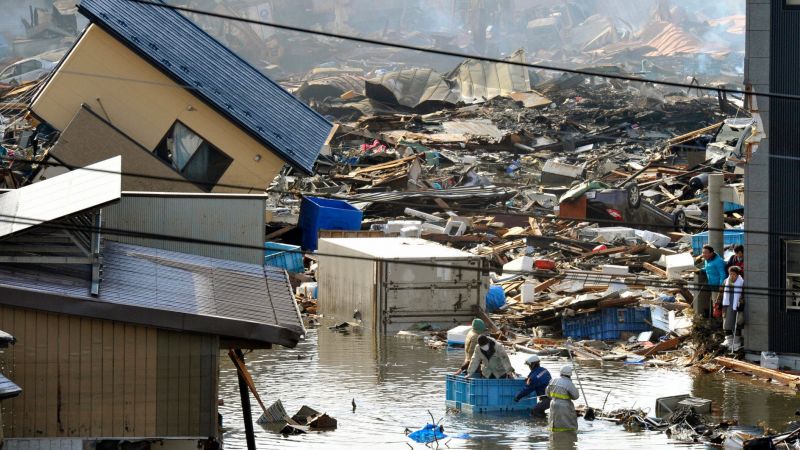
Sandego.net – On March 11, 2011, a 9.0 magnitude earthquake devastated Japan, sending shockwaves across the Pacific and triggering a catastrophic tsunami. But scientists have since identified a far less visible, yet significant, consequence of that event. GPS data revealed that nearly the entire country shifted eastward by as little as 5 to 6 millimeters—a minuscule movement compared to the visible destruction, yet permanent and measurable. This subtle but widespread displacement, occurring just 15 minutes after the initial tremor, was initially dismissed as a technical error or an overlooked data anomaly.
“What was unusual about this movement is basically the whole of Japan was moving nearly uniformly at the same time,” said Sunyoung Park, a geophysicist at the University of Chicago and lead researcher of the study.
Park’s team, after years of analyzing seismic and satellite data, discovered that the earthquake’s waves had penetrated deep into the Earth’s core before rebounding back to the crust. This journey, spanning approximately 3,600 miles, created a unique seismic phenomenon that reactivated fault lines across multiple tectonic plate boundaries. Unlike typical surface waves, which dissipate quickly, these deep-reaching signals caused a prolonged and widespread shift in the landmass, affecting regions from Hokkaido to Kyushu—covering roughly 1,800 miles in length.
The discovery challenges previous assumptions about how seismic energy propagates. While seismologists understood that large earthquakes could generate waves traveling through the planet’s interior, they believed the energy would fade before reaching the surface again. Park’s findings suggest that these deep-seated waves can retrigger tectonic activity in distant regions, creating a secondary effect that may have been underestimated in the past.
Energy Redistribution and Unseen Hazards
Though the primary earthquake caused dramatic ground movement, displacing two tectonic plates by up to 10 meters, the newly identified phenomenon involved a different mechanism. The core-reflecting waves, which took 15 minutes to complete their round trip, redistributed energy in a way that extended the seismic impact beyond the immediate rupture zone. This effect resulted in a displacement of four major tectonic plates, including the Pacific and Okhotsk plates, as well as the boundaries between the Philippine Sea and Eurasian plates.
“Even if there was any damage, it would likely be very difficult to distinguish it from damage caused by the mainshock and the subsequent aftershocks,” Park noted.
According to a press release, the energy released by this core-rebound event was equivalent to a 7.5 magnitude earthquake, yet it occurred over an immense geographic area. This broad displacement, while less intense than localized seismic activity, highlights a previously undocumented aspect of earthquake dynamics. The phenomenon’s reach across such a vast expanse—spanning the entire Japanese archipelago—raises questions about its frequency and potential for causing secondary effects in other regions.
The 2011 earthquake, which struck 231 miles northeast of Tokyo, remains the most powerful to ever hit Japan. It unleashed a tsunami that overwhelmed coastal cities and led to a nuclear disaster at the Fukushima Daiichi power plant, resulting in an estimated 20,000 fatalities. Despite its magnitude, the country-wide shift detected by Park’s team was not immediately recognized as a distinct seismic event. Instead, it was viewed as a minor anomaly until further research revealed its significance.
Preparing for the Unseen
Park emphasized that this newly recognized phenomenon could have far-reaching implications for disaster preparedness. Unlike aftershocks, which are unpredictable and often localized, the core-rebound process operates on a predictable timeline. The 15-minute delay between the initial event and its secondary impact suggests that such displacements could be forecasted, offering a potential window for early warnings and mitigation strategies.
“This rapid movement is what generated the ground shaking and the tsunami, and it also made the whole island of Honshu shift towards the East by 20 centimeters or so,” explained Goran Ekstrom, a geophysicist at Columbia University, who was not involved in the study. Ekstrom’s comments underscore the dual nature of seismic events: the initial shock and the subsequent, less obvious displacement. While the primary earthquake was a catastrophic force, the core-reflected waves added an additional layer of complexity to the geological response.
The study also shed light on how the main quake’s energy interacted with the Earth’s interior. Park proposed that the intense ground shaking of the initial event may have facilitated the arrival of the core-reflected waves, which then reactivated fault lines and triggered movement in plate intersections far from the epicenter. This suggests that the energy from a major earthquake can have a cascading effect, influencing tectonic activity across a vast network of boundaries.
A Network of Precision
Japan’s seismic monitoring infrastructure, one of the most advanced in the world, played a critical role in capturing this phenomenon. “Japan has a ‘magnificent’ network of seismic and satellite monitoring stations that make recording such an event possible,” remarked Vedran Lekić, a professor in the Department of Geological, Environmental, and Planetary Sciences at the University of Maryland. The country’s extensive array of GPS stations allowed scientists to track minute shifts in the crust, revealing the subtle yet profound effects of deep-seated seismic waves.
Lekić noted that while Japan’s system is exceptional, similar events could occur in regions with less sophisticated instrumentation. “This kind of phenomenon might be happening elsewhere, but we just haven’t detected it yet,” he added. The implications of this discovery extend beyond Japan, suggesting that seismic hazards could be more widespread than previously thought. By understanding these hidden processes, policymakers and scientists might develop new strategies to anticipate and prepare for earthquakes that do not follow traditional patterns.
The findings also challenge existing models of how seismic waves behave. Traditionally, scientists believed that energy from large earthquakes would dissipate before reaching the core. However, Park’s research indicates that the Earth’s liquid outer core acts as a reflective surface, redirecting waves back to the crust in a way that amplifies their impact. This revelation could lead to revised theories about tectonic plate interactions and the potential for secondary earthquakes in remote areas.
For Japan, the discovery offers both a warning and a lesson. While the 2011 event was a once-in-a-century disaster, the country’s robust monitoring system now allows for the detection of subtle, yet impactful, geological changes. These insights may help improve early warning systems and reduce the risk of future disasters. As Park stated, this previously unknown source of seismic energy underscores the importance of ongoing research and vigilance in earthquake-prone regions.
Despite its scale, the core-rebound phenomenon’s effects were relatively mild compared to the mainshock. However, its ability to cause widespread displacement without a dramatic rupture highlights the complexity of seismic events. Scientists are now working to determine how frequently such phenomena occur and whether they can be linked to other major earthquakes around the world. The 2011 event, while catastrophic, has opened a new chapter in the study of seismic waves, revealing that the Earth’s core may play a more active role in shaping the planet’s surface than previously imagined.
As the scientific community delves deeper into this phenomenon, the potential for applying these findings to other regions grows. With advancements in technology and a better understanding of deep-wave dynamics, it may soon be possible to predict not only the immediate consequences of an earthquake but also the long-term, widespread shifts that could accompany it. This could transform how we approach seismic risk assessment, ensuring that even the subtlest movements are not overlooked in the quest for safer, more resilient communities.