
Ukraine Faces a New Test of Its Dependence on Washington
Sandego.net – Ukraine’s ability to withstand Russia’s invasion is being tested again as tensions grow between Kyiv and the Trump administration. The dispute comes amid continuing Russian missile attacks, delayed deliveries of crucial air-defense ammunition and uncertainty over whether Washington will maintain the military and intelligence support that has shaped the war since 2022.
President Donald Trump has criticized Ukrainian President Volodymyr Zelensky for not reaching an agreement to stop the fighting. Kyiv, meanwhile, has voiced alarm over the withholding or delay of essential military assistance. Trump’s diplomatic push, including efforts by his envoy in Norway and Russia, produced a proposal to restart trilateral talks but no broader breakthrough.
For Ukraine, the question is not simply whether foreign support continues. It is which forms of support remain available, how quickly they arrive and whether Europe can cover gaps left by the United States.
Military aid has shifted, but American systems remain essential
The Trump administration stopped approving new aid packages for Ukraine at the start of 2025. Before that point, the United States had provided at least $131.5 billion in combined support, making it the largest individual contributor to Ukraine since Russia launched its full-scale invasion in 2022.
Some weapons ordered from US manufacturers during the Biden administration are still reaching Ukraine, although many of those contracts have already been completed. Europe has increasingly filled the financial and military gap. European Union countries and institutions together have committed at least $228.5 billion since the invasion began, exceeding the American total as a bloc.
Germany, Denmark, the Netherlands and Sweden have been among the leading EU providers of military support. Outside the bloc, the United Kingdom and Norway have also supplied substantial assistance. Much of the European effort involves purchasing US-built weaponry and transferring it to Ukraine.
That arrangement still leaves Washington with significant influence. Transfers of American-made weapons require Pentagon approval, meaning a political decision in the United States can affect deliveries financed by European allies.
Patriot interceptors illustrate the immediate danger
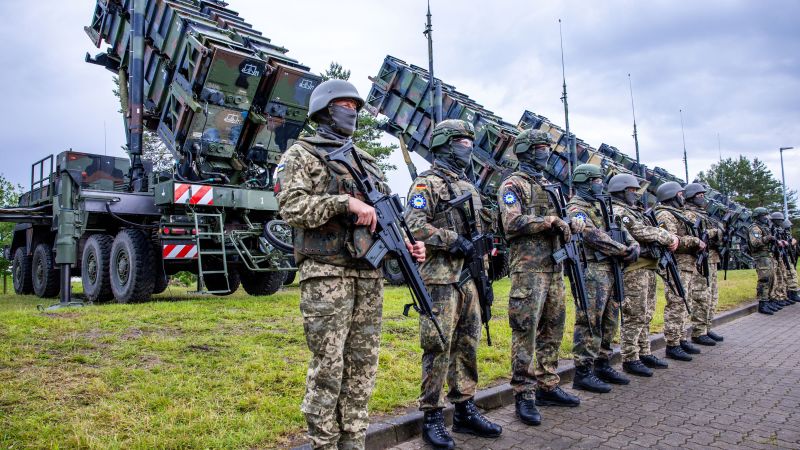
Ukraine’s shortage of Patriot missile interceptors has become one of the clearest examples of its vulnerability. The system is among the few available defenses capable of engaging ballistic missiles, which Russia has used against Ukrainian cities and infrastructure.
Zelensky said Friday that deliveries already agreed upon had not arrived.
The delivery of interceptors to protect us against Russian ballistic missiles is still delayed. We are waiting for interceptors that were already agreed on, but they are still not coming.
Ukraine ran out of Patriot interceptors last week, leaving its defenses substantially weaker against ballistic threats. During an overnight Russian attack on Kyiv that continued into Thursday, none of the ballistic missiles that struck the capital were brought down. That outcome suggested that Patriot reserves were either exhausted or dangerously close to empty.
The practical impact of such shortages reaches far beyond the battlefield. Air-defense failures expose homes, hospitals, energy facilities and civilians to a higher risk of casualties and destruction. They also place greater pressure on Ukraine’s emergency services and can drive more people to leave threatened areas.
Zelensky described two urgent priorities for Ukraine’s partners after the attack:
Not to lift sanctions from Putin … (and) to give us better missiles.
American weapons sales benefit US defense companies, a factor that could limit any long-lasting attempt to prevent allies from purchasing equipment for Ukraine. Yet even temporary interruptions can carry grave consequences when a country is trying to intercept incoming missiles every day.
Intelligence and technology may be harder to replace than money
European funding and weapons purchases have helped Ukraine reduce its exposure to the loss of direct American aid. At the same time, several US capabilities do not have readily available European alternatives.
Ukraine depends heavily on American intelligence, advanced warning technology and specialized defense systems. Patriot interceptors are one example. Others include Starshield, the military version of Elon Musk’s Starlink satellite network, and sophisticated missile-warning capabilities.
Max Bergmann, director of the Russia program at the Center for Strategic and International Studies, said Europe has not developed equivalent systems in part because it spent decades relying on US protection.
That is something Europeans don’t have, and they don’t have it because we have told them for the last 30 years not to develop it … because they can rely on us.
Without timely intelligence, Ukraine can lose precious minutes to prepare for attacks. Zelensky said earlier this week that Ukraine had, on several occasions, received no US warnings about ballistic missile launches. In such cases, Russian strikes could arrive without the usual air-raid alerts giving residents time to move toward shelters.
This creates a different kind of vulnerability from the loss of artillery shells or financial aid. A replacement weapon can sometimes be purchased or produced over time. Replacing an intelligence network, satellite infrastructure or missile-detection system is a far more complex undertaking.
Ukraine has adapted, but its choices would narrow
Ukraine has not remained static as US policy has changed. Europe has increased its contribution, while Kyiv has rapidly expanded domestic defense production. Those efforts give Ukraine more resilience than it had earlier in the war and reduce the likelihood that a single aid decision would immediately end its capacity to fight.
Still, greater self-reliance does not eliminate dependence on external partners. Ukraine would face more difficult decisions over where to deploy scarce air defenses, how to protect major cities and which military operations it could sustain. Civilian safety could be affected quickly if missile defenses and warning systems remain unavailable.
Bergmann argued that a deeper withdrawal of US backing could inflict severe harm without necessarily forcing Ukraine to surrender.
We’re in a situation where America is proving to everyone in Europe that it simply can’t be relied upon.
This could be really devastating for Ukraine in the sense that it could cause tremendous economic damage, tremendous loss of civilian life, civilians leaving. But I doubt it’s going to actually break Ukraine’s will to fight.
The central issue is therefore not whether Ukraine can continue at all without Washington. It is whether it can continue with the same ability to defend its population, deter Russian attacks and negotiate from a position of strength. As diplomatic efforts continue without a clear settlement, the answer may depend on the speed and reliability of weapons, intelligence and political support arriving from abroad.
Related Reading
Frequently Asked Questions
What is How reliant is Ukraine on US support?
How reliant is Ukraine on US support is the main topic of this guide. The article explains the context, practical details, and next steps readers should understand.
Why does How reliant is Ukraine on US support matter?
How reliant is Ukraine on US support matters because readers are looking for a useful answer, not just a short summary. Good content should match search intent and help them decide what to do next.