Can Pilots Be Criminally Charged After a Plane Crash?
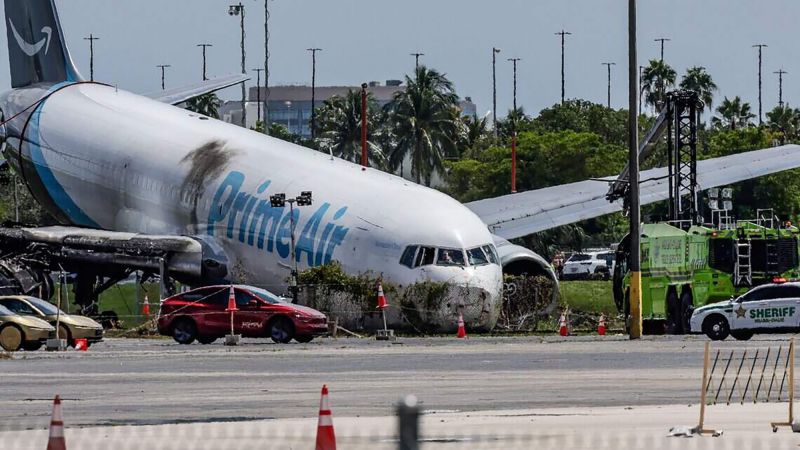
Sandego.net – Can pilots be criminally charged after a deadly plane crash? In the United States, the answer is yes in limited circumstances, but prosecutions are unusual. Five people died after an Amazon Air Boeing 767 cargo aircraft overran a runway at Miami International Airport last week and struck two vehicles. Both pilots sustained minor injuries as federal investigators began examining the accident.
Recently disclosed cockpit voice recorder information indicates that one pilot expressed concern about the aircraft’s speed while warning alarms sounded during the approach. The landing continued, a decision likely to be closely reviewed. But an investigation into pilot actions does not automatically mean criminal charges will follow.
What prosecutors must prove
Can pilots be criminally charged merely for making an error? Usually, no. Prosecutors would generally need evidence that goes well beyond a mistake, poor judgment or a flawed operational decision. Potential criminal conduct would typically involve gross negligence, recklessness or a disregard for human life.
“From a criminal perspective, there is a federal standard (when to prosecute), and it really has a high bar in terms of determining whether there was gross negligence, recklessness, or disregard for human life,” said Hassan Shahidi, president and CEO of the Flight Safety Foundation.
Federal, state and local authorities may open their own inquiries if evidence suggests a crime. Still, aviation-law specialists say criminal cases involving airline pilots after accidents remain rare in the United States.
Safety investigations focus on prevention
The National Transportation Safety Board investigates accidents to determine what happened, identify contributing factors and recommend changes that could prevent another disaster. Its work may take more than a year when investigators must assess aircraft performance, crew decisions, airport operations, maintenance records and cockpit data.
The NTSB does not prosecute people or make criminal findings. A final report may conclude that pilot actions contributed to a crash, but the agency’s purpose is to improve safety rather than assign legal punishment. Its reports and supporting investigative material are released publicly once an investigation is complete.
That approach differs from some countries, where criminal and safety investigations can begin at the same time after an accident.
“In other countries, automatically, there’s a dual track of investigation,” Shahidi said. “One is a safety investigation by the regulatory authorities, and one is a criminal investigation, and that is the law in those countries, regardless of whether it’s a minor incident or accident … And the U.S. is actually very unique in the fact that they don’t automatically start a dual track.”
Past crashes show why pilot error rarely leads to charges
The question of whether pilots can be criminally charged has arisen after other major accidents. In 2006, Comair Flight 5191 departed from the wrong runway in Lexington, Kentucky. The Delta Connection regional jet was traveling at nearly 160 mph when it reached the end of the shorter runway and crashed into trees, killing 49 people.
The first officer was the only survivor. Investigators found that he and the captain failed to confirm they were using the correct runway, while the NTSB also cited lost positional awareness associated with nonessential conversation during taxi. No criminal charges were brought.
In 2013, an Asiana Airlines Boeing 777 struck a seawall in San Francisco before cartwheeling along the runway. Three people were killed and 187 were injured. The NTSB found that the crew mishandled the descent, that one pilot inadvertently disabled an automatic airspeed system, and that the crew did not abandon the landing despite low speed. The pilots were not criminally charged.
FAQ: Criminal Charges for Pilots in the United States
Can pilots be criminally charged after an accident in the US?
Yes, but prosecutors generally need evidence of criminal behavior, such as recklessness, gross negligence or intentional misconduct. A finding that a pilot made an error is not, by itself, enough to establish a crime.
Does the NTSB decide whether a pilot is charged?
No. The NTSB conducts an independent safety investigation and does not prosecute individuals. Decisions about criminal charges belong to prosecutors and law-enforcement authorities.
Does a fatal crash automatically trigger a criminal investigation?
No. Unlike in some countries, the United States does not automatically open a criminal inquiry alongside every aviation safety investigation. Any criminal investigation depends on whether evidence indicates a possible crime.