Appalling AI Menu Pictures: Why They Repel Us
Sandego.net – Appalling AI menu pictures keep flooding restaurant signage worldwide, and diners are responding with a level of visceral disgust that has turned dining rooms into viral social-media flashpoints. Walk into any number of street vendors, delis, or food stalls right now and you may find yourself staring at a glossy, hyper-saturated rendering of a burger or a plate of pasta that looks almost right — until it isn’t. The reaction is not a mild preference. For many people, the sight of a synthetically fabricated dish triggers a physical revulsion comparable to spotting a hair in their soup.
A Hollywood Night Market Becomes a Case Study
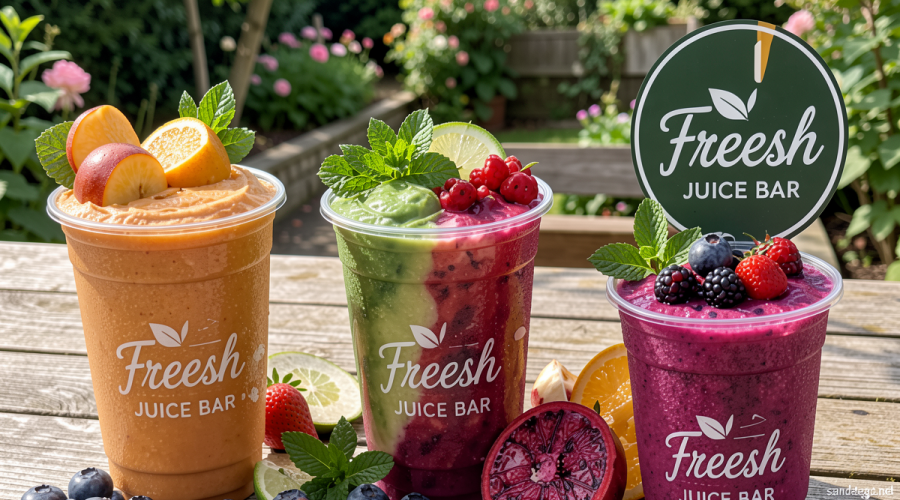
In late August, Adaeze Onejeme, a 28-year-old advertising sales professional based in Los Angeles, was browsing a Hollywood night market with her sister. Stall after stall displayed menus for loaded fries, taquitos, and blended drinks — all illustrated with images carrying an unmistakable, almost rubbery perfection. Onejeme pulled out her phone, recorded short clips of several vendors, and posted them to TikTok. She described what she had stumbled upon as an “AI flyer epidemic.”
“I was like, ‘Those don’t look like chicken nuggets. Those don’t look like typical food that we eat,'” Onejeme recalled.
Rather than patronize a vendor whose menu relied on synthetic imagery, she walked over to a neighboring stand that still advertised its wares with straightforward photographs. The distinction, to her, was not cosmetic.
“Not too long ago, people would just take a picture of the food and that would be on the menu. Now, these AI-generated pictures — the saturation, the coloring, the texture. It’s like you don’t even know what you’re going to get when it comes out,” she explained. “At that point, is it false advertising?”
The Psychology of Plate-Level Distrust
The revulsion is not merely aesthetic. Alexander Diel, a psychologist at Germany’s University of Duisburg-Essen, leads a research team examining how the public reacts to machine-generated depictions of meals. His framing underscores why the issue lands so hard: food occupies a uniquely vulnerable position in human psychology.
“Food is important to us,” Diel noted. “At the same time, it’s something that can easily make us sick, so we are very sensitive to when something is even slightly off.”
That evolutionary wiring — the same instinct that makes us recoil from a bruised apple or a discolored egg — appears to extend, with surprising force, to images that look too uniform, too digitally assembled. The brain registers the discrepancy between expectation and visual input and flags the entire stimulus as potentially dangerous. Appalling AI menu pictures keep exploiting that gap, producing a low-grade alarm response every time a diner’s eye meets an impossibly perfect plate.
From Tokyo to Berlin: A Global Menu Problem
The phenomenon is far from confined to American street corners. In Tokyo, a sandwich advertisement depicts a bagel whose crumb structure resembles spun cobweb, filled with a tuna salad that appears to have been extruded through a pastry piping bag. In Kuala Lumpur, a bowl of spaghetti marinara reads as neatly coiled yarn or strings of modeling clay. In Berlin, lunch-board imagery includes a quiche with suspiciously uniform holes and a penne pasta that looks molded from rubber.
Julia Damphouse, a 30-year-old tour guide, captured the now-viral photograph of a Berlin restaurant billboard last month after first spotting the image earlier that summer. Her assessment was blunt:
“I see a lot of AI food and it just looks a bit shiny and strange, but there’s something particularly alien and wrong with this one. There is something wrong with it. It looks too geometric. I imagine that’s like if you take acid and food stops looking like food.”
The discomfort these images provoke maps neatly onto a concept first articulated in 1970 by Japanese roboticist Masahiro Mori: the uncanny valley. Mori described the eerie, repulsive sensation that arises when a near-human figure carries just enough deviation from reality to trigger alarm. The same neurological tripwire, researchers argue, activates when a near-food image carries just enough deviation from organic texture to make the brain reject the stimulus entirely. Sam Biddle, a technology reporter at The Intercept, photographed a supposed shrimp scampi dish at a deli he visited in August. The image featured circular, bulbous creatures that he later likened to monsters from the fiction of H.P. Lovecraft.
Frequently Asked Questions
Why do AI-generated food images feel more disturbing than other AI art? Because food sits at the intersection of pleasure and survival. Our nervous system treats any anomaly in a food stimulus as a potential contamination signal, so even a minor textural deviation in an AI-rendered dish can trigger a full disgust response.
Is using AI images on a restaurant menu considered false advertising? In most jurisdictions there is no blanket ban, but consumer-protection agencies in several countries have begun reviewing whether synthetic imagery that misrepresents the actual product constitutes deceptive marketing. The question remains unsettled.
How can diners tell whether a menu photo is AI-generated? Look for uniform textures, overly saturated colors, geometric regularity in irregular foods (like pasta or fried items), and an absence of natural imperfections such as uneven browning or stray crumbs. When in doubt, ask the vendor for a real photograph of the dish.