
This tiny center in a UK seaside town is the first place vessels under attack in the Persian Gulf call
This Tiny UK Seaside Office Becomes a Lifeline for Ships in Peril Along the Hormuz Strait
This tiny center in a UK seaside – When a ship caught in the crossfire of the Strait of Hormuz signals for assistance, a single black telephone in a quiet corner of a Portsmouth-based office becomes a lifeline. It’s an unassuming device—much like the 1990s-era office equipment surrounding it—but its function is anything but ordinary. This phone connects to the UK Maritime Trade Operations Centre (UKMTO), a critical hub operated by the Royal Navy that oversees shipping activity in the Red Sea, Persian Gulf, and northern Indian Ocean. Since Iran imposed a blockade on the strait over two months ago in response to US-Israeli strikes, the volume of emergency calls has surged, transforming this modest office into a nerve center for maritime safety.
From Emergency Calls to Strategic Coordination
Commander Jo Black, the UKMTO’s head of operations, described the initial moments of an emergency call as “intensely high-pressure.” “The vessel may be in the midst of an attack. You can hear alarms and sirens in the background. On occasion, even gunfire,” she told CNN. These calls often originate from merchant ships navigating the narrow waterway, which serves as a vital artery for global energy and goods transport. With Iran’s military escalation, the strait has become a battleground, where threats range from missile fire to drone strikes and fast-moving Iranian vessels shadowing commercial traffic.
Black noted that the nature of the threat has evolved as the conflict drags into its third month. “At the beginning of March, we saw clear military operations,” she said. “Now, there’s a shift toward constabulary-style actions, with ships being intercepted and questioned as they approach the strait.” This change has led to incidents where vessels are detained, adding a new layer of complexity to the UKMTO’s role. Despite the rising tension, the team maintains a steady approach, ensuring that every call is handled with precision and urgency.
The Operational Backbone of Maritime Defense
Once an emergency is reported, the UKMTO’s staff spring into action. Known as watchkeepers, they coordinate with the ship’s crew, alert nearby vessels, and notify shipping companies and regional coastguards. Their primary task is to gather information, assess the situation, and disseminate warnings. The small team, consisting of just 18 individuals, operates in 12-hour shifts, with three watchkeepers always on duty and occasionally supported by an analyst. This structure allows for continuous monitoring, even during periods of low activity.
Black emphasized the importance of their role, stating, “If you call UKMTO, you’ll get a response. We can’t guarantee an immediate military intervention, but we ensure your data is shared widely to spark action.” The center’s efforts are bolstered by its network of contacts, including military bodies and regional authorities, which help verify incidents. “We prioritize speed and efficiency in confirming reports,” she said. “The initial alerts on X and our website provide a general overview, but we refine them as more details emerge.”
Monitoring the Seas in Real-Time
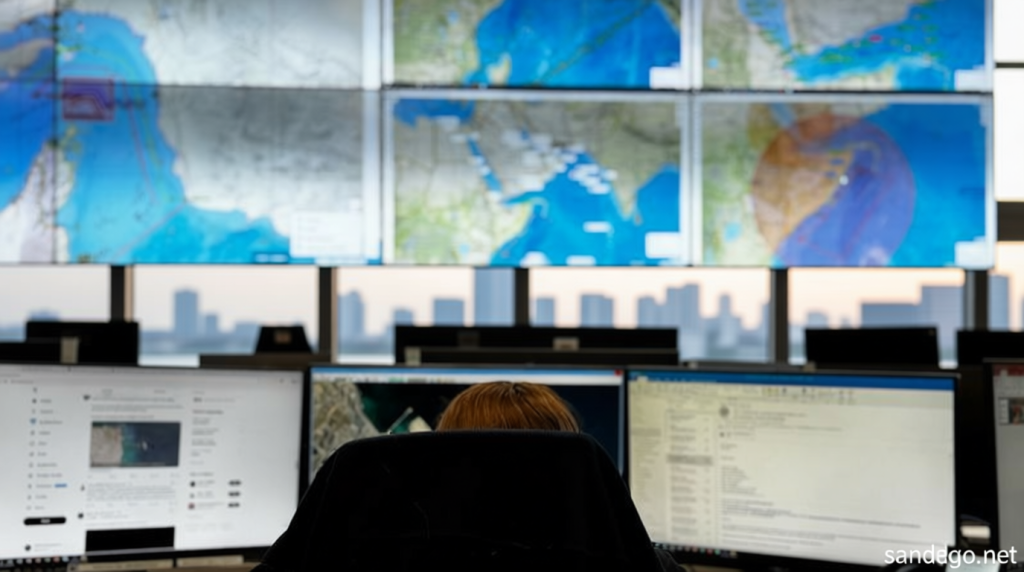
Even during non-crisis hours, the UKMTO remains vigilant. The office is equipped with banks of screens displaying real-time maps and shipping traffic patterns. One map focuses on the strait itself, marked by a red box that highlights the “hazardous area” likely containing Iranian mines. Watchkeepers use this visual data to track vessels and anticipate potential risks. However, their work extends beyond surveillance, as they also process over 2,500 emails daily from ships voluntarily sharing their positions, contact details, and surrounding activity.
These emails are crucial for maintaining situational awareness. By analyzing them, the team can often track a vessel even if it disables its Automatic Identification System (AIS) signal—a common tactic during attacks. This ability to follow ships offline is a testament to the UKMTO’s dedication to ensuring maritime safety. Black explained, “The information we receive helps us piece together the bigger picture, whether it’s a near-miss or a full-scale assault.”
Human Connection in Times of Crisis
Despite the high-tech tools at their disposal, the watchkeepers rely on human intuition and empathy to navigate the emotional toll of their work. “Dealing with a highly emotional situation can be stressful,” Black admitted. “We often build rapport with the crew, which helps us understand the gravity of each incident.” This personal touch is vital, especially when coordinating with distressed sailors or dealing with the aftermath of attacks. The center’s efforts have recorded 44 incidents since the war began, resulting in ten fatalities and significant damage to vessels.
For those stationed in Portsmouth, the stakes are clear. The office, though small, is a critical link between the global shipping network and the frontlines of the Middle East conflict. “A typical day is actually quite calm,” Black said. “But the moment that phone rings, everything changes.” The team’s calm demeanor and quick response are essential in an environment where seconds can determine survival. As the war continues, the UKMTO remains a beacon of coordination, ensuring that no ship is left alone in the face of Iranian aggression.
Global Implications of the Hormuz Crisis
The closure of the Strait of Hormuz has far-reaching consequences beyond the immediate conflict. With over 20% of the world’s oil supply passing through the waterway, disruptions have created a ripple effect across global markets. The UKMTO’s role in monitoring and reporting these incidents has placed it at the forefront of international efforts to stabilize the region. By acting as a central hub, the center helps bridge gaps between local authorities and global stakeholders, ensuring transparency and swift action.
As the situation evolves, the UKMTO faces new challenges. The shift from overt military action to more covert tactics, such as intercepting and detaining ships, has required the team to adapt their strategies. “We’re now dealing with a broader spectrum of threats,” Black said. “From direct attacks to more strategic disruptions, our focus is on staying ahead of the curve.” This adaptability is key to maintaining security in the strait, which remains a critical chokepoint for global trade. The center’s ability to process and share information quickly has been a lifeline for many vessels, providing them with critical time to evade danger or seek refuge.
Looking ahead, the question of how to free the 1,600 ships currently stalled in the strait looms large. These vessels, stranded due to Iran’s blockade, represent a significant logistical and economic challenge. The UKMTO, however, remains optimistic. “Our primary goal is to ensure that every incident is documented and shared with the right parties,” Black said. “With continued support from the international community, we believe we can mitigate the risks and restore normalcy to the region’s vital shipping lanes.”
The office in Portsmouth, with its modest setup and dedicated team, stands as a symbol of resilience and coordination in the face of global crises. While the threats in the Hormuz Strait continue to grow, the UKMTO’s efforts provide a critical layer of defense, proving that even in the most turbulent times, vigilance and communication can make a difference. As the conflict unfolds, the center’s role will only become more essential, ensuring that the world’s supply chains remain as secure as possible.
