
London’s Underground “Calm Space” Trial Draws Laughter, Skepticism, and a Hard Question About Who Gets to Rest
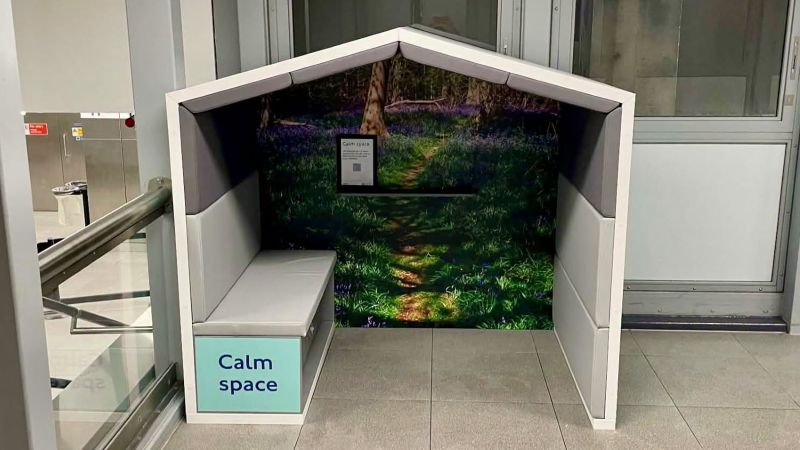
Sandego.net – A small, roofed structure bolted to the concourse of Ealing Broadway Tube station has become an unlikely flashpoint in London’s ongoing debate over sensory accessibility. The open-fronted pod — manufactured by American company NOOK and installed by Transport for London (TFL) as part of a pilot programme — was designed to give neurodivergent passengers a brief refuge from the roar of trains, the press of bodies, and the staccato of announcements. Instead, its debut has produced a wave of bemusement, gentle mockery, and pointed criticism from the very community it was meant to serve.
The trial, which launched in early September 2026, places a compact shelter at one of west London’s busiest interchange stations. TFL framed the initiative as a way to “support customers who may find travelling overwhelming and need a quiet space to pause, regulate and recover before continuing their journey,” according to a statement released on Friday. The programme runs in partnership with Autistica, a UK-based autism charity, and is intended to gather real-world feedback before any wider rollout.
Why the Need Is Real
The sensory environment of the London Underground is, by most objective measures, hostile to anyone with heightened perceptual sensitivity. Platforms echo. Announcements crackle through overhead speakers. Trains arrive with a concussive rush of displaced air. During peak hours, concourses pack with thousands of commuters moving in tight corridors. For the more than one in 100 people in the United Kingdom who live on the autism spectrum — and for the broader neurodivergent population including those with ADHD, sensory processing differences, or anxiety conditions — a single journey can become a sustained assault on the nervous system.
London’s tube network, with its 272 stations and roughly five million daily riders, has historically offered very few designated quiet zones. Most stations provide seating, but seating in a crowded concourse is not the same as a space where a person can lower their shoulders, dim their visual field, and reset their sensory load before re-entering the flow of travel. The calm-space concept attempts to fill that gap with a purpose-built micro-environment.
What the Pod Actually Looks Like
The unit installed at Ealing Broadway is small — roughly the footprint of a large garden bench — with a solid back, two side walls, and a flat overhead canopy. Its front is entirely open. There is no door, no curtain, no lockable enclosure. It sits at the top of the stairs descending to the platforms, adjacent to the lift shafts, in a position where foot traffic passes within arm’s reach.
That configuration, it turns out, was the first thing many Londoners noticed — and the first thing they mocked.
Public Reaction: From “Dog Kennel” to Constructive Critique
TFL promoted the trial on its Facebook page, and the comment section quickly became a forum of mixed sentiment. Several users praised the underlying aim while questioning whether the execution delivered anything useful.
“From someone that needs it…It doesn’t look like a calm space to me (the construction nor the location). But appreciate the thought.”
Others zeroed in on the pod’s diminutive scale. Multiple commenters compared it to a “dog kennel.” One user wrote that it looked like “a calm space for ants.” Another suggested it might have been designed for the hobbits of J.R.R. Tolkien’s Middle-earth. A third imagined teenagers vaping inside or a drunk passenger dozing unattended.
The location drew particular fire. One commenter, dining nearby on the metro — a common London practice — noted the irony of placing a “calm” zone at the top of the platform stairs, next to the lifts, where the noise and movement are at their peak.
The most pointed criticism came from a self-identified autistic user who focused on the absence of a door:
“As someone who’s autistic, that needs a door. You’re literally exposed, it’s just a bench with a roof. Good effort but maybe turn it the other way so people won’t be like animals in a zoo and gawped at.”
Another commenter simply called the structure “basically a cupboard.”
What Happens Next
TFL has confirmed the Ealing Broadway pod will remain in situ for a minimum of four weeks, after which the data collected — usage rates, passenger feedback, incident reports — will inform design revisions. A second trial unit is scheduled for the London Transport Museum in Covent Garden, where it will operate for eight weeks. That location, a quieter, museum-adjacent environment, offers a useful contrast to the high-traffic interchange setting.
Autistica weighed in with a statement from Michelle Newman, its senior research manager, underscoring that transport access is the gateway to every other neuroinclusive space:
“As we push for neuroinclusive spaces in education, healthcare, and employment, we’re reminded that accessibility must start with the journey to these places.”
The Broader Implication
The ridicule is, in one sense, understandable. A structure that looks like a garden shelter, bolted to a busy concourse, does not immediately read as “calm.” But the laughter also reveals a genuine design problem: how do you create a sensory refuge in an environment engineered for maximum throughput, where every square metre is accounted for by commercial leases, wayfinding signage, and passenger flow? The answer cannot simply be “a smaller bench with a roof.” It requires acoustic dampening, visual screening, a controllable entry mechanism, and placement away from the loudest, most crowded nodes of the station.
London’s tube system carries millions of riders daily, and the proportion of neurodivergent travellers among them is not a niche minority. If the pilot programme is to move beyond a novelty that earns a Facebook joke, the next iteration will need to address the very criticisms the public has already voiced: enclosure, orientation, acoustic isolation, and placement. The fact that those criticisms surfaced within days of installation is, arguably, the programme working as intended — surfacing failure modes before a wider rollout locks in a design that serves no one.
Whether the Covent Garden trial will yield a more convincing answer remains to be seen. What is clear is that the question the pod poses — where, in a city built for speed and density, does a person get to stop, breathe, and re-enter the world on their own terms — is one London’s transit planners can no longer defer.
Related Reading
Frequently Asked Questions
What is That s a dog kennel?
That s a dog kennel is the main topic of this guide. The article explains the context, practical details, and next steps readers should understand.
Why does That s a dog kennel matter?
That s a dog kennel matters because readers are looking for a useful answer, not just a short summary. Good content should match search intent and help them decide what to do next.