The Silicon Handshake: How Asia’s Oldest Tech Rivalry Became Its Most Critical Alliance
Sandego.net – Every time a user streams a high-definition film, interrogates a conversational AI model, or scrolls through a social feed on a smartphone, they are tapping into the output of a supply chain so tightly woven between two East Asian economies that neither could function without the other. South Korea and Taiwan, once locked in decades of zero-sum competition over consumer electronics and memory components, now depend on each other to deliver the single most contested product in global technology: the AI accelerator chip. These specialized processors execute trillions of arithmetic operations simultaneously, forming the computational backbone of generative-model training at scale.
The interdependence runs deep. A single Nvidia AI server — the kind populating vast data-center halls from Virginia to Germany — demands computing silicon fabricated by Taiwan’s TSMC, high-bandwidth memory supplied by South Korea’s SK Hynix or Samsung, and proprietary packaging technologies that fuse the two into a working accelerator. Taiwanese contract manufacturers then integrate those accelerators into server racks fitted with advanced liquid-cooling architectures before the units ship to hyperscale operators worldwide. No single nation can manufacture every component, and no single supplier can meet the volume demanded by the current infrastructure buildout.
A Rivalry Forged in Postwar Export Policy
The partnership did not emerge from mutual affection. It emerged from necessity, layered atop a history of bitter industrial competition. Both economies were former Japanese colonies that, after World War II, adopted export-led growth strategies and eventually transitioned from authoritarian rule to competitive democracies. Their industrial trajectories tracked each other closely: labor-intensive garment exports in the 1960s, followed by home-appliance and consumer-electronics manufacturing through the 1970s and 1980s, then a pivot into electronic components — display panels for televisions and monitors, memory chips for personal computers.
Competition intensified as Asia consolidated its role as the world’s component factory. On the consumer-brand front, Taiwanese firms Acer and Asus clashed with Samsung and LG in personal computing, while HTC challenged Samsung in the smartphone segment. Yet South Korea repeatedly pulled ahead, buoyed by conglomerates like Samsung that vertically integrate multiple stages of the supply chain under one corporate roof.
The intensity of that rivalry was captured in a 2013 feature in Taiwan’s Business Today magazine, written by veteran technology journalist Owen Lin, describing an internal Samsung meeting in 2008 where executives allegedly debated a “Kill Taiwan” strategy aimed at dominating every industry where Taiwanese firms competed. Samsung later rejected the existence of such a formal strategy and declined further comment. Lin himself, author of Chip Champion: The Triumph of TSMC and Taiwan, noted that cooperation between the two economies had historically been exceptional.
“Cooperation was actually very rare,” Lin said. “Competition was much more common.”
Sung Soo Eric Kim, distinguished guest professor at Keio University in Tokyo, urged readers against over-interpreting the anecdote. He observed that every major corporation formulates market strategies against rivals across multiple geographies.
“They would, of course, have market strategies competing with not just Taiwan, Japan, and the United States — they’re a global company,” Kim said.
The AI Boom Rewires the Relationship
Even in contract chipmaking — the sector TSMC now dominates — Samsung initially held the upper hand before the iPhone era reshaped demand toward advanced process nodes where TSMC’s manufacturing precision proved decisive. That historical advantage, however, has been eclipsed by a new dynamic: the sheer scale of AI-infrastructure demand has stretched every supplier to its limit, making bilateral cooperation not merely advantageous but operationally mandatory.
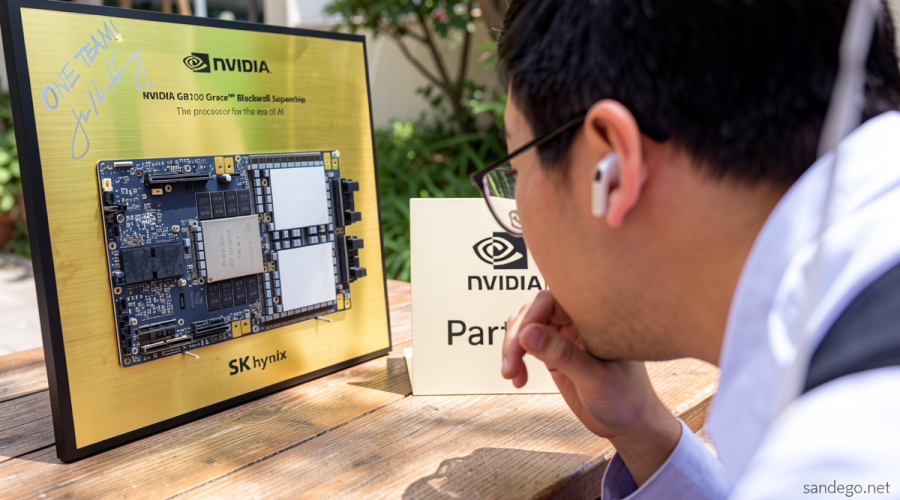
The urgency was made visible in June, when Nvidia chief executive Jensen Huang took a memory wafer produced by South Korean firm SK Hynix at Taipei’s annual computer show and scrawled a brief instruction on its surface.
“Please make more.”
The gesture, widely photographed, encapsulated a structural reality: the global expansion of AI data centers has generated computing demand so vast that no one country’s industrial base can satisfy it alone. Accelerator designs from Nvidia and AMD depend on a supply chain that threads through both Taiwan’s foundry capacity and South Korea’s memory-production capacity, and any bottleneck in either node cascades across the entire deployment pipeline.
SK Hynix has responded by accelerating plans for new fabrication facilities, a move its spokesperson framed in terms of timing rather than mere output.
“In the AI era, technological competitiveness alone is not enough and the ability to supply the required volume at the exact moment customers need it is the ultimate competitive advantage,” the spokesperson said.
What the Shift Means
For policymakers and investors watching East Asian technology, the Korea–Taiwan axis now functions less as a rivalry to be managed and more as a single, indivisible production system. The old framing — two economies competing for market share in flat-panel displays or NAND flash — has given way to a new one: two economies whose combined output determines how quickly the world’s frontier AI models can be trained, fine-tuned, and deployed. The competitive instincts remain; the arithmetic of supply simply no longer permits them to operate in isolation.
“We don’t have time to get into this old-fashioned conflict,” Kim said. “There’s so much demand; we have to cooperate and supply first.”
The implication extends beyond chips. As sovereign governments across Europe, North America, and Southeast Asia race to build domestic AI capacity, the reliability of the Korea–Taiwan supply corridor becomes a geopolitical variable in its own right — a reminder that the most advanced computation on Earth still depends on two small island-and-peninsula economies that, for most of their postwar history, spent more energy outcompeting each other than coordinating.
Related Reading
Frequently Asked Questions
What is From heated rivalry to frenemies?
From heated rivalry to frenemies is the main topic of this guide. The article explains the context, practical details, and next steps readers should understand.
Why does From heated rivalry to frenemies matter?
From heated rivalry to frenemies matters because readers are looking for a useful answer, not just a short summary. Good content should match search intent and help them decide what to do next.