New York City Locks Generative AI Out of Elementary and Middle School Classrooms for One Year
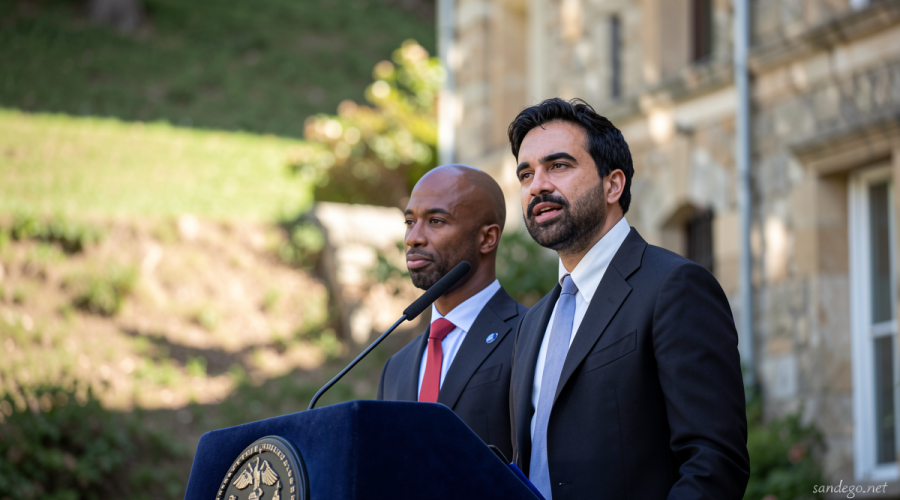
Sandego.net – The nation’s largest public school system has moved to shut the door on generative artificial intelligence for every student from pre-kindergarten through eighth grade, imposing a twelve-month moratorium that will reshape how nearly 600,000 children experience technology in their daily schooling. The decision, unveiled on Wednesday by Mayor Zohran Mamdani alongside Schools Chancellor Kamar Samuels, represents what the mayor’s office described as the most sweeping restriction on AI use in American public education to date.
The ban lands amid a widening national debate over whether machine-generated text, images, and conversation belong in the hands of young learners at all. Parents, educators, and policymakers in dozens of districts have pressed for tighter controls on both screen exposure and algorithmic tutoring, citing anxieties that early and unchecked contact with generative tools may blunt independent reasoning, erode the teacher-student bond, or introduce unvetted content into formative years of development.
Scope and Immediate Effect
Under the new framework, companion chatbots and mainstream consumer platforms such as ChatGPT and Claude will be blocked across every grade level in the district. Students in grades 2K through 8 will have no sanctioned access to generative AI during the school day. The moratorium covers roughly two-thirds of the district’s total enrollment, making it the single largest single-district intervention of its kind in the country.
As part of the rollout, the district will strip or deactivate the embedded AI features inside more than 38 software programs that had previously cleared approval for classroom use. Those tools will remain available only if their artificial-intelligence components are removed or disabled to satisfy newly articulated safety and oversight criteria.
“Discontinue or disable the AI components of more than 38 previously allowed programs that do not meet our new safety and oversight standards.” — Mayor Zohran Mamdani
What High School Students Will and Will Not Receive
The restriction is not a blanket prohibition across all twelve grades. Students in New York City high schools will retain access to a curated, limited set of AI-assisted tools and will enroll in dedicated “AI critical thinking” courses designed to build literacy about how these systems work, where they fail, and how to interrogate their outputs. The intent, as Samuels framed it, is to ensure that older students encounter the technology deliberately rather than by default.
Individual screen-time allowances will also be calibrated by grade level, capping the number of minutes a student may spend on a device during instructional periods. Exceptions are carved out for students with documented disabilities and for English-language learners, whose instructional needs may require adaptive technology that incorporates AI-assisted scaffolding.
The Teacher’s Role Redefined
Instructional staff will continue to use AI for lesson planning, administrative scheduling, and other what the district calls “operational tasks.” What they may not do is employ generative tools to grade assignments, generate student assessments, or produce evaluative feedback that replaces human judgment. The line, in practice, separates back-office efficiency from front-of-class pedagogy.
Michael Mulgrew, president of the New York-based United Federation of Teachers, issued a statement praising the screentime ceilings and the disability carve-outs while pressing a pointed question: how will the education department vet and continuously monitor the AI safeguards inside commercial learning products going forward? Without a transparent, recurring review process, he warned, individual schools and teachers could be left guessing which tools are cleared and which are not.
A Coalition to Watch and Report
Recognizing that a one-year experiment generates more questions than answers, the district is establishing a Technology in Schools Coalition composed of educators, parents, students, and outside stakeholders. The body will track the moratorium’s effects on learning outcomes, teacher workload, and student well-being, then issue recommendations for subsequent school years. The structure is designed to prevent the policy from becoming either a permanent prohibition or a silent rollback.
Notably, the district had already attempted a narrower version of this approach in 2023, when the education department blocked ChatGPT from school-issued devices and networks. That restriction was reversed within months, a reversal that Samuels acknowledged Wednesday as a lesson in the difficulty of drawing firm lines while the underlying technology evolves weekly.
Industry Pushback and the Home-Front Problem
Major technology firms including Microsoft, OpenAI, and Anthropic have poured millions of dollars into teacher-training initiatives aimed at equipping educators to integrate AI into curricula. Those investments, and the parallel funding streams directed at teachers’ unions to develop AI literacy modules, create a structural tension with a district that has just told the industry its tools are unwelcome in the earliest grades.
Samuels conceded on Wednesday that the policy cannot reach into living rooms. Students will still be able to open a phone or laptop at home and ask a chatbot to finish a math worksheet or summarize a history chapter. The district’s stated aim is to “expand our teachers’ and our understanding of how to combat the external use of AI,” while simultaneously urging families to monitor their children’s after-school technology habits. The admission underscores a practical limit: a school-day ban governs only the hours and walls of the institution.
National Context and the Broader Trend
New York City’s move does not exist in isolation. The Los Angeles Unified School District announced significant restrictions on classroom screen use earlier this year and has since moved to limit student access to generative AI platforms while it reviews its own safeguard protocols, a district spokesperson confirmed Wednesday. New York state, meanwhile, enacted a statewide ban on personal phone use during the school day in the previous legislative session. Together, these actions trace a clear arc: American school systems are retreating from the assumption that more device access automatically equals more learning.
Mamdani closed the Wednesday press conference by pushing back directly on the narrative he said the technology sector has spent years cultivating.
“The tech industry wants us to believe that AI in early education is not only inevitable, but that it is necessary. We do not see it that way.”
For the next twelve months, roughly 600,000 New York City students will sit in classrooms where the most powerful generative models of the decade are simply absent. Whether that absence sharpens their thinking, frustrates their assignments, or produces measurable differences in learning outcomes will be the central question the newly formed coalition is charged with answering before the next school year begins.
Related Reading
Frequently Asked Questions
What is Nation s largest school district bans?
Nation s largest school district bans is the main topic of this guide. The article explains the context, practical details, and next steps readers should understand.
Why does Nation s largest school district bans matter?
Nation s largest school district bans matters because readers are looking for a useful answer, not just a short summary. Good content should match search intent and help them decide what to do next.