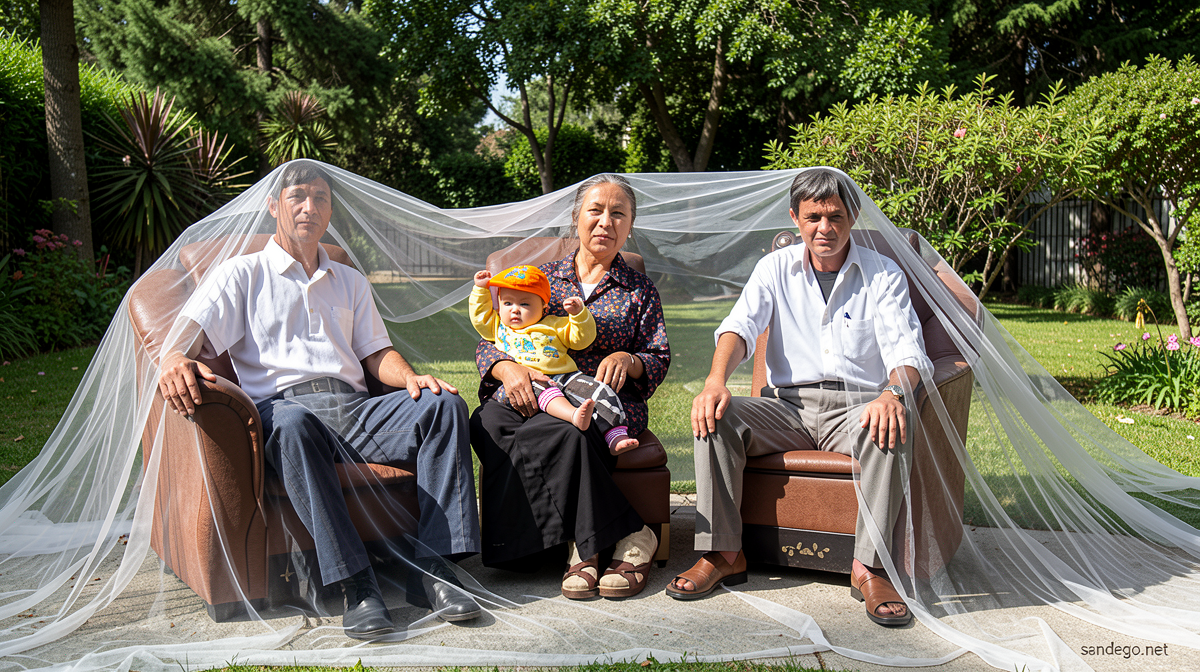
A Portrait of Hidden Heritage: The Siblings of a Cross-Cultural Union
Sandego.net – Under a delicate white veil, four generations of a Vietnamese-Japanese family gather on tan leather seating. At the center sits a woman cradling an infant, while her siblings and another family member look directly into the camera. Their partially concealed faces serve as a powerful symbol of hidden histories. Now in their sixties, these individuals are the offspring of a Japanese soldier and a Vietnamese woman during the wartime occupation of Vietnam.
Like many children from these previously forbidden relationships, they navigated social difficulties throughout their lives while growing up without their father present. Although some military personnel remained after hostilities ended, numerous families experienced forced separations by the mid-1950s when soldiers were mandated to return home. This situation applied to the family of Lê Thị Xuân and Yoshiharu Shimizu, known by his Vietnamese name Nguyễn Văn Đức, who had three children together.
The Re/cover Series and Its Symbolism
When photographer Phan Quang captured this image in 2014, the siblings represented four generations, with a great-grandchild resting on the central woman’s lap. The photograph forms part of “Re/cover,” a comprehensive multiyear project that Phan dedicated to documenting these families’ narratives, which he finished approximately ten years ago. Within each portrait, subjects are draped in white fabric that represents both marriage and unspoken truths.
Portions of this work are currently being displayed at the Rencontres d’Arles photography festival in France during the upcoming summer and autumn seasons. Due to Japan’s occupation, which included the military’s troubling history of sexual slavery involving “comfort women,” relationships between Japanese soldiers and Vietnamese women faced intense social judgment.
Japanese soldiers who married local women were often looked down upon by their peers, as these women came from what was then seen as a ‘lesser’ country.
On the other hand, their Vietnamese wives and children were stigmatized for carrying the bloodline of a former occupying force.
Through “Re/cover,” Phan searched for families created through genuine love and mutual agreement, whose experiences had remained largely unknown. The dual identity of these children produced legal and social complications, placing them in an intermediate position where they could not completely assimilate into Vietnamese society or travel to their father’s homeland.
Their lives seemed entirely erased by history, and they themselves appeared trapped in a melancholic loop of the past, with no way out.
A Love Story Spanning Decades
Xuân, one of the few Vietnamese wives still living when Phan created this work, “spoke about her love with a surprising warmth and devotion,” he remembered. Shimizu chose to remain in Vietnam following World War II to participate in the Việt Minh resistance movement against French colonial reoccupation. The couple wed in Hanoi and shared nine years of married life before circumstances separated them.
Their love was genuine, and she remained deeply proud of her husband, carefully preserving his belongings for decades.
Without official recognition from Japan or immigration pathways for Shimizu’s Vietnamese family, the household never reunited. Shimizu encountered difficulties after returning to Japan in 1955 and could not provide financial assistance to those left behind. When Vietnam implemented significant reforms in 1986 and permitted international travel, Shimizu came back accompanied by his new Japanese spouse to meet his grown children.
Xuân welcomed them both with extraordinary generosity.
Connecting Two Nations Through Fabric
Locating families for “Re/cover” proved difficult for Phan, who utilized his journalism background to spend years finding these relatives and building confidence with them. He sent over two hundred letters to Japanese consulates, historical organizations, and other institutions but received limited responses, which he attributed to the sensitive subject matter.
The veil concept emerged during a 2013 visit to a traditional Japanese kimono workshop in Kyoto. Phan noticed parallels between Japan and Vietnam in how the fabric was utilized—a Kyoto factory started producing voile material for kimonos in 1955, the same year Japanese troops departed Vietnam. This particular fabric remains popular for bridal veils in Vietnam. Transporting the material from Japan to Vietnam “created an invisible connection” between the two nations, according to Phan.
“Re/cover” combines both staged and documentary photography approaches. Curator Nadine Hounkpatin organized the broader exhibition at Arles, bringing these stories to international audiences and ensuring that the suppressed histories of these cross-cultural families would not be forgotten.