Tear your eyes away from the ballroom. This courthouse is the real face of Trump-era architecture
Sandego.net – In the heart of Chattanooga, Tennessee, a significant shift in federal architecture is unfolding, offering a striking contrast to the presidential spectacle that has dominated headlines. While President Donald Trump’s lavish $400 million White House ballroom and his proposed triumphal arch have captured the public’s imagination, a quieter but equally telling project is gaining traction. Set to open in 2030, the new federal courthouse in Chattanooga exemplifies the president’s vision for a reimagined architectural landscape, blending classical elegance with modern functionality in a style dubbed “Greco-Deco.” This design, though seemingly traditional, is poised to become a defining symbol of the Trump administration’s approach to public infrastructure.
A Shift in Federal Design
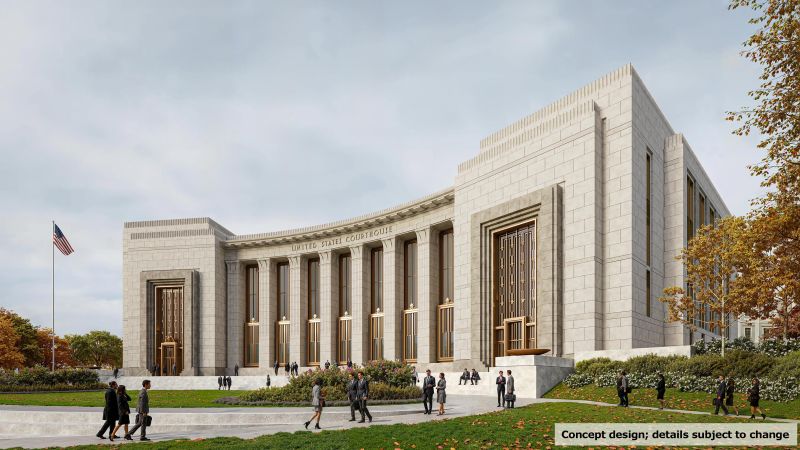
Since Trump’s executive order, “Making Federal Architecture Beautiful Again,” was announced last year, the federal building agency has embarked on a mission to revive what it deems the lost grandeur of classical design. The Chattanooga courthouse, designed by the contemporary firm HOK, stands as the first major federal structure to openly embrace this directive. Its imposing Art Deco Greek temple form, with its muscular columns and geometric precision, reflects a deliberate choice to project authority and tradition. Unlike the more flamboyant White House renovations, this courthouse has drawn fewer headlines but has sparked a nuanced conversation about the political and aesthetic implications of its design.
At first glance, the courthouse appears to be a straightforward interpretation of classical motifs. However, its creators have infused it with a distinct modern twist, redefining traditional styles for the 21st century. The building’s facade features a row of square columns, flanked by two bulky, mausoleum-like volumes—a visual metaphor for the strength and resilience of the judiciary. This interpretation, while rooted in historical references, also signals a departure from the minimalist trends that have characterized federal architecture in recent decades.
Architectural Interpretation and Critique
The National Civic Art Society (NCAS) has hailed the project as a “showpiece” of Trump’s vision, praising its ability to merge tradition with innovation. NCAS president Justin Shubow, a staunch supporter of classical architecture, emphasized that the design demonstrates the enduring appeal of classicism. “Classicism is still alive, can be done well, and can be both traditional and original,” he stated in a video call. Shubow’s remarks underscore the agency’s role in shaping the discourse around federal aesthetics, though he also acknowledged the potential for architecture to become entangled in political symbolism.
“Many judges, regardless of whether they were appointed by a Democrat or a Republican president, want a courthouse that looks like a courthouse.”
Despite the NCAS’s endorsement, some critics argue that the design carries deeper political connotations. Kevin D. Murphy, a professor and chair of the history of art at Vanderbilt University, suggested that the courthouse’s aesthetic evokes a 1930s classicism associated with fascist regimes. “It’s not just a matter of style—it’s about the message the judiciary is sending,” Murphy said over the phone. He challenged the architects’ claim that the building embodies transparency, noting that its solid, formidable appearance feels more like a statement of power than openness.
“Is that the message you want to send about the judiciary? That it’s intimidating?”
Christopher Hawthorne, a former Los Angeles Times architecture critic who now curates the Punch List newsletter, offered a more balanced perspective. He described the courthouse as a “handsome design” with the potential to be “perfectly competent.” Yet, he also questioned its ability to reflect broader societal values. “Architecture has a responsibility to say something fundamental about contemporary society,” Hawthorne noted. “I don’t think this design has anything to say except reflecting the current occupant of the White House.”
HOK, the firm behind the project, has remained silent on CNN’s inquiries, leaving room for speculation about its design philosophy. While the firm’s work is often associated with modernist tendencies, the Chattanooga courthouse represents a strategic pivot toward classical forms, aligning with Trump’s aesthetic priorities. This shift raises questions about how architects navigate political mandates while maintaining creative integrity.
Public Perception and Broader Implications
The debate over Trump-era architecture extends beyond academic circles, touching the American public. A Harris Poll conducted in 2020 revealed that over 70% of respondents, regardless of political affiliation, prefer traditional designs for federal buildings over modernist alternatives. This finding has fueled discussions about whether the public supports the revival of classical aesthetics or if it merely reflects a nostalgic preference. The FBI’s decision to vacate the J. Edgar Hoover Building and reports of potential demolition for the angular Dallas City Hall further illustrate a growing acceptance of traditional styles in public spaces.
While some view the new courthouse as a testament to architectural tradition, others see it as a symbolic statement of authority. Its muscular form and restrained ornamentation echo the 1930s era, a period marked by both the rise of fascist regimes and the establishment of modernist principles in architecture. The blend of these influences has led to polarized reactions, with critics accusing the design of evoking authoritarian undertones and advocates celebrating its revival of timeless elegance.
As the 2030 opening date approaches, the Chattanooga courthouse will serve as a focal point for evaluating the success of Trump’s architectural agenda. Will it be seen as a bold statement of national identity, or as a politically motivated aesthetic choice? The building’s design, while functional, has already ignited a broader conversation about the role of architecture in shaping public perception and institutional values. For now, it remains a quiet yet powerful symbol of an era defined by both ambition and controversy.
The Debate Continues
The contrast between the White House’s opulent ballroom and the Chattanooga courthouse highlights the diverse ways in which the Trump administration has sought to project its vision. While the former dazzles with excess, the latter offers a more measured, yet equally commanding, expression of federal authority. This duality reflects the broader tension between form and function, between grandeur and practicality, that defines the era’s architectural legacy.
As the design of the Chattanooga courthouse gains prominence, it invites scrutiny not only for its aesthetics but also for its implications. The building’s success will depend on its ability to balance tradition with innovation, and its reception will likely shape the future of federal architecture. For architects, the challenge lies in creating structures that are both politically aligned and artistically compelling. For the public, the question remains: Does this courthouse represent the future of American design, or is it just another chapter in the ongoing culture war over architectural styles?