Art Meets Atelier: Paris Couture Week’s Cultural Renaissance
Sandego.net – While my primary mission in Paris this week was to witness the haute couture presentations, I found myself continually crossing paths with artistic expression. This shouldn’t surprise anyone familiar with the French capital, where galleries and museums seem to emerge from every corner. Yet what struck me most was how deeply art had been integrated into the collections themselves. Fashion and the art world have always maintained a close relationship, and haute couture represents perhaps the most artistic form fashion has to offer. But there appears to be a deeper motivation at play. In today’s economic climate, luxury brands are actively seeking meaningful ways to engage with their clientele, and art serves as a reliable bridge for conversation and connection.
Chanel’s Living Canvas
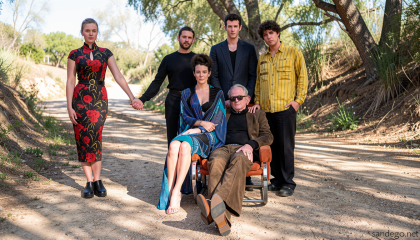
Even Chanel — a house experiencing remarkable commercial success under Matthieu Blazy’s creative direction — embraced this artistic impulse. Joël Blanc, a working artist, was positioned prominently in the front row, capturing the show through his paintings in real time. Blazy’s collection drew inspiration from fairy tales, with enormous twisting vines installed throughout the Grand Palais creating an atmosphere reminiscent of “Jack and the Beanstalk.” This whimsical narrative unfolded through impeccably crafted garments, with magical elements like beans and golden eggs appearing as subtle details. The presentation included delightfully charming shoes, a charming progression of buttons depicting ugly ducklings transforming into swans, and a dramatic black dress with wings that seemed to pursue the bridal gown.
Dior’s Sculptural Dialogue
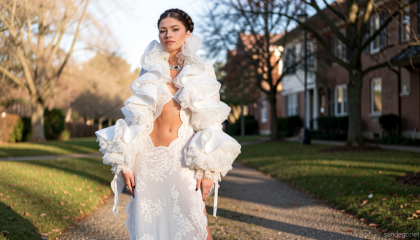
Jonathan Anderson brings his well-documented passion for art as both collector and curator to Dior, joining a distinguished lineage of designers who shared similar sensibilities. Christian Dior himself operated as a gallery owner before establishing his couture house, and numerous creative directors have drawn inspiration from contemporary artists. For Anderson’s second couture collection, presented at the Musée Rodin, he looked toward the work of Lynda Benglis, the eighty-four-year-old American sculptor known for her unconventional mixed media pieces that have challenged traditional art institutions. Benglis’s work spans the globe, but Anderson found particular resonance in her connections to Santa Fe, New Mexico, and Ahmedabad in Gujarat, India — landscapes whose colors and textures permeated the collection.
Sitting within the grounds of the Musée Rodin, I couldn’t help but envision this setting as an ideal wedding venue for a certain famous pop star and her athletic partner, who surprisingly chose a midtown stadium for their celebration. Imagine exchanging vows before Rodin’s “The Kiss,” followed by cocktails in the elegant eighteenth-century Hôtel Biron. Unfortunately, Anderson’s role was limited to designing the dress alone.
Emotion and Integrity in Fashion
Balenciaga’s Pierpaolo Piccioli delivered his inaugural couture collection with such artistry that literal references to artworks became unnecessary. Beyond his technical mastery, the Italian designer operates on an emotional frequency — his work generates feelings comparable to that sudden catch in your throat when moved by music, cinema, or visual art. “Couture isn’t only about the dress,” he explained to gathered press members backstage. “It’s about the mindset.”
Outside the showrooms, I visited the Azzedine Alaïa Foundation, a destination revered by fashion devotees. This space houses an extraordinary collection of archival garments, books, and artworks. The foundation also preserves Alaïa’s studio, sealed behind a circular glass window in its original state since his passing — a preservation largely credited to Carla Sozzani, the fashion world’s guardian of legacy. When asked to characterize Alaïa’s contribution, Sozzani immediately responded with a single word: “integrity,” a quality increasingly rare in fashion’s competitive landscape.
Speaking of integrity, Michael Stewart’s Paris Couture debut generated considerable excitement. The Irish designer’s label, Standing Ground, has built momentum through an expanding private clientele seeking his contemporary approach to eveningwear. Stewart demonstrates independence by introducing fresh concepts while respectfully challenging established fashion conventions. His collection reminded us that fashion achieves artistic status when designers refine techniques that serve a clear, distinctive vision — elevating themselves above the relentless cycle of trends and commercial pressures.