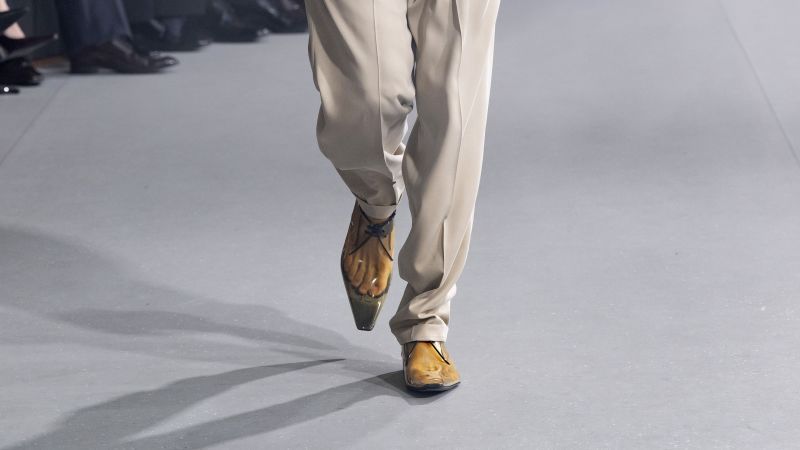
Look of the Week: Saint Laurent’s see-through shoes reveal fashion’s growing foot fetish
Sandego.net – Fashion’s gaze has increasingly turned to a curious focal point—our feet. At the men’s Summer 2027 Saint Laurent show in Paris, creative director Anthony Vaccarello surprised attendees with a bold collection that blurred the line between elegance and provocation. The runway spectacle featured a slate-blue suit, with fluid trousers and a boxy, 80s-inspired jacket, evoking the cool demeanor of a Bret Easton Ellis antihero. Yet, the collection’s climax came with a pair of transparent vinyl oxfords, their sleek design revealing the models’ toes in a manner that sparked both intrigue and unease. Amid the city’s sweltering heat, the shoes became a visual metaphor for the season’s themes, as the models’ feet perspired under the unyielding fabric.
The Foot as Fashion’s New Frontier
Vaccarello’s choice wasn’t just a stylistic whim. The French capital, already in a blistering heatwave, saw the show take place on the hottest June day of the year—until Wednesday’s temperature surged past it. This context amplified the visibility of the shoes’ see-through quality, as the models’ feet glistened like polished glass under the stage lights. The collection’s other pieces, including accordion-folder brown and taupe-toned sandals, further emphasized the foot’s role in defining the season’s aesthetic. These designs, with their corporate hues, merged with tailored suits to evoke a mood of corporate sophistication tinged with sensuality.
The trend of spotlighting feet in fashion isn’t new, but its intensity has grown in recent years. This season’s designs—ranging from the avant-garde to the quietly rebellious—seem to reflect a broader cultural fascination with the lower extremities. The Saint Laurent oxfords, for instance, are part of a wave of footwear that prioritizes transparency, playfulness, and the interplay of material and anatomy. Whether through the condensation fog clinging to the shoes’ uppers or the deliberate exposure of the models’ toes, the collection turned the foot into a canvas for both art and provocation.
Viral Footwear and Celeb Influence
Footwear’s current status as a cultural touchstone is evident in its ability to spark viral reactions. Earlier this year, Chanel’s resort show in Biarritz introduced a series of sandals that laced around the heel, leaving toes bare. The design, described as “whimsical” and “extravagant,” ignited debates about its purpose: was it a playful nod to minimalism, or a statement about the allure of the human form? The Saint Laurent shoes, however, take this concept further, blending the traditional with the daring. Their clear vinyl construction and streamlined silhouette suggest a modern take on the “shock trotter,” a term often used to describe footwear that challenges norms.
Other designers have also embraced the foot as a central motif. Jonathan Anderson, once at Loewe and now at Dior, has long been celebrated for his unconventional footwear. His designs—like balloon-pump shoes or soap-shaped heels—have become cult favorites, proving that even the most peculiar styles can captivate the public. Meanwhile, The Row’s minimalist aesthetic is undercut by its quirky shoe offerings, such as mesh flats and jelly shoes, which sell out despite the brand’s reputation for understated elegance. This contrast highlights how the foot, once a silent accessory, is now a driving force in fashion’s narrative.
Even Tory Burch, known for her Palm Beach-inspired collections, has contributed to the trend. Her latest line includes high-vamp pumps adorned with vibrant neon orange accents, blending sophistication with a dash of audacity. These designs, while not as extreme as Vaccarello’s, still reflect a shift in how footwear is perceived. The foot, once considered a background element, now demands attention as a symbol of individuality and desire.
Historical Context and the Foot’s Evolution
The fascination with feet in fashion has roots that stretch far beyond social media. The Margiela Tabi boot, introduced in the 1990s, is often cited as the first example of a shoe that redefined the foot’s role. Its split-toe design, inspired by Japanese traditions, challenged Western notions of footwear, making it a timeless reference in the industry. Similarly, Saint Laurent’s see-through shoes echo this legacy, using transparency to amplify the foot’s presence in a way that feels both nostalgic and contemporary.
Footwear’s rise as a focal point also reflects practical considerations. Unlike clothes, shoes are relatively easy to design and produce, allowing brands to experiment without the same level of risk. This accessibility has made them a powerful tool for generating conversation, especially when paired with controversial or striking aesthetics. The viral success of the Saint Laurent oxfords, for example, underscores how a single design can dominate media narratives, even in an era where attention spans are fleeting.
While some may dismiss the trend as a fleeting obsession, others argue it’s a sign of fashion’s evolving priorities. With handbags losing their once-irresistible allure and the Birkin bag becoming ubiquitous, the industry has turned to footwear as a fresh canvas. As Amy Odell, a fashion and culture journalist, noted this month, the ultra-exclusive Birkin has become so common that even its exclusivity feels diluted. In contrast, the Saint Laurent shoes, with their audacious design, represent a deliberate effort to reclaim the foot’s significance in a world that often overlooks it.
The Role of Social Media and Celebrity
Social media has accelerated this shift, turning the foot into a subject of endless analysis and admiration. From TikTok trends to Instagram aesthetics, the way we view feet has transformed. Consider the recent viral sensation of Charli XCX lighting Madonna’s cigarette as she waited for Vaccarello’s show to begin—a moment that, while notable, pales in comparison to the controversy surrounding the see-through shoes. The latter, with their unapologetic exposure, have become a talking point that lingers in public discourse for weeks, proving that footwear can rival even the most iconic celebrity moments.
Yet, the foot fetish isn’t solely a product of digital culture. For years, designers have used celebrity front rows to create spectacle, positioning runway shows as entertainment rather than industry events. But now, as stars like Hailey Bieber and Kim Kardashian model for a broader audience, the presence of a high-profile figure on the runway is no longer a shock. This shift allows the foot to take center stage without relying on star power alone. The Saint Laurent shoes, in their clarity and audacity, embody this new dynamic, where the design itself becomes the star.
As Spring 2027 approaches, the industry’s focus on feet shows no signs of waning. From the Balloon Pumps of Jonathan Anderson to the neon pumps of Tory Burch, the foot continues to shape the direction of fashion. Whether through the Margiela Tabi’s revolutionary design or the Saint Laurent oxfords’ modern reinterpretation, the foot remains a potent symbol of both innovation and desire. In a world where every detail is scrutinized, the foot’s newfound prominence is a testament to fashion’s enduring ability to captivate—and to challenge—its audience.
When the runway ends and the season begins, the question remains: what does the foot fetish mean for the future of fashion? As designers like Vaccarello and Blazy push boundaries, the foot becomes more than a body part—it becomes a statement, a symbol, and a subject of endless fascination. The Saint Laurent shoes, with their blend of elegance and exposure, are a fitting example of this movement, proving that even the simplest element can be transformed into a powerful cultural artifact.