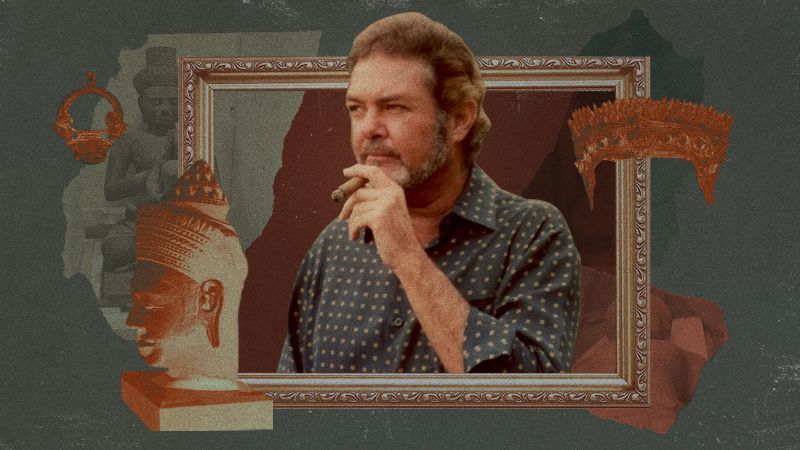
How a British Antiquities Dealer Made Millions from an International Looting Network
The Hidden Origins of Khmer Artifacts
Sandego.net – Khmer sculptures in Western collections often trace their origins to ancient temples like Angkor Wat and Koh Ker, where they were violently extracted during periods of political instability. These artifacts, once integral to Cambodia’s cultural heritage, frequently ended up in the hands of collectors and museums abroad. Central to this illicit trade was Douglas Latchford, a British antiquities dealer whose name became synonymous with the smuggling of Cambodian relics. His role in the network was pivotal, linking local looters to international buyers through a web of forged documents and strategic negotiations.
A Man of Prestige and Deception
For decades, Latchford was viewed as a respected figure in the art world—a trusted dealer, a published scholar, and an author of books on Khmer sculpture. His self-taught expertise and charismatic presence made him a sought-after intermediary, enabling him to sell exquisite pieces to wealthy patrons. Yet, behind this veneer of legitimacy lay a history of questionable practices. While his clients might have been reassured by his academic credentials, the artifacts he handled often arrived at their destinations with missing limbs, rough edges, or still encrusted with earth, their original context stripped away.
From the 1960s until his death in 2020, Latchford’s business model thrived on the assumption that many sculptures were “found” or “discovered” rather than stolen. He sourced pieces from remote archaeological sites, where small-scale looters—sometimes aided by local military forces—extracted them using tools ranging from shovels to dynamite. These items were then transported by oxcart to the Thai border, where Latchford’s network took over, ensuring their passage into global markets. His ability to craft compelling narratives for buyers, often with fabricated paperwork, allowed the trade to continue unchecked for years.
The Unraveling of a Looting Scheme
As US authorities delved into Cambodia’s history of artifact trafficking, the scale of Latchford’s operations began to surface. Investigations traced the flow of sculptures from war-torn regions to auction houses and museum collections, revealing that many had been looted during the Khmer Rouge era. The dealer’s denial of wrongdoing only added to the controversy, as he claimed that sculptures were often saved from destruction by being removed from Cambodia’s collapsing cultural landscape.
“Admittedly these things were moonlighted out of Cambodia and wound up somewhere else,” he told the New York Times in 2013. “But had they not been, they would likely have been shot up for target practice by the Khmer Rouge.” This defense, while plausible, failed to address the core issue: the systematic removal of relics from their historical sites, often without proper documentation or consent from local authorities.
By the late 2010s, the evidence against Latchford had grown overwhelming. Federal investigators argued that he was not just a facilitator but a “conduit” for plundered antiquities, knowingly building a career on the backs of looted art. The year before his death, he was indicted on charges of wire fraud, smuggling, and conspiracy, facing the prospect of legal battles in a distant courtroom. Yet, his health had deteriorated to the point where it’s unclear whether he even understood the gravity of the situation.
A Legacy of Repatriation
In the wake of Latchford’s indictment, a wave of accountability swept through the art world. Major institutions and private collectors, including the Metropolitan Museum of Art, the Denver Art Museum, and the National Gallery of Australia, began returning artifacts linked to his network to Cambodia. This shift marked the end of an era, as the once-thriving market for Khmer art faced a reckoning.
One of Latchford’s former associates, Nancy Wiener, admitted her complicity in the scheme, pleading guilty to conspiracy and possession of stolen property. Her actions underscored the widespread nature of the looting network, which spanned multiple continents and involved players at various levels. Even his daughter, Julia Kriangsak (who uses the Thai name Nawapan Kriangsak), took steps to rectify the damage. In 2021, she returned over 100 artifacts to Cambodia’s government, acknowledging the complexity of her father’s legacy without explicitly endorsing his guilt.
“Repatriating his records and art, irrespective of origin, was the best way to deal with his complex legacy,” Julia told CNN. Her decision reflected a broader movement among art institutions to distance themselves from Latchford’s controversial trade. The Man Who Stole the Gods, a book by Canadian journalist Matthew Campbell, further cemented this narrative. “There are going to be one-offs—things will get sold privately between two parties,” Campbell noted. “But Sotheby’s cannot put a big Khmer statue on auction in New York anymore. That’s over.”
The Market’s Collapse and Cultural Impact
Today, the effective sale value of Khmer sculptures has plummeted, with many collectors hesitant to risk reputational damage. The once-thriving market now operates in shadows, relying on discreet transactions rather than public auctions. For Cambodia, however, the repatriation efforts offer a glimmer of hope, as artifacts are slowly returning to their homeland. Yet, the damage inflicted by decades of looting remains significant, with countless pieces scattered across the globe.
Latchford’s legacy is now a cautionary tale of greed and exploitation. His ability to blend academic credibility with illicit trade allowed him to profit handsomely while obscuring the origins of his wares. The network he cultivated not only enriched himself but also enriched a global market that prioritized aesthetics over authenticity. As the art world grapples with its complicity in the looting, the name Douglas Latchford has become a symbol of the darker side of cultural exchange.
Despite his denials, Latchford’s impact on Cambodia’s heritage is undeniable. The sculptures he sold, often to billionaires or prestigious museums, were once part of sacred spaces that told the story of an ancient civilization. Now, their provenance is questioned, their value diminished, and their future uncertain. The case against him has not only exposed a network of theft but also sparked a reevaluation of how art is acquired and displayed in the West.
As the debate over cultural ownership intensifies, Latchford’s story serves as a reminder of the human cost behind the pursuit of art. His actions, though shrouded in the guise of scholarship, contributed to the loss of a priceless historical record. The legacy of his trade endures in the artifacts that remain abroad, yet the tide has turned in favor of restitution, ensuring that Cambodia’s cultural treasures may yet find their way home.
Two years after his death, the art world continues to reckon with the consequences of his actions. The once-mighty dealer is now a cautionary figure, his name a warning to those who prioritize profit over preservation. As institutions and collectors embrace transparency, the market for Khmer art has entered a new phase—one where the past looms large, and the future depends on the choices made today.