Beloved British Artist David Hockney Dies at 88
Sandego.net – David Hockney, the iconic British painter renowned for his bold visual narratives and luminous portrayals of daily life, has passed away at the age of 88. His death occurred “peacefully at home” on Thursday, just one month before his 89th birthday, as confirmed by his long-time publicist, Erica Bolton, who shared the news with CNN. Hockney’s career, spanning six decades, left an indelible mark on the art world, blending innovation with emotional resonance in every piece he created.
Early Life and Career Beginnings
Born in 1937 in Bradford, England, Hockney’s artistic journey began in his hometown, where he studied at Bradford School of Art. He later pursued further education at the prestigious Royal College of Art in London, a decision that would shape his future as a trailblazer in contemporary art. From the outset, his work captivated audiences with its vivid imagery and unapologetic exploration of human connection.
His early success led him to relocate to Los Angeles in the 1960s, a move that would redefine his artistic identity. In the United States, he became a pivotal figure in the Pop Art movement, though his approach diverged from the commercial focus of peers like Andy Warhol. While Warhol often highlighted consumer culture, Hockney turned his attention to the intimate details of everyday life, infusing his work with a sense of warmth and immediacy.
Aesthetic Innovation and Personal Expression
Hockney’s signature style was marked by a fusion of realism and playful abstraction. His portraits, often featuring self-referential themes, and depictions of friends, lovers, and even his beloved dachshunds Stanley and Boodgie, showcased a deep commitment to capturing fleeting moments. A notable series of pool paintings, created during the 1960s and 1970s, became celebrated for their ability to freeze time in a luminous, almost magical way.
These works, such as the iconic “Portrait of an Artist (Pool with Two Figures),” are now regarded as masterpieces that redefined how viewers perceive domestic scenes. The painting’s sale in 2018 for $90.3 million set a record for the most expensive work by a living artist at auction, though its original 1972 price of just $18,000 highlights Hockney’s enduring fascination with accessibility and authenticity in art.
“I’m perfectly happy doing this,” he said at the time. “I feel 30 when I’m in the studio, so I come in every day and work, because then I feel 30.”
Despite his global acclaim, Hockney remained grounded in his creative process. Even as his works gained commercial value—his double portrait “Henry Geldzahler and Christopher Scott” sold for $49.5 million in 2019, and his 1980 landscape “Nichols Canyon” fetched over $41 million—he often prioritized artistic integrity over financial gain.
Exploring Identity and Technology
Hockney’s work also reflected his personal journey. Having come out as gay in his early 20s—a period when homosexuality was still criminalized in England—he used his art to explore themes of sexuality and intimacy. His images, such as playful snapshots of men showering or sitting together, invited viewers to see the mundane as extraordinary.
In the 1980s, he expanded his creative toolkit by embracing photocollages, a technique that allowed him to experiment with composition and perspective. His later landscape paintings, often more abstract than his earlier works, continued to gain recognition, demonstrating his ability to evolve without losing his core vision. By the time of his 2017 visit to a California studio, Hockney had already integrated digital tools into his practice, using an iPad to create art that bridged the gap between traditional mediums and modern technology.
During the COVID-19 pandemic, Hockney spent much of his time in Normandy, France. There, he produced a series of digital renderings of the countryside, which were later printed and displayed at major institutions such as London’s Royal Academy and the de Young Museum in San Francisco. These pieces underscored his adaptability and his belief in art’s capacity to transcend physical boundaries.
Legacy and Recognition
Hockney’s influence extended far beyond his paintings. He was a central figure in the UK’s art scene, having been honored with numerous accolades, including the John Moores Painting Prize and the Praemium Imperiale from the Japan Art Association. His refusal to accept a knighthood in 2012, despite being invited to join the Royal Academy, reflected his independent spirit, though he later embraced the Order of Merit—a select group of distinguished public figures.
Throughout his career, Hockney’s work was characterized by an unrelenting curiosity and experimentation. From his early days in Bradford to his later years in Los Angeles, he consistently challenged conventions and redefined artistic possibilities. His ability to capture the essence of a moment, whether through a photograph or a painted scene, earned him a place among the most celebrated artists of the 20th and 21st centuries.
A statement from Alex Farquharson, director of Tate Britain, highlighted Hockney’s lasting impact: “He was an endlessly inventive artist who taught us about the joy of looking, seeing things the rest of us failed to notice—his witty and sharp observations a constant presence in his work and in person.” This sentiment echoes the admiration he garnered from critics and audiences alike, who saw his art as both personal and universal.
Even in his later years, Hockney remained prolific. His studio, a hub of creativity, produced works that spanned multiple disciplines, from photography to stage design for ballet and opera. This versatility ensured that his legacy would not be confined to a single medium, but would instead resonate across the entire spectrum of visual arts.
As his career unfolded, Hockney’s oeuvre grew in diversity and depth. His early realism gave way to abstract explorations, and his embrace of digital tools in the 21st century demonstrated a willingness to innovate without abandoning his artistic roots. This adaptability, paired with his unwavering dedication to his craft, made him a symbol of resilience in the ever-changing art world.
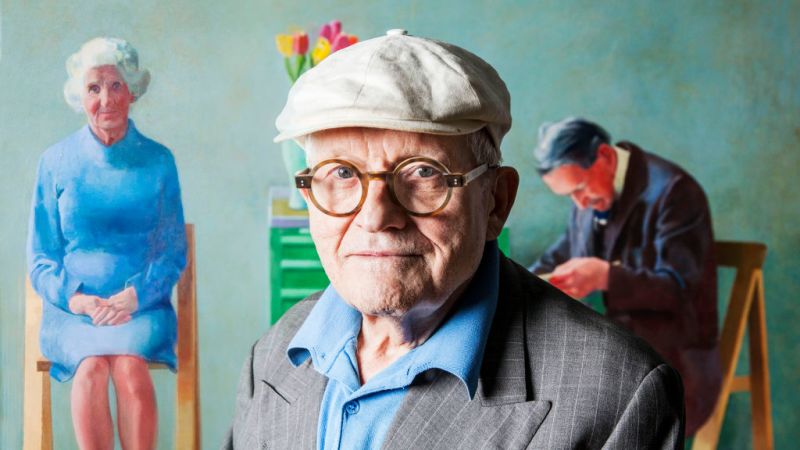
Hockney’s physical presence was as distinctive as his work. His signature look—marked by a mop of blond (or gray) hair, oversized glasses, and a cigarette in hand—became as recognizable as his art. This image, often seen in media and public appearances, encapsulated his charismatic and unpretentious persona.
During his lifetime, Hockney was the subject of several major retrospectives, including a 2017 exhibition that traveled to Tate Britain, the Pompidou Centre in Paris, and the Metropolitan Museum of Art in New York. These exhibitions celebrated his ability to blend personal experience with universal themes, ensuring that his contributions to art would be widely acknowledged.
His death marks the end of an era, but his work continues to inspire. From his early days as a student in Bradford to his later digital creations, Hockney’s art remains a testament to his vision, energy, and enduring creativity. As the world mourns his passing, it also celebrates the legacy of a man who saw art not as a commodity, but as a means of connection and expression.