Spain’s Homage to 2010: A Perfect World Cup Finale
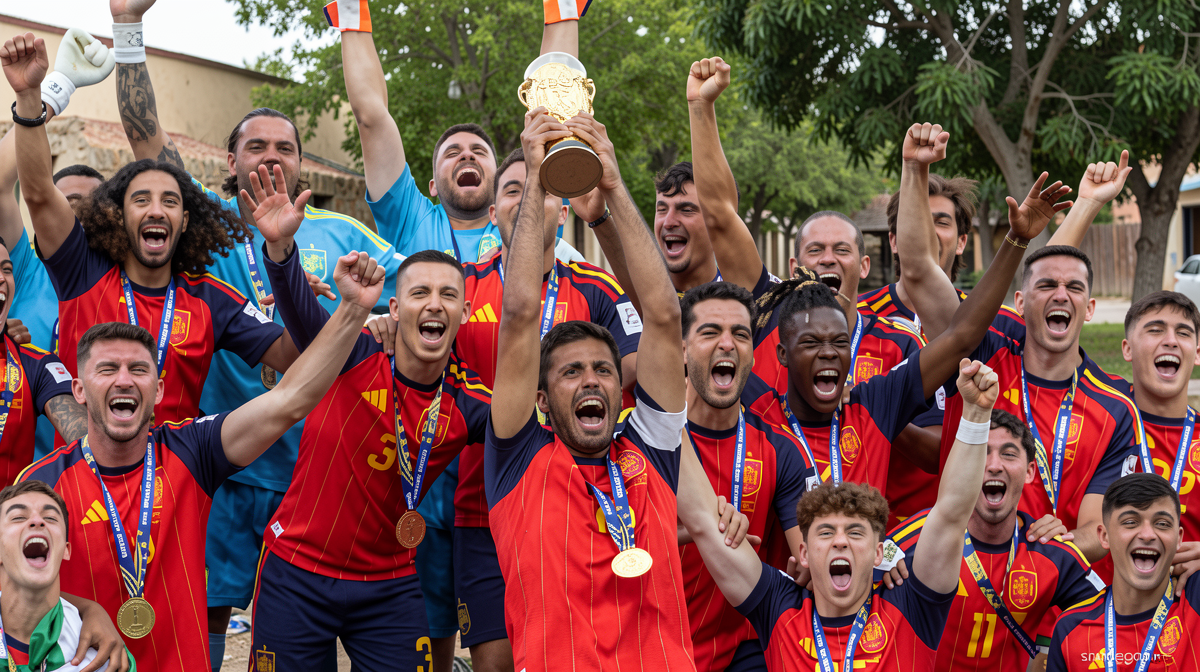
Sandego.net – Why Spain s homage to 2010 resonated so deeply became clear when the referee’s whistle ended the 2026 final. The 1-0 extra-time victory over Argentina transported fans to another legendary moment in football. This triumph mirrored Spain’s maiden World Cup win in 2010 in remarkable ways. Both finals showcased elegant, controlling football that mesmerized viewers worldwide. Argentina’s physical approach in each encounter sought to disrupt Spain’s fluid style. Despite similar officiating debates, La Roja claimed dramatic victories both times.
Emotional Connections Across Decades
Both victories carried powerful emotional significance through tributes to those lost too soon. The 2010 championship honored Dani Jarque, the Espanyol midfielder who died of a heart attack at twenty-six in 2009. The 2026 celebration remembered María Caamaño, a passionate Spanish fan who passed from Ewing’s sarcoma on April 16 at thirteen years old. These remembrances added extraordinary depth to Spain’s latest title.
“The parallels between 2010 and 2026 proved remarkably striking, uniting generations of Spanish football fans.”
Two fundamental truths connect these tournaments clearly. Both Spanish teams achieved world championship status through an unmistakable identity. The 2026 squad represents the natural evolution of the side that won the 2024 European Championship, which itself grew from the golden period between 2008 and 2012.
Tactical Adaptation Under Pressure
The 2024 European champions depended on dynamic wing play behind a commanding midfield for their fourth continental crown. Expectations were high that this formula would succeed in North America. However, devastating hamstring injuries to Lamine Yamal and Nico Williams during domestic campaigns removed that explosive attacking dimension. This setback led to one of the tournament’s most unexpected outcomes—a draw against Cape Verde.
Manager Luis de la Fuente showed remarkable faith in his adaptability. He trusted he could integrate alternative players seamlessly, similar to his work with midfield talents including Fabián Ruiz, Pedri, and Dani Olmo. Most importantly, he understood that Spain’s essence came from midfield mastery rather than wing play. De la Fuente adopted a more traditional tiki-taka approach, emphasizing strong defensive structure advancing into attack.
Defensive Excellence Defines Campaign
While Yamal eventually returned to full fitness and Williams made impactful substitute appearances, the real transformation happened in Spain’s defensive solidity. The team conceded just one goal throughout the entire expanded tournament, setting a new record. Aymeric Laporte, Pau Cubarsí—who won Young Player of the Tournament honors—Pedro Porro, and Marc Cucurella formed an impenetrable unit operating with remarkable harmony. They gave Unai Simón, who remained steadfast between the posts despite occasional nervous moments, exceptional protection.
Rodri’s comeback, performing at Ballon d’Or level, proved arguably decisive. The Manchester City midfielder controlled Spain’s possession-based approach and rightfully earned the 2026 World Cup Golden Ball as the tournament’s outstanding player. His logic was straightforward: opponents struggle to score when they rarely possess the ball.
Spain’s superiority permeated every aspect of the final. After initially shaky opening minutes caused by nervous energy, La Roja gradually asserted control. What began as comfortable possession evolved into complete dominance, culminating in absolute authority after halftime. The statistics told the story clearly: Spain recorded two shots on target with 65 percent possession in the first half, then produced eight shots on target while maintaining 68 percent possession in the second half.
Argentina, typically known for their physical approach that unsettles opponents, found themselves on the receiving end of their own tactics. Frustrated by Spain’s possession game, Argentine players launched aggressive tackles that eventually resulted in Enzo Fernández receiving the tournament’s first red card during extra-time. Despite finishing with ten men for the closing minutes, Argentina could not find an equalizer.