
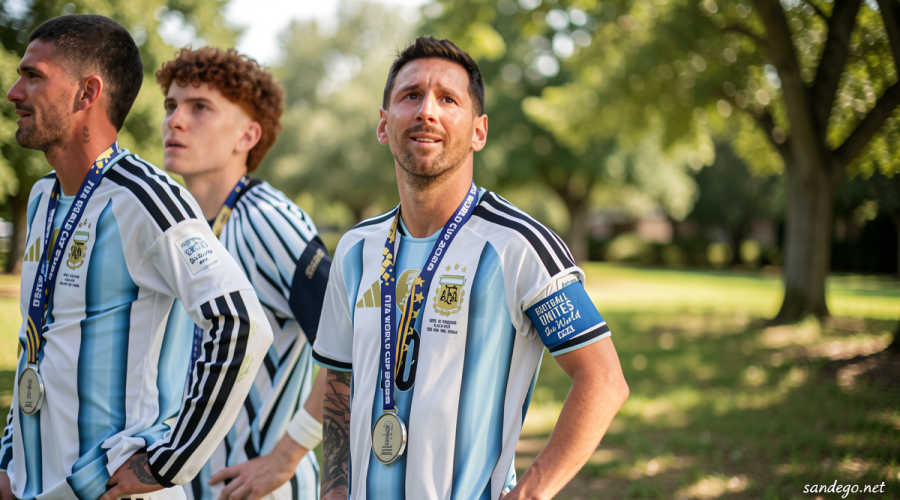
The Boy from Rosario Who Chose a Jersey Over a Trophy
Sandego.net – When the final whistle sounded and the World Cup trophy slipped through his fingers once more, the stadium erupted into a storm of red. Teammates collided in embraces that blurred the line between celebration and grief. Fans in the stands — thousands of them, packed shoulder to shoulder — sang songs of gratitude even as their hearts broke. Somewhere in that cacophony of triumph and heartbreak, one man stood motionless, eyes locked on the section of the crowd where his fellow Argentines had gathered. He was not angry. He was memorizing. Every note, every shout, every tremor of emotion was being filed away for the thousands of nights ahead when he would replay this single evening in his mind.
Lionel Messi had just lost the World Cup Final. But the tears that followed were not solely about the scoreline. They were about something far older and far more personal: the knowledge that this would be his last appearance in the sky-blue-and-white shirt of the Argentine national team.
An Immigrant’s Unbreakable Thread
What makes Messi’s story resonate far beyond the pitch is its quiet parallel to millions of families who cross borders every year in search of survival, opportunity, or simply a future that feels possible. He left Rosario at thirteen, a child uprooted from the only geography he had ever known, and carried his talent into the youth academy of FC Barcelona. The economic realities of Argentina — and of much of Latin America — often leave the airport as the only practical exit. Messi’s departure was not a choice made from comfort; it was a necessity shaped by a medical crisis his family could not finance.
As a young boy, he had been diagnosed with a growth hormone deficiency. The treatment was expensive. His local club in Rosario declined to cover the cost. Barcelona intervened, absorbing the medical expenses and offering him a home, a career, and a second country. In exchange, the club received a player who would go on to become, by most measures, the greatest footballer ever to wear a professional shirt.
Yet the boy never stopped being Argentine. In interviews from his earliest years, he spoke plainly about one ambition: representing his homeland. The Argentine Football Association, sensing the fragility of that attachment, moved quickly. They arranged a friendly match specifically to give him his debut in the under-20 squad, effectively locking him into the national-team pipeline before any rival federation could make a competing claim. That debut arrived on June 29, 2004, mere days after his seventeenth birthday.
The Debut That Wasn’t
Argentine supporters waited another year for the senior call-up. When it finally came — August 17, 2005, in a friendly against Hungary — the moment was almost cruelly brief. Messi entered the match nineteen minutes into the second half and was sent off seconds later, a red card that seemed to foreshadow the turbulence ahead. His path to international glory would be anything but straightforward.
The comparison to Diego Maradona was unavoidable and, in many ways, unfair. Messi was left-footed, wore the number ten, and possessed a flair that triggered the same electric reactions in Argentine crowds. The weight of that association sat on his shoulders from the start, layered atop a national identity that had been searching, for decades, for a successor to restore its footballing prestige.
Enduring the Fire
While he collected virtually every available trophy at Barcelona, the senior national team remained stubbornly out of reach. Back home, the criticism was relentless and personal. His devotion to the jersey was interrogated. His body language was dissected. Before matches, commentators fixated on whether he sang the national anthem with sufficient fervor. All of this was directed at a man who could have chosen an easier, more forgiving path elsewhere in the world — a path that, statistically, might have yielded three or four World Cup titles under a different flag.
He stayed. He endured the scrutiny with a composure that bordered on the stoic, setting a standard of conduct that transcended his own performances.
Rock Bottom and the Long Road Back
Brazil 2014 represented the nadir. Argentina reached the World Cup Final after twenty-four years of absence from that stage, only to be dismantled by Germany. Two consecutive Copa América finals followed, both lost to Chile. The cumulative toll was devastating. Messi broke publicly, announcing his retirement from international football with words that carried the exhaustion of a decade:
“I’ve now lost four finals… My time with the national team is over. Four finals. It’s not for me. Unfortunately, I tried. It was what I wanted most.”
He did, in fact, come back. And eventually, after years of rebuilding, leadership, and quiet persistence, the trophy arrived. But the journey to that moment — the years of doubt, the weight of expectation, the immigrant’s constant negotiation between two homelands — is what gives the story its enduring power.
Messi’s final chapter in the Argentine jersey was not a story of failure. It was the story of a child from Rosario who crossed an ocean for a medical treatment, who could have worn any flag in the world, and who chose, again and again, the one that made him weep. That choice, repeated over two decades, is the thing that separates a great athlete from a symbol. It is the reason his name will outlast every statistic, every record, every matchday headline. It is the reason the immigrant’s story, told through the lens of football, still moves millions who have never seen him play.
Related Reading
Frequently Asked Questions
What is Messi the immigrant who never forgot?
Messi the immigrant who never forgot is the main topic of this guide. The article explains the context, practical details, and next steps readers should understand.
Why does Messi the immigrant who never forgot matter?
Messi the immigrant who never forgot matters because readers are looking for a useful answer, not just a short summary. Good content should match search intent and help them decide what to do next.