The Trionda Ball’s Technological Debut: A Game-Changing Decision in the World Cup
How the new World Cup ball – In a moment that has ignited fierce debate among football fans, the VAR decision in Croatia’s World Cup clash against Portugal has sparked intense discussion, with some calling it the most pivotal call in the tournament’s history. The outcome, which saw Croatia eliminated in the Round of 32, hinged on a seemingly minor technicality involving the new Trionda ball. This innovation, embedded with advanced sensors, has already become a focal point of controversy and admiration in the world of soccer.
A Last-Minute Goal That Wasn’t
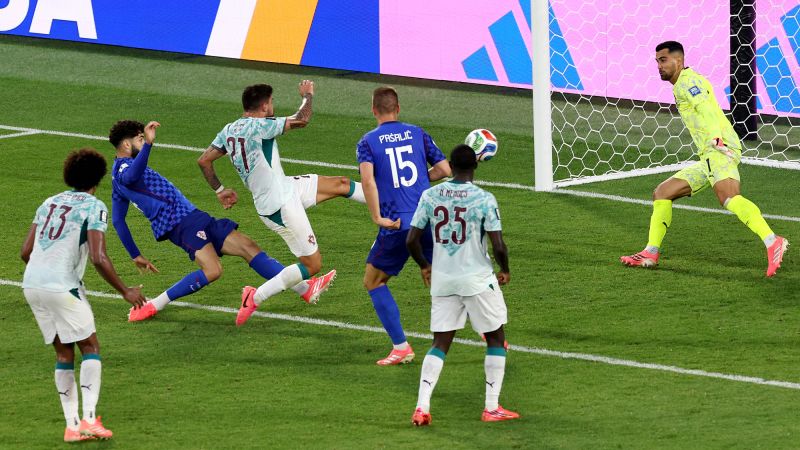
The dramatic turn of events unfolded in the 103rd minute of the match, when Croatia’s Joško Gvardiol appeared to score an equalizer. The goal, which would have sent the game into extra time, was met with jubilant celebrations by the Vatreni team and their supporters. However, just as the moment seemed to solidify Croatia’s hopes, the referee signaled for a review. The video assistant referee (VAR) swiftly intervened, revealing that the goal had been disallowed due to an offside infraction.
The offside call was based on a subtle interaction involving Mario Pašalić. As the ball was passed to Gvardiol, Pašalić was positioned just beyond the touchline. A cross from the wing had nudged the ball toward him, and at first glance, Pašalić was onside. But the key detail lay in the journey of the ball. Before reaching Pašalić, the ball made a slight contact with Igor Matanović’s head—a touch so minuscule that it was nearly imperceptible to the naked eye. This tiny interaction, undetected by human observers, triggered the offside ruling, effectively ending Croatia’s tournament dreams.
The technology at play was a game-changer. FIFA’s Trionda ball, introduced this year, is equipped with sensors that detect every touch, no matter how subtle. These sensors transmit data in real time to VAR officials, providing them with precise information to challenge calls. The system, which displays a “heartbeat graphic” on broadcasts, allows referees to analyze minute details that might otherwise go unnoticed. This innovation has drawn both praise and criticism, particularly for its ability to alter the flow of games with its exacting standards.
The Human Element vs. Machine Precision
While the Trionda ball’s sensors were instrumental in this decision, the human element of the game remains a critical component. The goal’s validity hinged on a single, almost imperceptible brush between the ball and Matanović. In previous World Cups, such a touch might have been overlooked, allowing the goal to stand. But this year, the technology ensured that even the smallest movements were captured and analyzed. This precision has made VAR decisions more objective, though not without controversy.
FIFA’s governing body swiftly addressed the incident, affirming that Matanović’s contact had been “proven” and that the offside call was accurate. The statement highlighted the Trionda ball’s ability to detect even the faintest interactions, a feature that has been both praised and scrutinized. Critics argue that the ball’s unnatural movement can create confusion, but supporters claim it enhances fairness by eliminating subjective judgment. The outcome of this match has undeniably brought the Trionda ball’s capabilities into sharp focus.
A New Era of Decision-Making
The use of the Trionda ball in this game marks a significant step forward in the integration of technology into soccer. Unlike the NBA, which has begun testing similar sensor-equipped balls in its summer leagues, soccer has been slower to adopt such tools. However, FIFA’s commitment to innovation is evident, as the Trionda ball’s sensors are now playing a central role in determining game-changing moments. The system’s ability to capture every touch and display it in real time has set a new standard for accuracy in officiating.
Despite its advantages, the technology has not been without its challenges. The incident in question was a perfect example of how even the most minor actions can be scrutinized under this system. For Croatia, the loss was not just a result of a goal being disallowed but of a shift in the game’s dynamics. The players and fans, who had spent weeks preparing for the Round of 32, were left grappling with the implications of a decision that felt both fair and frustrating.
Reactions from the Field
Croatia manager Zlatko Dalić expressed his discontent with the VAR call, arguing that it had eroded the emotional essence of the game. “It kills the emotions. It kills everything within you,” he said, per TNT Sports. Dalić’s frustration was palpable, as the decision forced his team to confront a reality where technology could override the instinctive, passionate moments that define football. His comments resonated with many Croatian fans, who had thrown bottles onto the pitch in protest, causing delays in the game’s restart.
On the other hand, Portugal manager Roberto Martínez took a more measured approach. “The message is very clear,” he stated after the match. “The balls now have a chip, and it’s very clear that’s why the VAR intervened. It’s not a subjective opinion.” Martínez’s perspective underscores the growing acceptance of technology as a tool for fairness, even if it comes at the cost of some spontaneity. His team’s ability to capitalize on the decision has highlighted the ball’s potential to reshape how matches are officiated.
The incident also raised broader questions about the role of technology in soccer. While the Trionda ball’s sensors have been hailed as a breakthrough, some fans and analysts remain skeptical. The debate over whether this level of precision enhances the game or detracts from its human element is ongoing. For Croatia, the outcome is a reminder of the fine line between technological accuracy and the emotional stakes of competition. For Portugal, it’s a testament to the effectiveness of the new system in making critical decisions.
Looking Ahead: The Future of VAR and the Trionda Ball
This decision has set a precedent for future matches, showcasing the Trionda ball’s ability to influence outcomes with its meticulous detection. The technology’s impact is not limited to this single game; it’s a harbinger of how VAR systems will continue to evolve. As FIFA integrates more advanced tools, the focus will shift toward balancing precision with the integrity of the game’s spirit. For now, the Trionda ball has proven its worth, even if it’s not without its detractors.
The introduction of the Trionda ball has also sparked a conversation about the broader implications of technological advancements in sports. While the NBA is already testing similar innovations, soccer’s adoption of such systems has been more cautious. This match, however, has demonstrated that the Trionda ball can be a decisive factor in high-stakes games. As the tournament progresses, the question remains: will this technology be embraced as a necessary evolution, or will it continue to divide opinion? One thing is certain—the Trionda ball has already left an indelible mark on World Cup history.