US Army attack helicopters crashing at a record pace
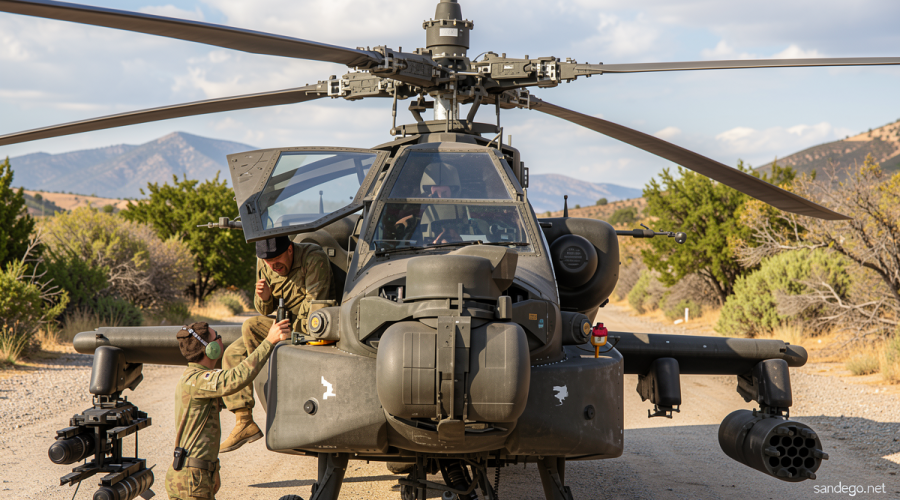
Sandego.net – The US Army attack helicopters crashing problem has escalated sharply this fiscal year, with five major Apache accidents logged since October and a fatal incident in Texas that killed two soldiers and ignited a wildfire. The Army briefly grounded routine Apache training flights after that mishap, though the pause — which exempted units deployed to the Middle East — was lifted on Wednesday. At the current pace, fiscal year 2026 is tracking toward the second-worst stretch of Apache flight accidents since the E-model AH-64 entered service in 2011.
In Army terminology, a Class A mishap denotes any accident that kills or permanently disables a service member, destroys an aircraft, or inflicts at least $2.5 million in damage. CNN’s review of publicly released accident data, combined with flight-hour estimates supplied by an Army safety spokesperson, places this year’s major-crash rate at roughly 6.24 per 100,000 flying hours — a figure that rivals the service’s worst recorded year, fiscal 2024, when nine such incidents occurred.
“We express our deep sadness over the we loss of the two Soldiers near Fort Hood,” said Maj. Montrell Russell, an Army spokesperson, in a statement to CNN.
Transmission failures and the grounding of a tenth of the fleet
The mechanical heart of the crisis is the Apache’s transmission, a component whose failure can simultaneously disable the tail rotor, electrical power, and hydraulic systems. Losing those systems can throw the helicopter into a sudden spin and strip pilots of flight controls. Two internal safety messages obtained by CNN — one issued in April, a follow-up in mid-July — identified a combined total of 80 potentially faulty transmissions and ordered affected aircraft grounded pending repair. Together, those directives touched roughly one-tenth of the Army’s attack helicopter fleet.
The April message, first reported by trade publication Defense One, listed 70 suspect units. The mid-July update added 10 more and reiterated that the root cause remained “under investigation.” An early-June Army official told CNN that every affected Apache was still on the ground; the service did not respond to follow-up questions about whether any have since returned to flight. An August 14 internal order formally cited both safety messages as references for the post-Texas-crash training pause, though Russell cautioned that “including these messages in safety reviews does not imply causation for any individual mishap.”
The July issue of the Army’s official flight-safety newsletter attributed just over half of this year’s Apache incidents — including lesser ones — primarily to human error. It noted that “a catastrophic transmission failure was noted in one Class A mishap,” but did not specify how many of the most severe crashes trace back to equipment problems. By comparison, Army leaders in fiscal 2024 blamed that year’s spike on diminished pilot experience and a surge in training intensity and complexity following Russia’s invasion of Ukraine.
Through August 15, the Apache fleet had logged approximately 80,171 hours this fiscal year, combining 42,971 hours reported through March 31 in an internal safety newsletter with an Army-provided estimate of roughly 37,200 additional hours. Fiscal 2024, for reference, carried a major-crash rate of 7.02 per 100,000 hours for the same aircraft type.
Frequently asked questions
How many major Apache crashes have occurred in fiscal year 2026? Five Class A mishaps have been recorded so far, putting the year on pace for the second-worst Apache accident stretch since 2011.
What caused the Texas crash? The Army has not released preliminary findings. Maj. Montrell Russell cited “special controls and release protections” that prevent disclosure of detailed technical aviation information.
How many helicopters were grounded over transmission concerns? The two safety messages combined to affect roughly one-tenth of the Army’s attack helicopter fleet. As of early June, all affected Apaches remained grounded, and the Army has not confirmed any return to flight.
Is the US Army attack helicopters crashing trend linked to pilot error or mechanical failure? The July safety newsletter attributed just over half of all incidents to human error while flagging at least one catastrophic transmission failure in a Class A event. The root cause of the broader transmission problem was still “under investigation” as of mid-July.