Two Fronts, One Doctrine: How Trump’s Power Calculus Collides With Reality
Sandego.net – Within the span of a single week, the United States found itself locked in simultaneous confrontations with one of its oldest democratic partners and one of its most entrenched adversaries. On Monday, Treasury Secretary Scott Bessent unveiled what he called an “economic onslaught” aimed at severing Iran’s remaining threads of global financial connectivity. Hours later, President Donald Trump took to social media to remind Ottawa that American economic gravity dwarfs Canada’s, and that its leaders ought to “fall in line.” The juxtaposition is almost surreal: a G7 nation and a Middle Eastern theocracy, both now engaged in forms of economic warfare with Washington, both operating under the assumption that the United States will ultimately prevail through sheer scale.
The Ideological Engine
The logic driving these twin campaigns is not accidental. It is the explicit architecture of a presidency that has discarded the post–Cold War consensus on multilateral engagement. In January, senior White House aide Stephen Miller articulated the governing philosophy to CNN’s Jake Tapper, describing a world shaped by “iron laws” that are “governed by strength, that is governed by force, that is governed by power.” That formulation has since become the operating manual for a foreign policy that treats every bilateral relationship as a contest of wills rather than a negotiation of interests.
What makes the current moment distinctive is that the doctrine is being stress-tested on two axes at once. Iran has endured six months of American military pressure in a conflict Trump initiated but has yet to conclude. Canada, meanwhile, has watched its Prime Minister Mark Carney formally suspend trade negotiations with Washington and publicly declare that the United States under Trump “has changed.” Carney told his own parliament on Saturday that the president was deploying “economic integration as a weapon” — language that would have been unthinkable from a North American ally just a few years ago.
The Iran Gambit
Bessent’s Monday announcement framed the new sanctions push as a financial equivalent of the Normandy landings, invoking D-Day as the moment that reversed the trajectory of World War II. The comparison drew immediate criticism. Allied commander General Dwight Eisenhower did not spend days previewing an invasion only to follow through with open-ended threats and no operational timetable. The analogy, critics noted, also sat uneasily beside the enormous human cost American soldiers paid to liberate Western Europe.
Still, the underlying economic logic has genuine force. Max Meizlish, a former senior Treasury official, appeared on CNN News Central Monday to argue that a truly coordinated global effort to choke off Iranian financial channels could inflict severe damage on an economy already battered by years of isolation. He singled out Bank Melli, the state-controlled Iranian commercial bank with branches in France, Germany, and other jurisdictions, describing it as a critical gear in Tehran’s sanctions-evasion machinery.
“It can work if we can get the buy-in of our partners,” Meizlish said, specifically referring to Bank Melli, an Iranian commercial bank controlled by the government that operates in France, Germany and elsewhere and is a cog in Iran’s efforts to evade sanctions.
Kenneth Rogoff, former chief economist of the International Monetary Fund and now a chair at Harvard University, offered a more measured assessment to CNN’s Richard Quest:
“Fundamentally, sanctions work if you can get most of the world behind you. But if they’re not, it’s very hard.”
That caveat carries weight. The Trump administration has spent the past year alienating traditional allies through a war many observers consider both unwise and lacking clear legal authorization. The willingness of European and Asian partners to enforce secondary sanctions on their own banks is therefore uncertain. Moreover, Washington has historically overread internal Iranian political signals — treating factional disputes between pragmatists and hardliners as precursors to regime collapse, only to find the system reconstituting itself.
One conspicuous omission from Monday’s package was any immediate action against the Chinese banks that facilitate Beijing’s purchases of discounted Iranian crude. China has already stated it will defend its commercial interests, and the absence of pressure on those channels undercuts the claim that the campaign is truly global.
The Canadian Dimension
On the western front, the stakes are different but the rhetorical posture identical. Trump posted on social media that “The U.S.A. will always be far bigger, richer, and stronger than Canada,” before adding: “Someone should get these clowns to ‘fall in line.'” The administration’s stated objective is a lopsided trade agreement that would tilt the bilateral balance decisively toward American exporters.
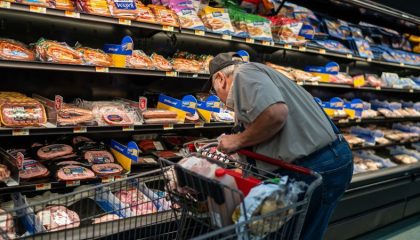
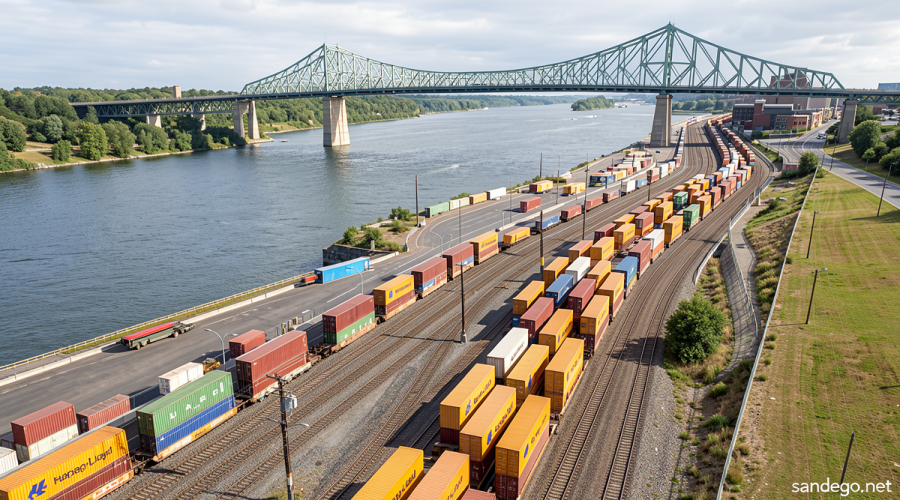
Yet the mechanics of enforcement remain unclear. A prolonged tariff war with Ottawa — the United States’ largest trading partner by volume — risks pushing energy and food prices higher for American households at precisely the moment some investors are already nervous about a potential bond-market stress event. Retaliation from third-party nations caught in the crossfire of Iran sanctions could compound those pressures.
The Lame-Duck Question
Analysts who track the president’s pattern of escalation followed by retreat have coined the acronym TACOs — “Trump always chickens out” — to describe episodes in which maximalist threats dissolve once the economic feedback loop becomes visible. If Monday’s posturing follows that script, the administration will have spent credibility it cannot recover before the November midterm elections, when Congress may shift control and the president’s remaining leverage over foreign policy will narrow considerably.
The deeper question is whether a doctrine built on the premise of unchallengeable dominance can survive contact with two sovereign states that have decided, for now, to test its limits. The answer, as of this writing, remains unresolved — and the cost of finding out is being paid by consumers, markets, and the diplomatic architecture that took decades to construct.
Related Reading
Frequently Asked Questions
What is Trump s theory of global power?
Trump s theory of global power is the main topic of this guide. The article explains the context, practical details, and next steps readers should understand.
Why does Trump s theory of global power matter?
Trump s theory of global power matters because readers are looking for a useful answer, not just a short summary. Good content should match search intent and help them decide what to do next.