
Trump is cutting the numbers of US troops in Europe. Here’s how
Trump is cutting the numbers of US troops in Europe. Here’s how
Trump is cutting the numbers of US – Defense Secretary Pete Hegseth made a sudden decision this week to halt two US military deployments to Europe and reassign other personnel from the region, according to two defense officials. These actions mark a shift in the Pentagon’s strategy, aimed at reducing troop presence in Europe amid growing tensions between President Donald Trump and European allies. The move comes as Trump continues to criticize NATO members for their lack of commitment to collective defense efforts, particularly during the ongoing conflict with Iran.
Key Deployments Cancelled
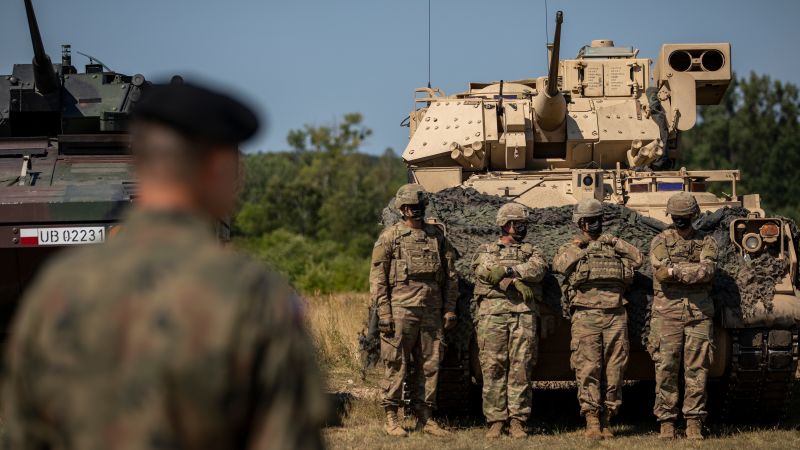
The officials confirmed that Hegseth issued a memo abruptly halting the scheduled deployment of the 2nd Armored Brigade Combat Team from the 1st Cavalry Division. This unit was set to rotate through Poland and other Eastern European nations, including the Baltic states and Romania. Some members of the brigade were already stationed in Europe and will now be redeployed back to the United States. The memo also canceled a future deployment of a specialized battalion in long-range rocket and missile capabilities, which was expected to move to Germany later this year.
Additionally, the defense officials noted that a command responsible for overseeing these missile capabilities in Europe has been directed to relocate. This change is part of a broader effort to streamline military operations and adjust force posture in response to Trump’s frustrations with European nations. The decision reflects a shift in priorities, with the administration seeking to reduce its footprint while maintaining strategic readiness.
Triggering Events and Rhetoric
The troop reductions follow Trump’s recent criticism of German Chancellor Friedrich Merz. Merz had accused the US of being “humiliated” by Iran’s actions, which Trump has used as a justification to question Germany’s contributions to NATO. This rhetoric has intensified calls for the US to reduce its reliance on European allies, particularly after the Pentagon announced on May 1 that it would withdraw approximately 5,000 troops from Germany following a comprehensive review of its European force structure.
While the exact number of troops affected by the deployment cancellations remains unclear, officials estimate that around 4,700 soldiers from the 2nd Armored Brigade Combat Team and over 500 from the long-range missile battalion will be impacted. As of 2025, the Council on Foreign Relations reported that there were roughly 38,000 US troops stationed in Germany and an estimated 80,000 in Europe overall. The Pentagon’s decision to scale back troop numbers has raised questions about its long-term implications for regional security.
Defense Department’s Messaging
Official statements from the Defense Department tie the troop level changes to dissatisfaction with European allies, especially Germany. A prepared talking point reviewed by CNN states that “European nations have not stepped up when America needed them,” and that “recent Germany rhetoric has been inappropriate and unhelpful.” These remarks suggest the administration believes that European countries should take a more active role in shouldering the responsibility for Europe’s defense.
The talking points also claim the decision will “help restore readiness” and send a clear message to allies about the importance of self-reliance in military operations. “The President is rightly reacting to these counterproductive remarks,” the document asserts. However, critics argue that the move could undermine NATO unity and signal a lack of commitment to collective security. The Defense Department declined to provide further details about the deployment cancellations or the underlying rationale, leaving room for speculation about the broader implications of the strategy.
Reactions from Capitol Hill
The announcement of the troop reductions has sparked concern among lawmakers. Republican leaders on the House and Senate Armed Services committees expressed “very concerned” reactions to the plan, highlighting its potential impact on US military operations in Europe. In a joint statement released on May 2, Sen. Roger Wicker and Rep. Mike Rogers noted that Germany had increased its defense spending and provided logistical support to US forces during the Russia-Ukraine conflict. “Germany has stepped up in response to President Trump’s call for greater burden sharing,” they said, adding that the withdrawal “sends the wrong message” to key adversaries like Vladimir Putin and China.
Democratic Sen. Jeanne Shaheen, a member of the Senate Armed Services Committee, voiced surprise at the cancellation of the deployment to Poland. “As far as I know, we weren’t notified about it,” she told reporters. Shaheen criticized the abrupt change, calling it “very short-sighted” and warning that it could weaken the US’s ability to project power in Europe. Her comments underscore the debate over whether the troop reductions are a temporary adjustment or a more permanent shift in strategic posture.
Legal and Strategic Context
The 2026 Pentagon funding bill mandates that the US military cannot have fewer than 76,000 troops permanently stationed or deployed to Europe for over 45 days without providing detailed notifications to Congress. This requirement adds a layer of complexity to the current reductions, as the administration seeks to balance its commitment to maintaining a robust force presence with the need to respond to domestic and international pressures. The cancellation of the 2nd Armored Brigade’s rotations may serve as a way to bypass some of these legal constraints while still achieving a reduction in troop numbers.
According to the prepared talking points, the Biden administration had previously surged US brigade combat teams into Europe to support operations against Russia. These forces were initially deployed on a temporary basis, but the current moves suggest a lasting realignment. The 3rd Battalion, 12th Field Artillery Regiment, which focuses on long-range missile capabilities, was set to be stationed in Germany in the years ahead. Its removal now raises concerns about the continuity of critical defense assets in the region.
While the immediate effects of the troop cuts remain uncertain, the actions have set the stage for a more sustained reduction in US military involvement. This shift could reshape the balance of power in Europe, with implications for NATO’s collective defense posture and the US’s ability to respond to emerging threats. As the administration continues to adjust its strategy, the responses from European allies and lawmakers will play a crucial role in determining the future of the US military presence in the region.
“Germany has stepped up in response to President Trump’s call for greater burden sharing, significantly increasing defense spending and providing seamless access, basing, and overflight for US forces in support of Operation Epic Fury,” Sen. Roger Wicker and Rep. Mike Rogers said in a joint statement on May 2.
“It is, I think, very short sighted,” Jeanne Shaheen said. “It sends the wrong message — wrong message to Vladimir Putin, wrong message to China, wrong message to”
