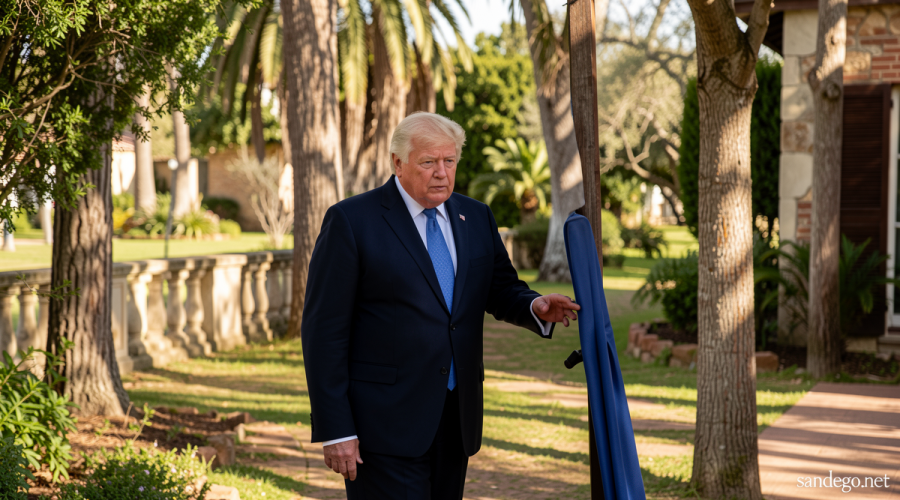
With Midterm Losses Looming, Trump Points the Finger at His Own Party
Sandego.net – As the November 2026 congressional elections draw closer, President Donald Trump has begun a familiar ritual: pre-emptively assigning blame before the votes are even counted. Over the past several weeks, the president has made increasingly pointed suggestions that if congressional Republicans suffer a significant defeat, the fault will rest squarely with their own shoulders — not his. The framing is transparent. The political stakes, however, are anything but.
Trump’s relationship with electoral defeat has long been strained. He has repeatedly invoked unsubstantiated claims of widespread voter fraud to explain past losses. Now, facing what many analysts see as a genuinely unfavorable environment for his party, he appears to be cultivating a new narrative: that the GOP’s own legislative inaction, rather than his personal unpopularity, will be the decisive factor in November.
A Month-Old Warning, Resurrected for Maximum Effect
The latest salvo came Wednesday, when Trump re-shared a social media post originally published roughly four weeks earlier by Matt Van Swol, a vocal supporter. Van Swol’s original message warned that Republicans were
“sleepwalking toward a midterm reckoning they don’t see coming.”
He went further, placing responsibility directly on lawmakers:
“If Republicans in Congress don’t start producing tangible results, they’re going to discover that frustration has consequences.”
Trump followed the re-share with a lengthy post cataloguing what he described as his own accomplishments, then capped the sequence with an image declaring “mission accomplished” in connection with the Iran conflict. The subtext required little interpretation: the president had delivered, while his party had failed to deliver alongside him.
The White House Pushes Back — Quietly
Asked Thursday whether the president was effectively washing his hands of congressional Republicans, White House press secretary Karoline Leavitt offered a measured rebuttal:
“The president is wholeheartedly committed to helping Republicans across the board retain the majority.”
The statement, however, sat uneasily beside Trump’s own words from earlier in the month. In an interview with Punchbowl News, he went further than most presidents typically do in distancing themselves from their party’s electoral fate:
“The question is, will (people) vote? Because a lot of them are very angry at Republicans, to be honest with you.”
He continued:
“They’re angry at Republicans, but they’re not angry at me.”
The claim sits in sharp tension with polling data. In the CNN Poll of Polls, 63 percent of Americans express disapproval of Trump. Across most high-quality surveys, fewer than one in five Americans say they “strongly” approve of him. The gap between the president’s self-assessment and what voters actually report is, by any measure, substantial.
The Filibuster Gambit and the Save America Act
Trump’s blame architecture was laid well before the summer. Earlier in the year, he pressed Senate Republicans to eliminate the filibuster and enact his elections legislation, the so-called “Save America Act.” He repeatedly asserted that passage would effectively lock Democrats out of future electoral victories, while failure to act could cost the GOP dearly.
At Mount Rushmore on July 3, he framed the midterm outcome as entirely within the party’s control:
“We can only lose the midterms if we allow ourselves to lose the midterms – if we are foolish, stupid, and unwise.”
Days later, he warned:
“If they don’t get it done, it’s going to be a very bad thing for the party.”
On July 29, speaking about the midterms, he added:
“If we don’t (have unanimous GOP support), people should look at those Republicans.”
Thune in the Crosshairs
Throughout July, Trump singled out Senate Majority Leader John Thune with particular frequency, in messaging that suggested he was positioning the South Dakota senator as the designated scapegoat for any failure to abolish the filibuster. One social media post read:
“Remember, stupidity always brings LOSING & DEATH!”
The tone was unmistakable. If the legislation stalled, Thune — and by extension the Senate GOP leadership — would be the face of the failure.
Making the Midterms About Himself
In recent days, Trump has urged voters to “pretend” he is personally on the ballot this fall and to cast their votes accordingly. He is also staging a Trump-centric midterm convention next month, an event that has generated considerable anxiety among congressional Republicans. According to reporting from The Atlantic, his super PAC is heavily featuring the president himself in campaign advertisements aimed at down-ballot races.
The strategy exposes a structural vulnerability in the GOP coalition. Trump-aligned voters turn out at markedly lower rates when the president is not personally on the ballot. With his approval ratings depressed, party strategists acknowledge there is little margin to attract swing voters. Their best path to victory, sources have indicated, is to maximize turnout among the MAGA base — precisely the voters most likely to be mobilized by a convention and ad campaign centered on the president himself.
The Intraparty Fracture Line
The broader implication is a collision course within the Republican Party at its most vulnerable moment. If the GOP loses control of either chamber in November, Trump’s pre-emptive blame assignment will transform a normal post-election reckoning into a factional war. The party will be licking its wounds, debating whether to continue down the Trump-era path or chart a different course, while simultaneously being told by its most powerful figure that the wound was self-inflicted.
Congressional Republicans could certainly have insulated themselves better from the president’s excesses, pushed back harder on his legislative demands, or built broader coalitions beyond the MAGA base. Those are fair criticisms. But the arithmetic of voter sentiment suggests the lion’s share of electoral risk in 2026 attaches to the president’s own name, not to the legislative record of his party. Whether Trump accepts that arithmetic — or whether he prefers the scapegoat narrative — will shape not just the post-election landscape but the future architecture of the Republican Party itself.
Related Reading
Frequently Asked Questions
What is Trump has already found someone to blame?
Trump has already found someone to blame is the main topic of this guide. The article explains the context, practical details, and next steps readers should understand.
Why does Trump has already found someone to blame matter?
Trump has already found someone to blame matters because readers are looking for a useful answer, not just a short summary. Good content should match search intent and help them decide what to do next.