Trump Backs Irish Reunification During Ireland Visit
Sandego.net – President Trump says Irish reunification “would be a fantastic thing,” offering his view during a Saturday visit to Ireland. Speaking alongside Taoiseach Micheál Martin in Dublin, Trump said he would welcome a united Ireland while acknowledging that any constitutional change would involve the United Kingdom.
Northern Ireland is part of the United Kingdom, while the Republic of Ireland is an independent state. Its future remains one of the most sensitive political questions on the island, shaped by history, identity and the peace process.
“Well, I don’t want to cause any trouble. But I will tell you, I’d love to see it unified.”
Trump said reunification could be “a great feather in everybody’s cap” and suggested it would happen eventually. He also told Martin that he believed the Irish leader could help move the issue forward.
“But yeah, I think it would be a fantastic thing. Now the UK will have something to say about obviously, but I think it would be a great thing. I mean, how can it be bad?”
How Irish reunification could be decided
The Good Friday Agreement, the US-brokered 1997 peace accord, sets out the process for any change in Northern Ireland’s constitutional status. The agreement helped end decades of sectarian violence and political instability known as the Troubles.
A future border poll could take place under the agreement, but reunification would require majority support in separate votes in Northern Ireland and the Republic of Ireland. That means leaders in Dublin, London and Washington cannot decide the question on their own.
Unionists generally support Northern Ireland remaining in the United Kingdom, while republicans support unification with the Republic of Ireland. President Trump says Irish reunification is desirable, but the issue remains deeply divisive across communities in Northern Ireland.
UK Prime Minister Andy Burnham discussed the possibility of a referendum during a late-August visit to Northern Ireland. He said the matter was currently “off the table,” while also saying he would “100%” follow the Good Friday Agreement. Downing Street cited those comments after Trump’s remarks.
Trump’s meetings and security in Ireland
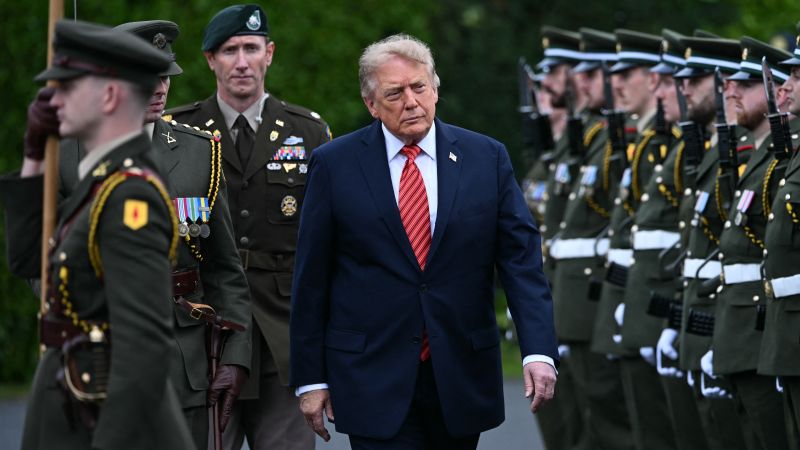
Trump arrived in Ireland for meetings with Irish leaders before taking part in a tournament at one of his golf properties. Donald Trump Jr. and his wife, Bettina, left the aircraft afterward and greeted officials at the airport.
The president also made a courtesy visit to Irish President Catherine Connolly. As he returned to his armored vehicle, Trump briefly answered questions, including one about shipping through the Bab al-Mandeb strait.
“Everything will work out just fine. It’s all going to work out fine.”
His schedule includes a bilateral meeting with Martin and remarks to business leaders at the residence of US Ambassador to Ireland Edward Walsh. The discussions are expected to address economic cooperation, opportunities for American industry and shared international concerns.
US companies play an important role in Ireland’s economy, with many operating European headquarters in the country. That relationship adds a business focus to a visit also marked by high-profile political comments.
Irish authorities planned extensive security measures, including limiting Trump’s time in public areas and closing Phoenix Park from Friday night. Demonstrations were expected in central Dublin, Doonbeg near Trump’s golf course, and Shannon Airport.
FAQ: President Trump says Irish reunification
What did Trump say about Irish reunification?
Trump said he would like to see Ireland unified and described the prospect as “a fantastic thing.”
Can Ireland reunify because of a US president’s comments?
No. Under the Good Friday Agreement, reunification would require majority support in separate referendums in Northern Ireland and the Republic of Ireland.
Why is the issue sensitive in Northern Ireland?
The question concerns competing national identities and follows decades of conflict. Unionists generally favor remaining in the United Kingdom, while republicans seek a united Ireland.