Polymarket Referred Dozens of Possible Military Insider Cases to DOJ
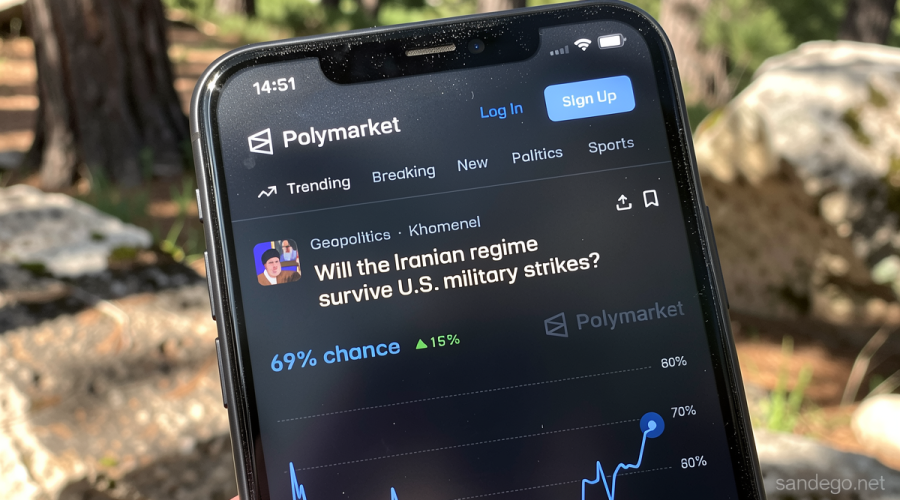
Sandego.net – Polymarket referred dozens of possible military insider-trading matters to the Department of Justice before any public watchdog report made the underlying data visible, according to a senior platform executive who spoke on condition of anonymity. The hand-off had not been disclosed until now, and its timing—preceding the release of an independent analysis—signals that the company’s internal systems flagged the activity and escalated it to federal prosecutors without waiting for outside scrutiny.
The accounts at issue were identified by the Anti-Corruption Data Collective, a nonpartisan research group that published a detailed Thursday analysis built entirely from publicly accessible Polymarket data. The collective traced 152 wallets that together extracted roughly $8 million from markets tied to armed conflict, including positions on the ongoing Iran war. Recurring hallmarks of insider activity across those wallets prompted the platform to forward the file to DOJ.
The Justice Department had not returned a comment request by Friday. Polymarket itself faces no formal accusation of misconduct; the focus rests on individual traders and, separately, on whether the platform’s offshore operating structure complies with existing federal rules.
War Markets in a Legal Gray Zone
Current US law prohibits wagering on the outcome of military operations, yet war markets continue to operate on Polymarket’s offshore platform, which sits outside the direct jurisdiction of domestic regulators. Traders using that offshore venue are not bound by the same statutory constraints that would govern a fully domestic exchange, creating a regulatory gap that has drawn fresh attention as prediction-market volumes have surged into the billions weekly.
The revelations land amid a broader mainstreaming of prediction markets. Platforms such as Polymarket and its chief rival, Kalshi, have shifted from niche curiosities to instruments attracting institutional-scale participation. With that growth has come intensified scrutiny over whether information asymmetries—especially around classified military events—are being exploited by well-connected participants.
Cases Already Before the Courts and Regulators
In April, prosecutors charged a member of the US Special Forces with leveraging classified intelligence to place bets on the operation that captured Venezuela’s then-leader, Nicolás Maduro. The soldier entered a not-guilty plea. Separately, investigative reporting established that a single trader banked nearly $1 million through a string of suspiciously well-timed positions on US and Israeli strikes against Iran.
Parallel concerns have surfaced on Kalshi, though those cases involved elections, cultural events, and so-called “mention markets” that let bettors wager on what President Donald Trump would say during public addresses. Kalshi maintains a data partnership with major news organizations for event coverage, and editorial staff at those outlets are barred from trading on prediction platforms.
The Anti-Corruption Data Collective’s report highlighted several red flags among the 152 accounts: freshly created wallets placing bets at remarkably precise moments, often at longshot odds implying near-certain knowledge of an outcome. Across the flagged group, the win rate stood at 97 percent—a figure that dwarfs the typical prediction-market trader, who more often than not loses money over time.
A senior Polymarket official acknowledged that such patterns are commonly associated with insider activity but cautioned that statistical anomalies alone do not establish guilt. The company’s internal surveillance infrastructure, the official said, tracks roughly 150 distinct signals and behavioral patterns in an ongoing effort to detect and deter undisclosed-information trading.
Polymarket founder and CEO Shayne Coplan addressed a public meeting of the Commodity Futures Trading Commission on Thursday, the federal agency charged with regulating prediction markets. Coplan sits on a CFTC advisory committee, a role that places him in regular dialogue with the very body overseeing his company. He highlighted a recent hire: a former FBI official tasked with building what the company describes as bespoke surveillance tooling for the platform.
“We talk with our partners – Palantir, Chainalysis – and they’re like, ‘damn, you guys have this in-house? This is serious!'” Coplan said. “We’re grateful to have that, and we continue to invest more in it.”
Coplan characterized the Maduro prosecution and other insider-trading episodes as validation that the sector’s surveillance investments are producing tangible results, while stressing that Polymarket’s role is to detect, document, and refer—not to adjudicate.
Frequently Asked Questions
What exactly did Polymarket refer to the DOJ? The company forwarded files on dozens of prediction-market accounts whose betting patterns were consistent with military insider trading. The referrals were made before the Anti-Corruption Data Collective’s public report and had not been disclosed until now.
Is Polymarket itself under investigation? No formal accusation of misconduct has been leveled at the platform. Scrutiny centers on individual traders and on whether the offshore operating structure complies with federal rules.
Why can war markets exist if US law bans wagering on military operations? Polymarket’s war markets operate on an offshore platform outside the direct jurisdiction of domestic regulators, so the statutory prohibition that applies to domestic exchanges does not automatically extend to those offshore venues.
How many accounts were flagged, and what were the key indicators? The Anti-Corruption Data Collective identified 152 wallets with a combined 97 percent win rate, freshly created addresses, and bets placed at precise moments at longshot odds—patterns commonly associated with access to non-public information.