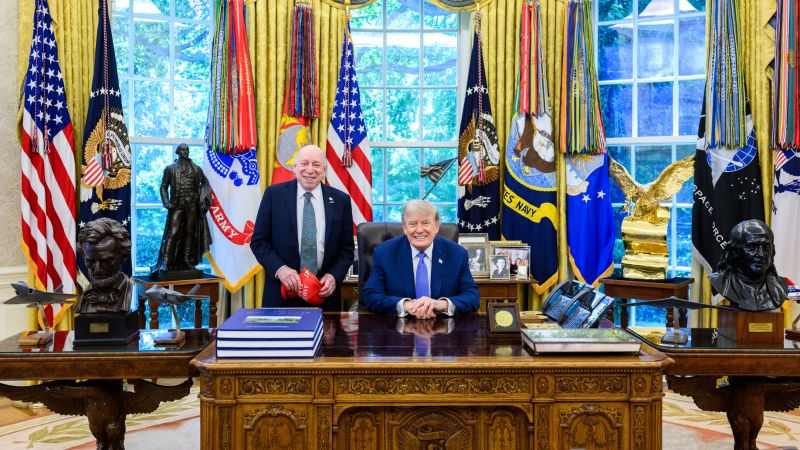
Peter Ticktin: From Trump’s Boyhood Friend to Midterm Election Firebrand
He was Trump s boyhood friend – He was Trump’s boyhood friend, a bond forged in the halls of the New York Military Academy where the future president and his ally shared classrooms. Now, Peter Ticktin, a Florida-based attorney, is spearheading a bold political strategy to challenge the upcoming midterm elections. His proposal centers on declaring a national emergency to seize control of the voting process, arguing that this will prevent Democrats from manipulating the results to unseat Trump and his allies. Ticktin’s vision hinges on the belief that a coordinated effort by state-level officials threatens the constitutional integrity of the United States.
Ticktin’s Radical Shift from Friendship to Conspiracy
Ticktin, who is 80 years old, has long positioned himself as a trusted confidant of Trump, a role that has now evolved into a leading voice in the 2020 election denier movement. While he once served as a close companion to the former president, his recent advocacy has taken a more aggressive turn, focusing on the idea of federal intervention to safeguard the election. His legal work has drawn attention from high-profile figures, including a Backstreet Boys member and Meghan Markle’s estranged half-sister, underscoring his influence within the right-wing political ecosystem. Yet, his shift from a personal connection to a political campaign has sparked debates about his credibility and strategic role.
Ticktin’s claims about the 2020 election are rooted in his assertion that foreign powers, including Venezuela, China, and Iran, conspired to subvert the outcome. He has repeatedly emphasized that electronic voting machines are susceptible to manipulation, a narrative he reinforces by linking the election to the Trump administration’s indictment of Nicolás Maduro. This argument, while central to his push for a national emergency, remains unproven. Critics argue that Ticktin’s focus on external conspiracies overlooks domestic issues, yet his ability to mobilize support within Trump’s inner circle continues to fuel his influence.
The National Emergency Proposal: A Controversial Blueprint
Taking a dramatic step from his earlier role, Ticktin is now advocating for a presidential executive order to declare a national emergency over election procedures. This move would effectively strip state governments of control, allowing federal authorities to oversee the midterms. His rationale is that Democrats are orchestrating a plan to secure enough congressional seats to remove Trump and Vice President JD Vance from power, with Hakeem Jeffries as the potential beneficiary. Ticktin’s strategy has drawn both support and skepticism, with some viewing it as a necessary safeguard and others as an overreach of executive authority.
“With the evidence we’ve got, and with the evidence that would be forthcoming, there’ll be no question about it — and what these machines did. It’s a surreptitious overtaking of a country.”
Ticktin’s push for a national emergency has not only captured the attention of political figures but also embedded himself in the media spotlight. He claims he maintains regular communication with Trump, leveraging their history to amplify his arguments. While a White House official acknowledges Ticktin’s loyalty, they note that his connection to the president is more symbolic than instrumental. Nevertheless, his campaign has resonated with a segment of the electorate, highlighting the enduring impact of his boyhood friendship with Trump on contemporary political discourse.
Challenges and Criticisms of Ticktin’s Narrative
Despite Ticktin’s confident assertions, the evidence of foreign manipulation in the 2020 election remains elusive. A 2021 U.S. intelligence report confirmed that Russia, China, and Iran engaged in information campaigns, but found no proof of tampering with vote-counting processes. Ticktin, however, remains undeterred, insisting that the truth will surface through ongoing investigations and the indictment of Maduro. His argument blends historical context with modern political tensions, framing the midterms as a pivotal moment that could redefine the nation’s democratic framework.
Ticktin’s strategy also faces scrutiny for its potential to undermine state autonomy. By advocating for a national emergency, he risks centralizing power in the federal government, a move critics argue could erode the decentralized nature of American elections. Yet, Ticktin’s position is bolstered by his belief that the stakes are too high for state officials to act independently. His campaign, therefore, represents a calculated attempt to leverage his boyhood friendship with Trump into a broader political movement, one that seeks to reshape the electoral landscape through decisive action.