America Steps In to Support Yen Amid Historic Currency Weakness
Sandego.net – In a significant move that underscores the depth of transatlantic economic ties, the United States has purchased Japanese yen for the first time in over ten years. President Donald Trump announced the decision on Sunday while speaking to journalists aboard Air Force One, characterizing the action as “a signal of friendship” between the two nations. This uncommon bilateral intervention aims to stabilize the yen, which has recently plummeted to its lowest level in four decades against the American dollar.
Coordinated Market Intervention
The timing of this currency purchase follows reports from the Financial Times published on Friday, which indicated that the Federal Reserve Bank of New York had sold euros in exchange for yen on behalf of the Treasury Department. According to sources familiar with the transaction, this operation was designed to provide immediate relief to Japan’s struggling currency markets.
They have a weakening yen, and they wanted a little bit of help. And we’re always there for Japan, Trump told reporters during his flight.
Treasury Secretary Scott Bessent provided additional details about the coordination effort, explaining that American and Japanese officials worked together to counter what he described as disorderly movements in the yen’s value. Bessent emphasized that the Treasury Department “will not hesitate to participate in further joint intervention” should market conditions warrant additional support.
Strategic Economic Considerations
Trump framed the yen purchase within a broader context of American economic leadership, stating that supporting Japan’s currency would be “good for the world economy.” The president drew parallels to previous US interventions, citing last year’s $20 billion financial rescue package for Argentina and the capture of Venezuelan President Nicolás Maduro as examples of how American involvement has strengthened other nations’ economic stability.
While Trump presented these examples as clear successes, the actual impact of such interventions remains more nuanced. Currency markets are influenced by numerous factors beyond direct government action, including interest rate differentials, trade balances, and global risk sentiment. Nevertheless, the symbolic value of coordinated intervention cannot be understated, particularly when major economies like the United States and Japan work together to stabilize their currencies.
Behind the Scenes at Camp David
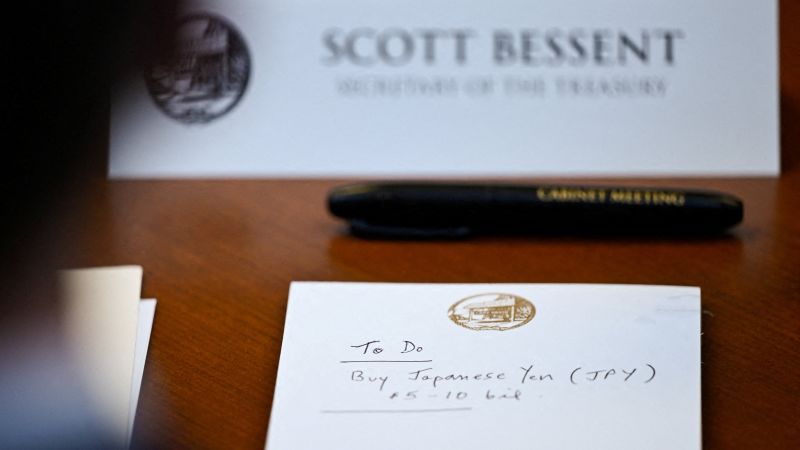
A revealing photograph from President Trump’s cabinet meeting at Camp David on Friday provides insight into the planning process. The image shows Treasury Secretary Bessent with a handwritten notepad that included a “to-do” list for the incoming US purchase. Captured over Bessent’s shoulder during an on-the-record segment of the meeting, the notepad displayed the underscored heading “To Do” followed by the specific instruction: “Buy Japanese Yen (JPY) $5-10 bil.”
This visual evidence confirms that the currency purchase was not merely reactive but part of a deliberate strategy involving substantial financial commitment. The range of $5 to $10 billion represents a significant allocation of resources, demonstrating the seriousness with which both governments approached the situation.
Political and Diplomatic Dimensions
The intervention also carries political significance, particularly given Trump’s relationship with Japanese leadership. The president, who has previously referred to conservative Japanese Prime Minister Sanae Takaichi as “a delight,” indicated that the United States would derive financial benefits from the move, though he did not elaborate on the specific mechanisms. Trump concluded with a characteristic quip: “Japan has always been very good to us, with the exception, of course, of Pearl Harbor.”
Bessent further reinforced the diplomatic message on X, stating: “We strongly support Japan’s decisive market and monetary steps to correct the substantial undervaluation of the yen.” This endorsement of Japan’s domestic policy actions highlights the complementary nature of the intervention, combining American financial support with Japanese monetary measures.
The yen’s decline to a 40-year low has raised concerns about potential economic consequences for Japan, including increased import costs and inflationary pressures. By stepping in to support the currency, the United States has not only provided immediate market assistance but also sent a clear signal of its commitment to maintaining stable international financial relationships.
Related Reading
Frequently Asked Questions
What is US buys Japanese yen as it drops?
US buys Japanese yen as it drops is the main topic of this guide. The article explains the context, practical details, and next steps readers should understand.
Why does US buys Japanese yen as it drops matter?
US buys Japanese yen as it drops matters because readers are looking for a useful answer, not just a short summary. Good content should match search intent and help them decide what to do next.