
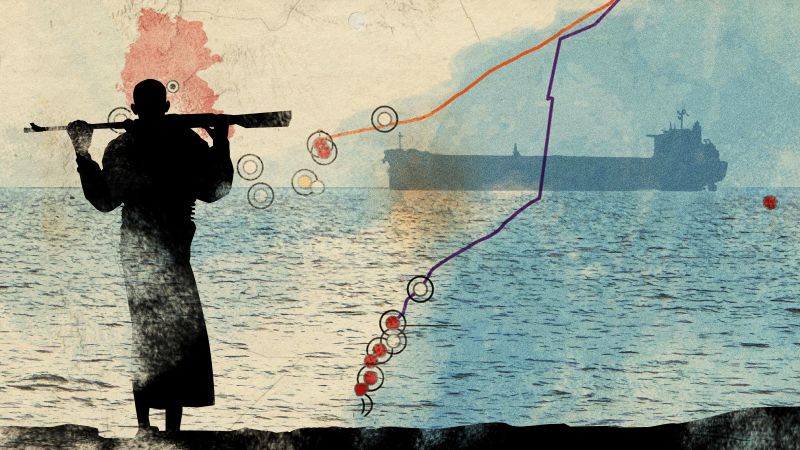
Somali Pirates Return as Shipping Routes Grow More Dangerous
Sandego.net – “If you don’t stop, they’ll kill all of us,” was the desperate warning heard aboard the diesel tanker Honour 25 after Somali pirates attacked the vessel. Armed men boarded within about three minutes of gunfire beginning, launching a five-month ordeal for most of the ship’s 17 crew members.
The April 21 hijacking ended in violence last month, with five crew members losing their lives. For those held aboard, captivity meant long periods confined to the bridge, a space less than 50 feet long, with bathroom trips allowed only under escort.
The attack highlights the return of Somali piracy in the western Indian Ocean. Piracy off Somalia became an estimated $18 billion criminal enterprise during the 2010s, before international naval patrols, armed guards and stronger shipping practices sharply reduced successful hijackings.
Why Somali piracy is becoming a threat again
Economic hardship in Somalia and disruption linked to the Iran war have created new opportunities for pirate groups. Naval resources have shifted toward the Persian Gulf, while Houthi attacks in the Red Sea and Gulf of Aden have forced commercial vessels to reconsider their routes.
Some ships are traveling closer to Somalia’s coastline to avoid danger near Yemen. That decision can place vessels within reach of pirates. For crews on poorly protected ships, the message can become terrifyingly clear: if you don’t stop and take safety precautions, the risks can quickly escalate.
Large shipping companies may be able to avoid the region by sailing around Africa’s Cape of Good Hope, but that route can add weeks to a voyage and cost millions of dollars more in fuel. Smaller operators may feel pressure to use routes through the Bab-al-Mandab strait, Red Sea, Gulf of Aden or waters near Somalia.
Honour 25 carried 2,700 tons of diesel
The Honour 25 left Shinas Port in Oman carrying 2,700 tons of diesel for Mogadishu, Somalia’s capital. Pakistani crew member Yassir Khan said this was the crew’s second voyage to Mogadishu that year. Their January trip had passed safely, but Khan said the ship was not properly equipped for a high-risk route.
He described the tanker as rusted, with unreliable engines and generators. It had no armed guards, barbed wire or other basic anti-piracy measures.
“No guards. No barbed wires. No nothing,” Khan said.
Armed guards are considered one of the strongest deterrents against pirate attacks. Tim Walker, maritime project leader at the Institute for Security Studies, Africa, said no ship carrying armed guards has been successfully attacked since 2008.
“The ships being hijacked aren’t carrying guards to deter pirates,” Walker said. “And those ship owners are likelier to disappear before the ransom is paid.”
Gunfire and threats aboard the tanker
The attack began after 2 p.m. in the Gulf of Aden. Khan saw Somali pirates in small boats firing toward the tanker’s bulkhead, with some carrying AK-47 rifles. He ran from the engine room and urged other crew members to secure themselves in their cabins.
“Lock the doors!”
The pirates quickly seized control, shut down the tanker’s engine and used weapons and gunfire to intimidate the crew. The danger was especially severe because of the diesel cargo. Crew members pleaded with the attackers to stop shooting, warning that a spark could trigger a catastrophic explosion.
“It has 2,700 tons of diesel,” Khan said. “If you fire a gun, it can make a spark, and it will explode the ship.”
More boats later arrived, bringing the number of pirates to about three dozen. The group placed people in key areas, including the pump room, engine room, forecastle and bridge, before ordering the crew to head toward Durdura, a coastal fishing village in Somalia.
The Honour 25 anchored about two nautical miles offshore, where the lengthy hostage crisis unfolded. The case shows why the warning, “If you don’t stop,” carries such weight for crews operating near Somalia: once pirates move a ship into coastal waters, resolving a hijacking can become far more difficult.
FAQ: Somali piracy and shipping near Somalia
Why are ships sailing near Somalia again? Attacks and instability around the Red Sea, Gulf of Aden and Persian Gulf have disrupted normal shipping routes. Some vessels travel closer to Somalia’s coast while seeking to avoid other dangerous areas.
Why are fuel tankers attractive targets? Fuel cargos can be highly valuable, especially when diesel prices and insurance costs rise. Tankers also create serious safety risks because gunfire near a diesel cargo may cause an explosion.
What can help prevent pirate hijackings? Armed guards, physical protections and stronger voyage planning have helped reduce successful attacks in the past. The Honour 25 case underlines the danger when vessels lack basic anti-piracy protections.