‘It’s not by mistake’: A family demands justice after 7-month-old killed by Israeli soldier
Sandego.net – On June 5, 2026, a harrowing moment unfolded in the city of Hebron, Palestine, when a 7-month-old infant, Sam Abu Haikal, was fatally shot by an Israeli soldier. The incident, captured in a video later obtained by the Israeli human rights group B’Tselem, has sparked a demand for accountability from Sam’s family. Fahd Abu Haikal, the child’s father, recounted the events to CNN, detailing how the tragedy occurred as his family drove through the city. According to Fahd, the car slowed to a stop near a group of soldiers, only for one to raise his rifle and fire. The bullet struck Sam directly in the head, leaving the family in devastation.
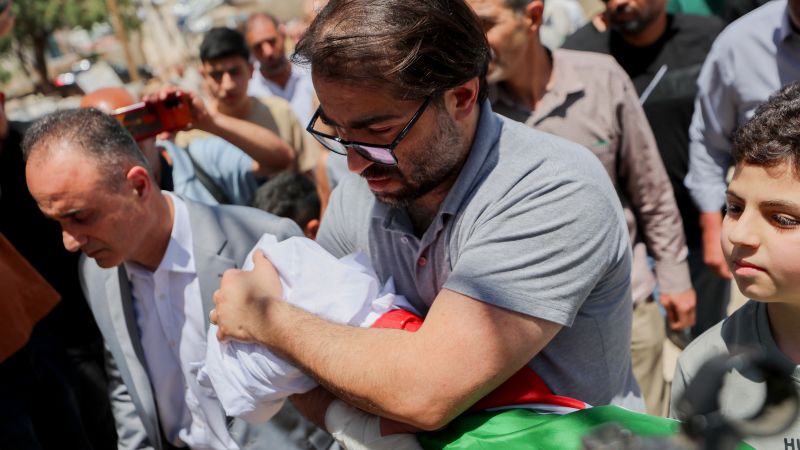
B’Tselem reported that Sam was the 13th Palestinian child killed by Israeli forces in the occupied West Bank this year. The organization has documented 236 children’s deaths since the Hamas attacks on Israel began on October 7, 2023. The video, which lacks audio, depicts the aftermath of the shooting: Fahd cradling his bloodied son, his hand pressed against the baby’s head in a desperate attempt to stop the bleeding. The footage captures the family’s anguish as Sam’s mother and grandmother wail in the background, and Fahd swiftly transports the infant into a passing car. The scene is a stark reminder of the fragility of life in the conflict-torn region.
A Conflicting Account
The Israeli military initially stated that the soldier “perceived a vehicle accelerating toward them” and “responded with single shots toward the vehicle” during the June 5 incident. However, the video evidence presented by B’Tselem challenges this narrative. It shows Fahd’s car decelerating as it approaches the soldiers, not speeding up. The footage also identifies the same soldier—standing no more than 30 feet from the vehicle—as the one who fired the fatal shot. Fahd and his mother, who was seated in the front passenger seat, confirmed this in their review of the video with CNN.
“We expect that they will say to us, ‘go out, return, you must return’ (or) shoot in the air to let us turn around,” Fahd’s mother, Feryal Abu Haikal, said. “But they didn’t do anything—only they shoot him.” The soldier, after the shot, walks away from the vehicle, leaving the family to deal with the aftermath. Eyewitnesses claimed none of the soldiers provided immediate medical aid, adding to the sense of helplessness.
“I just – I wanted to go out and carry him to the hospital,” Fahd said in an interview days later. “And there is … if you see this hit, there is no hope. No hope.”
Sam’s mother, Dania Abu Haikal, expressed her grief and the physical toll of the tragedy. “They tried to save him, they give him blood units, but they couldn’t do anything to save him,” she said. “Nothing could be done.” Dania’s own injuries, sustained during the shooting, have compounded her sorrow. A portion of the bullet that killed her son also struck her face, entering her right cheek and exiting behind her ear. Shrapnel fragments remain lodged in her chest, so near to her heart that doctors chose not to operate, fearing further damage.
Dania’s pain is both physical and emotional. “I was breastfeeding him,” she shared, her voice trembling. “Now, my chest is hurting me.” To cope, she now uses a breast pump, a daily ritual that triggers waves of tears. Her phone’s camera roll, once filled with joyful photos of her son, now serves as a somber testament to his life. Sam was her only child, and the loss has left her in a state of profound mourning.
The Weight of a Shooting
The family’s anguish is part of a larger pattern of violence in the occupied West Bank. The B’Tselem data highlights the alarming frequency of such incidents, with 236 Palestinian children killed by Israeli forces since the start of the conflict in 2023. For Sam’s parents, the tragedy is not just a personal loss but a symbol of the broader suffering endured by families in the region.
Despite the emotional weight of the case, the Israeli military has maintained a measured response. It acknowledged the shooting and launched an investigation, though the process has been criticized for its lack of transparency. CNN’s efforts to gather more information from the scene revealed several CCTV cameras, but local residents and business owners reported that Israeli forces returned later and confiscated all the recordings. This has raised questions about the availability of evidence and the military’s commitment to uncovering the truth.
Fahd, though devastated, has pledged to cooperate with the investigation. “When you see something in front of you and aim at him and shoot him, it’s not by mistake,” he said, addressing the soldier responsible. “He shot directly to kill.” This statement underscores the family’s belief that the shooting was intentional, not an accident. Their determination to seek justice reflects a growing resolve among Palestinians to challenge what they see as unjust actions by Israeli forces.
A Community in Grief
In the wake of the shooting, the family mourning house in Bethlehem became a gathering place for friends and relatives. The space, usually filled with laughter and celebration, now echoes with quiet sorrow. Sam’s mother, Dania, lies on a bed in the corner, her body bearing the scars of the incident. She struggles to find solace, her pain a constant reminder of the life she lost.
While the military investigation continues, its track record suggests that disciplinary action or criminal charges may be rare. Nevertheless, the Abu Haikal family remains steadfast in their pursuit of justice. Their story, like many others, highlights the human cost of the ongoing conflict and the urgent need for accountability. As the community mourns, the hope is that the investigation will bring clarity and healing to a family shattered by tragedy.
The incident has also reignited discussions about the use of force in civilian areas. Critics argue that the soldier’s actions—firing at a stationary vehicle—demonstrate a lack of caution, particularly when the target is a child. For the Abu Haikals, the question is not just about who fired the shot, but why it was fired and whether the soldier’s intent was to kill.
As the investigation unfolds, the family’s resilience stands in stark contrast to the grief they carry. Their journey from the moment of the shooting to the present reflects the enduring spirit of those who demand justice in the face of violence. Sam’s story, though brief, lingers in the hearts of his loved ones, a reminder of the lives lost and the battles yet to be fought.