Dolores Huerta Dies at 96, Leaving a Lasting Legacy in Labor and Civil Rights
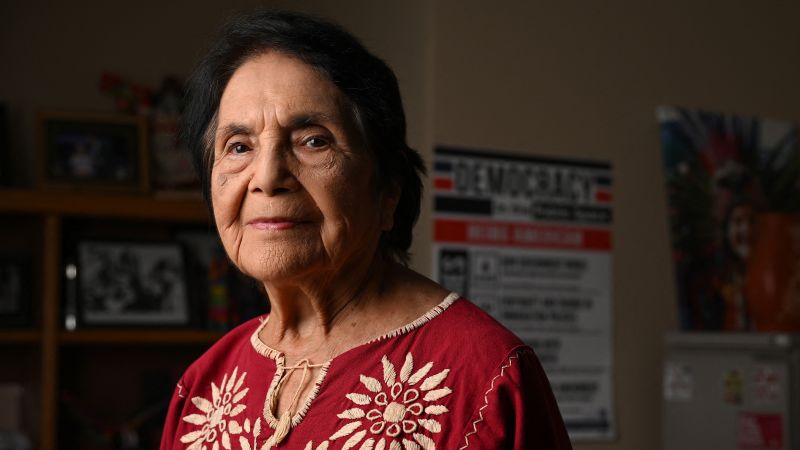
Sandego.net – Dolores Huerta, whose decades of organizing helped reshape the fight for farmworkers, labor protections and civil rights in the United States, has died at age 96. Her family announced her death Wednesday and said details about memorial events would be shared later.
“We are deeply saddened to announce that our beloved mother, Dolores Huerta, has passed away today.”
Her death prompted tributes from labor advocates, elected officials, artists and community organizers who remembered Huerta as a forceful campaigner for people whose work and voices were often ignored. Her family asked for privacy while mourning what they described as an extraordinary loss.
Huerta became nationally known as a cofounder of the United Farm Workers alongside Cesar Chavez during the 1960s. The organization became central to efforts to secure better wages, safer working conditions and collective bargaining power for agricultural laborers, many of them migrants working in harsh conditions.
A Movement Built Around Farmworkers
The United Farm Workers said its most meaningful memorial to Huerta would be to carry forward the organizing work to which she devoted her life. The union emphasized that the organization she helped establish must continue expanding and supporting agricultural workers wherever they gather to seek change.
“Our greatest monument to her memory is for the union she helped found to continue to grow.”
Huerta’s name became inseparable from the phrase “Sí se puede,” commonly translated as “Yes, we can.” The rallying call conveyed the belief that collective action could overcome entrenched inequality. It later became familiar well beyond farmworker campaigns, appearing in political and social movements across the country.
Former President Barack Obama, who awarded Huerta the Presidential Medal of Freedom in 2012, called her one of his heroes. He said her work helped migrant laborers speak up and seek fairer treatment.
“She also came up with a pretty good slogan, ‘Si, se puede’ — Yes, we can — that I too often get credit for. But as usual, Dolores got there first.”
Obama also noted that Huerta spent her life confronting discrimination and defending marginalized communities while enduring sexism and abuse herself.
Speaking Publicly About Abuse
Earlier in 2026, Huerta disclosed allegations that Chavez sexually assaulted her in 1966, during the period of the United Farm Workers’ grape boycott. She said he drove her to a secluded grape field near Delano, California, and raped her.
Huerta also described an earlier encounter from 1960, when she said Chavez pressured her into sex during a work trip. She explained that she did not report the incidents at the time because she feared hostile treatment from police, doubted that others in the union would believe her, and felt she had to keep the trauma private.
“I have kept this secret long enough. My silence ends here.”
Her decision to speak publicly added a difficult dimension to the history of a movement long associated with both Huerta and Chavez. It also underscored the risks women can face within political and labor organizations, including movements built around justice and equality.
Public Grief in Los Angeles and Beyond
On Wednesday, activists and public figures gathered for a vigil in downtown Los Angeles. Candles and roses were placed beneath a mural of Huerta created earlier this year by artist Robert Vargas. Music filled the street as those attending remembered her contributions.
Vargas said Huerta attended the mural’s unveiling near her 96th birthday, around the same period she spoke about the alleged assaults. He recalled that she was pleased with how she appeared in the artwork and said her enduring legacy would be hope.
California Gov. Gavin Newsom said he had planned to visit Huerta on the day she died. In a statement, he said she represented the country at its best and credited her work for influencing generations of advocates for workers, women and civil rights.
“California — and the United States — would not be what we are today without her resolute spirit, her passion for justice and fairness, and her commitment to those overlooked and forgotten.”
Illinois Gov. JB Pritzker called Huerta a fearless labor leader and a lifelong defender of working people. Rep. Joaquin Castro wrote that she transformed the American labor movement and improved the lives of countless people, urging others to honor her message: “Sí se puede.”
Actor Danny Trejo also paid tribute, saying Huerta had affected his life and the lives of many others, and that her work would continue.
An Enduring Call to Organize
Huerta’s influence reached far beyond one union or one moment in history. Her work placed farmworkers at the center of national conversations about economic dignity, racial justice, political participation and the right to organize. She demonstrated that the people harvesting food and sustaining agricultural communities could become powerful advocates for themselves.
In the 2018 documentary Dolores, Huerta reflected on feeling compelled to fight for something larger than herself. That commitment remained visible throughout her long public life, from union campaigns to her advocacy for gender equity and civil rights.
For the many people who adopted her words as a promise of possibility, Huerta’s death closes a remarkable chapter in American activism. The organizing tradition she helped build, however, remains rooted in the belief she made famous: Sí se puede.
Related Reading
Frequently Asked Questions
What is Dolores Huerta pioneering labor leader and civil?
Dolores Huerta pioneering labor leader and civil is the main topic of this guide. The article explains the context, practical details, and next steps readers should understand.
Why does Dolores Huerta pioneering labor leader and civil matter?
Dolores Huerta pioneering labor leader and civil matters because readers are looking for a useful answer, not just a short summary. Good content should match search intent and help them decide what to do next.