A Manila Museum Brings the Galleon Era Back to Life
Sandego.net – In a city where modern commerce moves at full speed, a new attraction offers a quieter passage into the history of trade, migration and life at sea. Museo del Galeon has opened inside Manila’s vast Mall of Asia complex, placing the story of the Manila galleons beside one of the Philippines’ busiest shopping and entertainment destinations.
The contrast is deliberate and striking. The mall contains more than 660 shops and restaurants in its main building, creating a lively, sometimes overwhelming environment for visitors. Not far from performances by the mall’s own marching band, guests can enter the museum and leave much of that noise behind. Inside, the atmosphere shifts from contemporary retail spectacle to the open Pacific of several centuries ago.
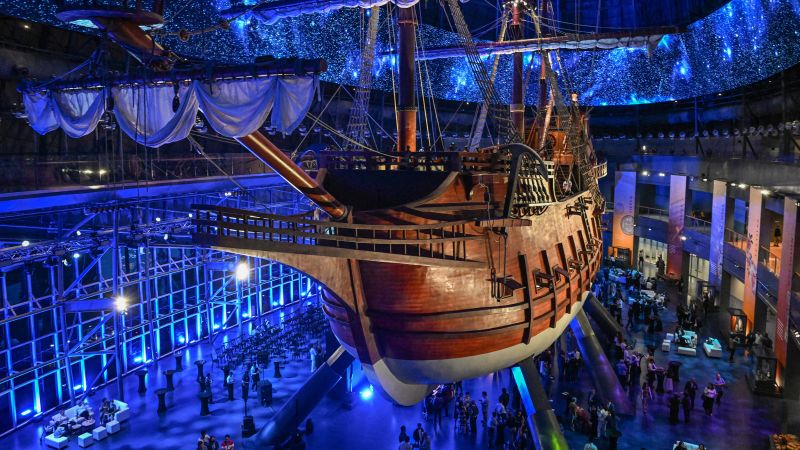
A full-scale vessel at the center
The museum’s defining feature is a life-size representation of the Galeon Espiritu Santo, a ship that sailed the Pacific between 1603 and 1618. Rising almost 100 feet and stretching beyond 130 feet in length, the installation gives visitors a sense of the physical scale of a transoceanic vessel built for a difficult and lengthy route.
Above the ship, an expansive ceiling filled with stars evokes the night sky encountered by its crew. The original Espiritu Santo carried roughly 200 people and completed 10 voyages along the route between Manila and Acapulco, the Spanish trading center on Mexico’s Pacific coast.
Standing on its deck, visitors can begin to imagine the challenges faced by mariners crossing a sea that offered little certainty. The museum uses LED screens surrounding the upper space to create a changing visual setting, helping transform the gallery into a stylized Pacific crossing even without the motion of waves or the heat and humidity experienced aboard the original ships.
The route that linked continents
The Manila-Acapulco galleon trade connected Asia, the Americas and Europe long before modern globalization. Porcelain, silk, spices and other Asian goods traveled east across the Pacific to Acapulco. From there, cargo moved overland across Mexico by mule to the Atlantic coast, where it was loaded onto ships headed for European markets and royal palaces.
Silver from the New World moved in the opposite direction, making its way westward through Manila and into Asian trade. The museum describes the system as one of history’s earliest global trade networks.
“It is considered one of the earliest global trade networks in history.”
The scale of the route becomes clearer through maps displayed in the exhibition. Over 250 years, 181 ships completed 798 voyages. Today’s maritime routes used by Filipino seafarers follow some of the same broad ocean connections, although the Panama Canal has removed the need to carry goods across Mexico by land.
The historical story also provides context for the continuing importance of Filipino workers at sea. Filipinos account for an estimated 25% to 30% of ship crews worldwide, serving on vessels ranging from tankers and bulk carriers to cruise ships. Their role in contemporary merchant shipping has deep roots in the maritime life of the archipelago and in Manila’s former position as a major Pacific trading hub.
Navigation before modern instruments
Museo del Galeon turns the experience into more than a visual display. Interactive touchscreens in English explain how crews navigated across the Pacific using the sun, stars and early instruments. The methods required skill, patience and constant calculation.
The galleon trade began more than a century before a reliable clock suitable for ocean travel was developed. Without accurate timekeeping, determining longitude was especially difficult. A small error could place a ship hundreds of miles from its intended position, a dangerous prospect on a route that crossed one of the world’s largest oceans.
The museum also uses scent to bring the commercial world of the galleons closer to visitors. A spice display invites guests to explore six stations, each holding aromas in large jars. The installation links fragrances to foods and places across Asia, reminding visitors that the galleon trade was built around goods with sensory and cultural value as well as financial worth.
Built in Cavite, reconstructed in Manila
The original Espiritu Santo was constructed in Cavite, south of central Manila, on a peninsula extending into Manila Bay. Builders used hardwoods from Luzon, including teak, molave and lanang. Studies indicate that a single galleon could require 2,000 trees, reflecting the enormous material demands of shipbuilding at the time.
Shipyards relied heavily on Filipino workers, much like the ships themselves relied on Filipino crews. Historical records also show that specialized craftspeople, including carpenters and blacksmiths, came from Japan, China and other places. This mix of labor and expertise illustrates how the shipyards became meeting points for multiple maritime traditions.
Exhibits examine the organization of a Cavite shipyard and the process through which these large vessels were assembled and launched. Galleons could carry between 50 and 400 people, depending on their size and the stage of a journey. At the beginning of a voyage, a ship might be especially crowded with crew members, passengers, cargo and provisions.
The museum’s replica was made from fiberglass rather than timber. It was built in Pampanga, north of Manila, then dismantled and transported by truck before being reconstructed within the Mall of Asia display space. That logistical effort mirrors, in a contemporary form, the complexity involved in bringing a vessel of such proportions into being.
A pause within the mall
Museo del Galeon offers a different kind of Manila experience: one that places a major chapter of Philippine history inside a setting usually associated with leisure and consumption. Its location makes the past accessible to shoppers, families and travelers who may not have planned a museum visit.
More importantly, the museum gives shape to a history that can otherwise feel abstract. The vast trade route is represented through a ship, a night sky, navigational tools, spices and the labor of sailors and shipbuilders. In doing so, it invites visitors to consider how the Philippines helped connect distant economies centuries ago—and how the country’s relationship with the sea continues today.
Related Reading
Frequently Asked Questions
What is Inside one of the largest malls?
Inside one of the largest malls is the main topic of this guide. The article explains the context, practical details, and next steps readers should understand.
Why does Inside one of the largest malls matter?
Inside one of the largest malls matters because readers are looking for a useful answer, not just a short summary. Good content should match search intent and help them decide what to do next.