Yemen’s Saudi-Backed Government Begins Major Offensive Against Houthis
Sandego.net – Yemen’s Saudi-backed government has announced a major military offensive against the Iran-backed Houthi movement, signaling a sharp escalation in a conflict that could further endanger civilians and shipping routes near the Red Sea.
Rashad al-Alimi, head of Yemen’s presidential council, announced the operation in a televised address on Sunday. He said government forces aim to regain territory held by the Houthis and restore state authority across the country.
“The Houthi militias’ continued mobilization, escalation and attacks, as well as their threats against civilians, facilities, neighboring countries, and international shipping lanes.”
Fighting Raises Red Sea Shipping Concerns
The announcement came after the Houthis advanced along Yemen’s Red Sea coast last month, taking a strategically important port and pushing south toward the Bab al-Mandeb waterway. The narrow passage connects the Red Sea to routes leading toward the Indian Ocean and is essential to trade between Europe, Asia and the Middle East.
The Houthis have said Saudi-linked vessels using the strait could be targeted. Such threats have increased concern about commercial shipping, energy supplies and the broader regional consequences of renewed fighting in Yemen.
Yemen’s Saudi-backed government relies heavily on Saudi support, while the Houthis have developed missile, drone and coastal capabilities that can affect neighboring countries and international maritime traffic.
Airstrikes and Houthi Retaliation Claims
Military action had appeared increasingly likely after Saudi strikes on Houthi positions and continued Houthi advances in southern Yemen. The Houthis said Saudi airstrikes hit Sanaa, the Yemeni capital, on Saturday and again early Sunday, though the Saudi-led coalition did not publicly confirm the attacks.
The Houthis said they responded to more than 50 attacks on Sanaa and other areas by striking Saudi energy facilities. In a military statement, the group said it targeted two Aramco sites, one in Riyadh and another in the Khurais area, and claimed major fires broke out.
“The first targeted Aramco company in the Saudi capital, Riyadh, and the second targeted Aramco company in the Khurais area.”
Saudi authorities had not commented on the claimed strikes. The Houthis have launched ballistic missiles and drones at Saudi industrial and energy targets since late July.
Pressure Builds Around Taiz and al-Jawf
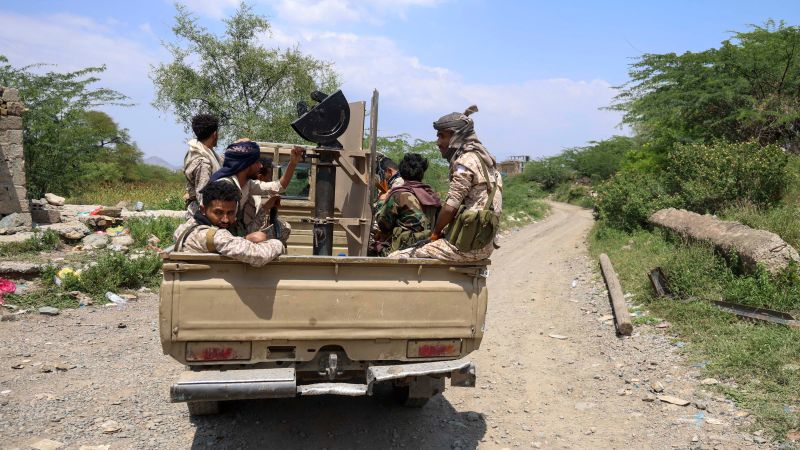
Clashes have intensified around Taiz in southern Yemen, where Houthi forces have sought to isolate government troops in the regional capital. The Houthis said they had taken a major highway linking Taiz with Aden, where Yemen’s government is based.
Taiz, Yemen’s third-largest city, is home to several hundred thousand people and thousands of government soldiers. Control of roads around the city can determine whether civilians can travel safely and whether troops and essential goods can reach the area.
In al-Jawf, the Houthis said they inflicted heavy casualties on government forces with missiles and drones as troops repositioned for the offensive. Those claims could not be independently verified.
The conflict between Yemen’s Saudi-backed government and the Houthis has lasted for more than a decade. Saudi air support and restrictions on Houthi-held territory have formed a central part of the government side’s strategy, but the latest escalation could alter the military balance after comparatively quieter front lines.
Humanitarian Emergency Remains Severe
Renewed large-scale fighting is likely to deepen the suffering of civilians. Tens of thousands of people have been displaced, and hunger remains widespread in areas affected by the conflict. The World Food Program said last week that three out of every four families in parts of Yemen are facing hunger amid the renewed violence.
Yemen has faced one of the world’s worst humanitarian emergencies since the conflict expanded into full-scale war in March 2015. The United Nations estimated that 377,000 people had died from direct and indirect consequences of the war by the end of 2021. More than 150,000 of those deaths were directly caused by armed violence, while hunger, disease and failing essential services caused many others.
A United Nations-brokered truce in 2022 reduced hostilities for a period. Violence began increasing again in August, and the newly announced offensive raises the prospect of a longer and more dangerous phase of the war.
Yemen Conflict FAQ
Who is fighting in Yemen?
The main conflict involves Yemen’s internationally recognized government and the Houthi movement. Saudi Arabia is a key supporter of the government, while the Houthis are described as Iran-backed.
Why is the Bab al-Mandeb important?
The Bab al-Mandeb is a narrow waterway between the Red Sea and routes toward the Indian Ocean. It is used by commercial ships carrying goods and energy supplies between Europe, Asia and the Middle East.
What does the offensive mean for civilians?
More fighting can lead to displacement, disrupted aid deliveries, damaged infrastructure and worsening hunger. Communities near front lines, including those around Taiz and al-Jawf, face particular risks when roads and supply routes are contested.
Related Reading
Frequently Asked Questions
What is Yemen s Saudi backed government announces?
Yemen s Saudi backed government announces is the main topic of this guide. The article explains the context, practical details, and next steps readers should understand.
Why does Yemen s Saudi backed government announces matter?
Yemen s Saudi backed government announces matters because readers are looking for a useful answer, not just a short summary. Good content should match search intent and help them decide what to do next.