Amazon Cargo Jet Overruns Miami Runway, Plunges Into Neighborhood at Speed
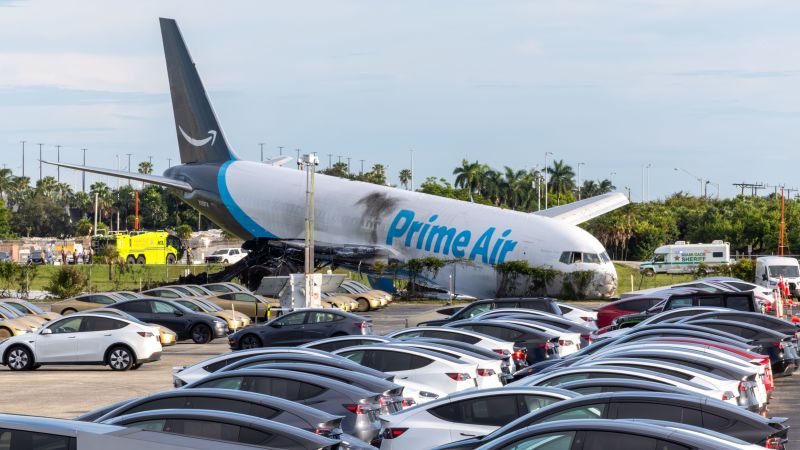
Sandego.net – A Boeing 767-300 freighter carrying Amazon’s distinctive “Smile” branding on its tail fin tore through a chain-link fence, shattered concrete barriers, and collided with multiple vehicles before slamming into a blaze near a crowded parking lot outside Miami International Airport on Sunday afternoon. At least five people lost their lives, and five more sustained injuries, in what has become one of the most dramatic commercial aviation accidents in recent U.S. history.
The aircraft, operating as Flight 7598 under the banner of 21 Air — the cargo carrier that absorbed former Amazon logistics operator Atlas Air — attempted to touch down on Runway 30, a strip exceeding 9,000 feet in length, at approximately 2 p.m. Eastern Time. What followed was a sequence of failures that carried the 100-plus-ton jet well beyond the paved surface and into a four-lane public roadway.
Approach Gone Wrong
Tracking data compiled by Flightradar24 indicates the jet climbed above the standard glide path during its final approach before descending sharply to rejoin the correct corridor. The aircraft had threaded through a developing thunderstorm — one of several short-lived cells popping up across the region at the time — before reaching the airport threshold.
Once on the runway, the situation deteriorated rapidly. Video captured by bystanders and posted to social media shows the plane hovering well past the normal touchdown zone. Two sets of landing gear made contact with the pavement, yet the left rear strut continued to bounce along the strip. By the time the aircraft reached the far end of the runway, it was still traveling at roughly 130 miles per hour, according to the same tracking data.
David Soucie, a former FAA safety inspector who now works as a transportation safety analyst, pointed to a sudden shift in wind direction during the rollout. That change converted what should have been a headwind into a tailwind, effectively adding speed to an aircraft that was already struggling to decelerate.
“You’re picking up speed instead of bleeding speed off at that point,” Soucie explained.
No distress call or mechanical problem report was transmitted to air traffic control before the landing, according to available communications records.
Into the Neighborhood
After crossing a narrow grassy median, the jet punched through a razor-wire-topped chain-link fence separating the secure airfield perimeter from public land. Concrete jersey barriers, built to keep automobiles from entering the restricted zone, gave way under the aircraft’s momentum. The freighter then sliced across the asphalt of a four-lane road, striking several parked and moving vehicles. At least one car was flipped onto its side and twisted into a dramatic arc before the plane ground to a fiery halt just short of a parking lot packed with dozens of automobiles.
“Plane’s on fire!” a first responder broadcast over an emergency radio channel. “Put your game faces on.”
Witnesses Describe the Moment
Spencer Deno, mayor of the Village of Virginia Gardens — the municipality nearest the crash site — said his home shook from the impact. He and his wife grabbed their keys and drove toward Northwest 36th Street, roughly a block from their residence.
“When I turned onto 36th Street, I immediately saw officers responding from multiple directions. As soon as I reached Perimeter Road, I saw the tail section of the aircraft, and at that point I knew there had been an aviation-related crash,” Deno recounted.
Francisco Diaz, a Boeing 747 captain and president of the Captains Council, a Miami-based pilots’ organization, was leading a classroom session at the Boeing training center when the crash occurred. He felt the entire building tremble and sprinted outside. A fellow instructor arrived seconds later, visibly shaken.
“He was shaking because he was almost hit by the airplane when the airplane came out of the airport into the street,” Diaz recalled.
Investigation and Liability
Roughly a dozen National Transportation Safety Board investigators were surveying the wreckage at the scene, NTSB spokesperson Peter Knudson confirmed, alongside local first responders. The agency was expected to convene a press briefing on Monday to outline its initial findings.
Under federal aviation regulations, the operating carrier — not the cargo customer — bears primary responsibility for a crash. In this case, that responsibility falls to 21 Air. Mary Schiavo, a transportation analyst and former inspector general of the Department of Transportation, drew a parallel to a fatal 2019 Amazon freighter accident in Texas, in which an Atlas Air 767 crashed into water. The NTSB’s final report in that matter cited both pilot error and inadequate company training.
“Because Atlas was the operator, not Amazon Prime or Amazon Fulfillment, Atlas was liable and its insurers paid,” Schiavo noted.
Airport Operations and Broader Questions
The crash forced Miami International to close two of its four runways during a peak Labor Day travel period, compounding congestion for passengers and cargo operators alike. The incident has also sharpened debate over whether the airport’s perimeter infrastructure — fences, barriers, and terrain features — is adequate to contain an aircraft that has overshot its runway at high speed.
The pilots were rescued from the cockpit, though details about their condition and the precise locations of all victims at the moment of impact remained unclear in the hours following the event. As investigators work through the wreckage and flight-data recorder, the full sequence of mechanical, meteorological, and human factors behind the accident will take weeks to parse.
Related Reading
Frequently Asked Questions
What is What we know about an Amazon?
What we know about an Amazon is the main topic of this guide. The article explains the context, practical details, and next steps readers should understand.
Why does What we know about an Amazon matter?
What we know about an Amazon matters because readers are looking for a useful answer, not just a short summary. Good content should match search intent and help them decide what to do next.