Washington Chemical Tank Called Unfit Before Rupture
Sandego.net – Investigators confirmed what Longview residents feared: the Washington chemical tank was called unfit for service ten months before it tore apart and killed eleven people. On May 26, 2026, a massive storage vessel at the Nippon Dynawave Packaging Company plant in Longview, Washington, ruptured and released roughly 900,000 gallons (3.4 million liters) of caustic white liquor into the facility. Workers who had spent years on those factory floors were among the dead, and several others — including a firefighter — suffered injuries.
The detail that deepens the tragedy is that the warning had been written down, stamped with top priority, and set aside. A federal investigation update issued Friday by the U.S. Chemical Safety Board disclosed that an outside inspection firm had flagged the vessel as structurally unsound in July 2025. No corrective repairs were performed between that assessment and the May 2026 catastrophe.
What the Inspectors Found — and What Happened Next
Applied Technical Services LLC conducted an external examination in July 2025 and documented “significant thinning” in the lower shell of the vessel, with wall thickness dropping below the calculated minimum safe threshold. The report carried a Priority 1 designation: “Not fit for continued service unless corrected,” coupled with a notation of “high likelihood/consequence of failure (or) critical code/standard deficiency.” Technicians further advised that an internal inspection was needed and warned it was “likely that the entire shell course should be replaced.”
Follow-up exterior checks in October 2025 and February 2026 confirmed that large portions of the structure still fell below safe thickness limits. The company neither took the vessel offline nor adjusted operating parameters to compensate for the weakened metal. Steve Owens, Chairperson of the U.S. Chemical Safety Board, stated:
“We are greatly concerned that the tank was not promptly removed from service or properly repaired after the clear findings in the inspection report.”
The Morning of May 26
The mechanical sequence that morning was straightforward. Shortly before 2 a.m., a digestor — a processing vessel in the pulping line — was taken offline for routine maintenance. With the digestor disconnected, outflow from the storage vessel stopped while inflow continued. By approximately 6:20 a.m. the vessel had neared full capacity. Less than sixty minutes later, the structure failed.
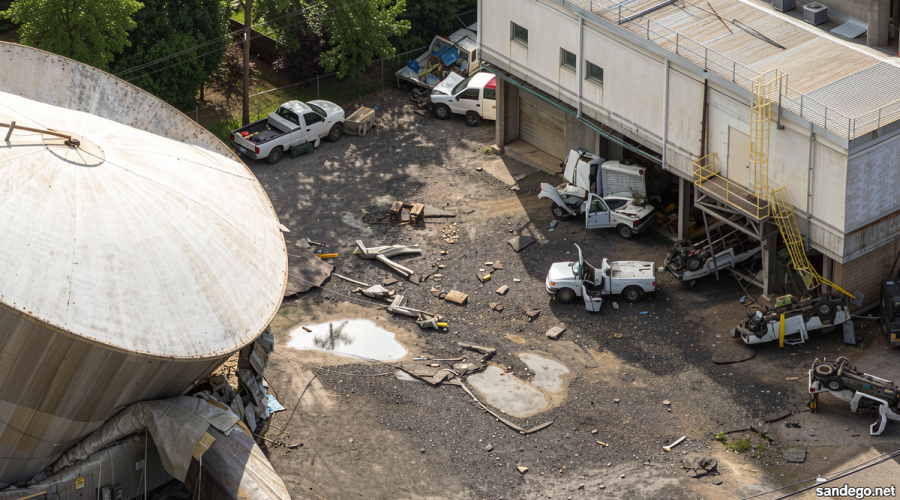
The rupture blew out sections of building walls, flooded the courtyard, crushed parked vehicles, and tore through adjacent structures before the liquid reached lower floors where workers had gathered for morning briefings. All eight employees in the electrical maintenance shop were killed, along with one worker in the courtyard. In the mechanical maintenance shop, five employees and their foreman escaped, but two of those who got out died from chemical exposure. Two additional survivors sustained serious burns.
A compounding failure followed in the emergency response. The company radioed its medical emergency team but did not specify that white liquor — a highly corrosive solution used to break down wood fibers in papermaking — had been released. One responder waded into what appeared to be a pool of water, discovered it was caustic liquid, and suffered serious burns while attempting a rescue.
Regulatory Aftermath and Open Questions
The Chemical Safety Board stressed that its investigation is ongoing and that the precise structural cause of the failure has not yet been determined. The agency emailed Nippon Dynawave seeking comment; a person who answered the phone at the Longview plant declined to speak, and a voicemail was left requesting a statement. A similar message was left with Applied Technical Services, though the federal report did not explain why that firm had been conducting the inspections.
Earlier that same week, the Washington Department of Ecology issued a notice listing 35 environmental violations against Nippon Dynawave, adding regulatory pressure to the already intensifying scrutiny of the company’s maintenance and safety practices.
Frequently Asked Questions
Where did the tank rupture occur? The failure took place at the Nippon Dynawave Packaging Company facility in Longview, Washington, on May 26, 2026.
How many people died? Eleven people were killed: eight in the electrical maintenance shop, one in the courtyard, and two who escaped the mechanical maintenance shop but died from chemical exposure.
When was the tank first flagged as unsafe? An outside inspection in July 2025 declared the vessel “not fit for continued service.” Follow-up inspections in October 2025 and February 2026 confirmed the problem persisted.
What substance was released? Approximately 900,000 gallons (3.4 million liters) of caustic white liquor, a corrosive solution used in the papermaking process to break down wood fibers.
What is happening now? The U.S. Chemical Safety Board investigation remains open. The Washington Department of Ecology has separately cited 35 environmental violations against the company.