
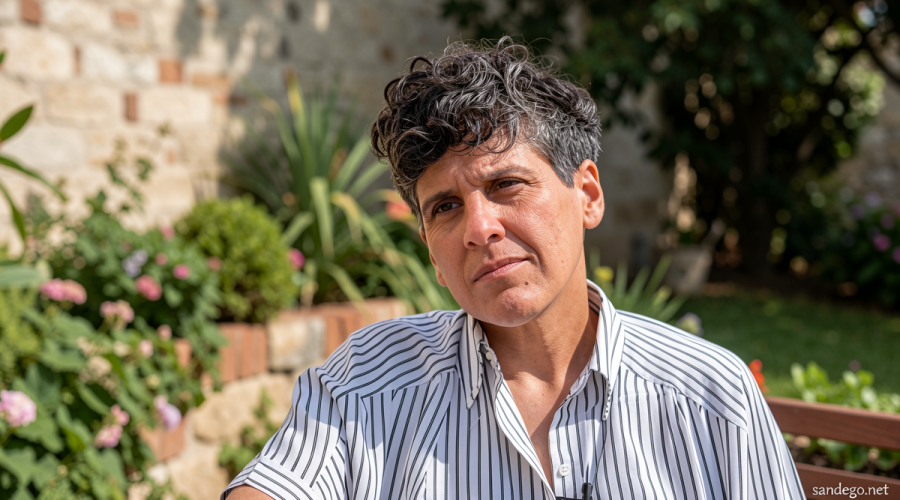
A Venezuelan Woman’s Three-Week Detention After a Routine Domestic Flight Exposes the Reach of New Immigration Enforcement
Sandego.net – Indi Veitia, a 47-year-old Venezuelan professional who has lived in Indiana since 2019, spent three weeks in a federal detention center after immigration officers pulled her from a jetway at Hartsfield-Jackson Atlanta International Airport earlier this month. She was boarding a domestic flight home when men in plain clothes pressed her against the wall of the boarding bridge, cuffed her wrists, and escorted her down a set of stairs into unmarked sport-utility vehicles. The episode, which she described as indistinguishable from a kidnapping, ended only after a Tuesday court-ordered compliance visit to an Immigration and Customs Enforcement field office tucked inside a generic commercial complex along the I-465 loop around Indianapolis.
Veitia entered that nondescript building without knowing whether she would walk out. After roughly twenty minutes of waiting, officers moved her to a nearby facility operated by a government-contracted security firm. Approximately two hours after her initial arrival, she stepped outside, collapsed into the arms of friends who had gathered to meet her, and wept. Clamped to her right ankle was a new electronic tracking device. The psychological toll, she said, was heavier than any hardware.
“I’m broken. There is nothing I can do.”
A Life Built on Paperwork That Was Supposed to Be Enough
Veitia arrived in the United States on a visa in 2019 and filed for asylum in 2020. Her application receipt, issued that same year, carries the language: “You may remain in the US until your asylum application is decided.” She holds a driver’s license and a work permit. As of her detention, she had not yet been scheduled for an asylum interview and was still awaiting a call from the agency to process her claim.
She describes herself as a rule-follower. Over the years she climbed from a warehouse position to a corporate role at a national clothing company, a job that required regular business travel across the country. In Indiana, she and her wife cultivated friendships, adopted puppies, and settled into the rhythms of suburban life while the government processed their paperwork. The notion that a routine domestic flight could trigger a three-week incarceration never crossed her mind.
When the officers finally asked her immigration status at the jetway, she chose silence. She explained the decision to CNN:
“In any other circumstances, I probably will have answered those questions, but at that moment I felt that they were already being extremely rude and extremely aggressive to me. That’s how kidnaps happen in my country.”
Conditions Inside the Lumpkin Detention Center
Veitia was held at the federal facility in Lumpkin, Georgia, where she said she was issued a thin sheet, a uniform, and towels worn nearly to threads. Her dormitory had no windows and housed more than sixty women who shared four toilet stalls and four shower fixtures. On one occasion, running water was unavailable for eight consecutive hours; on another, the building lost electrical power entirely.
“In that center, everything is awful. The treatment is awful.”
The Broader Enforcement Shift
Veitia’s case sits inside a rapidly expanding pattern. The Trump administration, which made mass deportation a centerpiece of Donald Trump’s re-election platform, has set an internal target of 2,000 daily arrests. Deputy chief of staff Stephen Miller has been a visible architect of that agenda. Enforcement tactics have widened steadily: from processing undocumented immigrants already in custody, to sweeping foreign-student populations, to workplace raids frequently staged in cities governed by Democrats, to routine traffic stops, and now to cross-referencing the personal data passengers submit before boarding domestic flights.
The Department of Homeland Security, which supervises ICE, declined to answer specific questions but issued a statement framing the policy change:
“DHS reversed the horrendous Biden-era policy that allowed aliens in our country illegally to jet around our country. Under President Trump, DHS will no longer tolerate this. This administration is working diligently to ensure that aliens in our country illegally can no longer fly unless it is out of our country to self-deport.”
The statement’s language treats Veitia’s situation as straightforward, yet her asylum receipt, work authorization, and driver’s license all indicated lawful presence while her claim was pending. The gap between what her documents said and what officers assumed at the jetway illustrates a deeper problem: a system in which even people holding valid paperwork cannot reliably predict whether a routine act—buying a ticket, walking down a boarding bridge—will end in handcuffs.
What the Chaos Means for People in Pending Status
Jorge Gavilanes, an immigration attorney with decades of practice, summarized the current environment in blunt terms:
“We’ve been describing the immigration system as broken for decades. Now it’s just complete chaos.”
For the estimated hundreds of thousands of asylum-seekers nationwide who are waiting for interviews, work permits, or travel documents, Veitia’s experience functions as a warning that the threshold for detention has dropped below what most people assumed. A pending application, once treated as a shield against removal, now appears to offer no practical protection against a jetway stop. The ankle monitor she wore home to Indianapolis signals that even after release, the state’s grip does not loosen; it simply changes form.
Veitia chose to tell her story publicly because, in her words, she had contributed to her community and her employer, had never broken a single law, and still endured what she calls “hell.”
“I thought that I was going to lose my mind. I never thought that I could experience something like this in a country where you believe that the people do the things by the book.”
As the administration presses toward its daily-arrest quota and DHS continues to close what it calls loopholes in domestic travel, the question facing every person with a pending immigration case is no longer whether their paperwork is complete. It is whether the officers at the next boarding bridge will bother to look at it at all.
Related Reading
Frequently Asked Questions
What is She thought she had permission to be?
She thought she had permission to be is the main topic of this guide. The article explains the context, practical details, and next steps readers should understand.
Why does She thought she had permission to be matter?
She thought she had permission to be matters because readers are looking for a useful answer, not just a short summary. Good content should match search intent and help them decide what to do next.