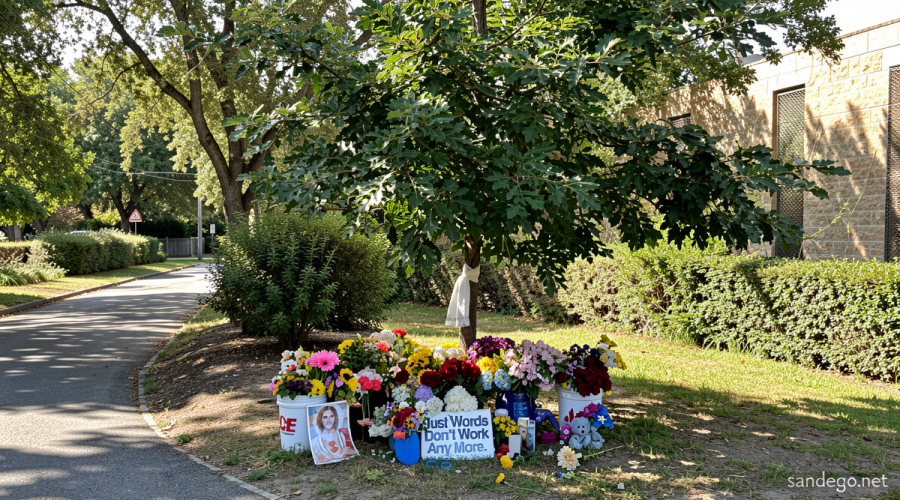
One Year Later: Minneapolis Releases Extensive Files on Annunciation Church Massacre
Sandego.net – City officials in Minneapolis unveiled a sweeping collection of records marking the first anniversary of the August 27, 2025, massacre at Annunciation Church and School — a Catholic parish and educational campus in the city’s north side. The trove, assembled in response to a public records request, spans hundreds of pages and nearly 1,500 photographs, capturing witness statements, evidence inventories, and officer narratives from the hours and days following the attack. What the files make unmistakably clear is how rapidly law enforcement converged on the scene. What they leave largely unanswered is why a 23-year-old man named Robin Westman chose that morning to walk into a congregation and open fire.
A Response Measured in Minutes
Dispatch timestamps embedded in the records show the first responding unit reached the church roughly three and a half minutes after the initial call reporting a possible shooting. Within that narrow window, dozens of officers from Minneapolis Police plus agencies representing state, federal, and neighboring local jurisdictions had already begun moving toward the campus. By the time the first boots crossed the threshold, Westman — armed with a rifle, a shotgun, a pistol, knives, smoke bombs, and multiple magazines of ammunition — was already lying on the ground with a self-inflicted gunshot wound. The gunfire had stopped; the aftermath had begun.
The documents describe a crime scene of extraordinary scale. Bullet perforations pocked the church walls. Shell casings were recovered not only from the sanctuary and the adjacent playground but from the gutters and exterior walls of homes scattered through the surrounding residential block. Officers who entered the nave reported victims sprawled across pews, shattered glass on the floor, and the sharp acrid odor of discharged powder hanging in the air. One report opened with a candid note that the author had not reviewed his own body-camera footage from the call and did not intend to.
Triage Under Pressure
In the chaotic first minutes inside and outside the building, responding officers performed field triage on as many wounded as they could reach. Pressure was applied to open wounds; a tourniquet was applied to an adult woman struck in the leg in the parking lot, who was hemorrhaging rapidly. The officer who stabilized her rode alongside her ambulance to the hospital. Hospital staff later told investigators that his intervention likely kept her alive.
Survivors recounted the experience from inside the sanctuary. Many had been seated for Mass when the first shots rang out from outside and windows exploded inward. At least one witness described pressing both hands against the inner doors of the church, holding them shut as the exterior doors rattled with impacts. Children told officers they had dropped beneath pews or followed adults into side rooms. Preschool teachers described barricading classroom doors and working to keep small children calm while sheltering them as best they could.
The records also capture the human tide that followed: parents rushing the perimeter searching for their children, spouses who worked at the school frantically calling for colleagues. One woman told investigators her husband had scooped up their young child and concealed the pair beside an ice machine in the church basement until officers arrived.
What the Files Add — and What They Do Not
Most of the evidentiary material — weapon lists, seized personal effects, journal entries, photographic logs — had already been reported in the weeks after the shooting. A small number of previously undisclosed details, however, shed limited light on Westman’s movements in the days before the attack. A search warrant attached to the file revealed that the vehicle Westman drove to the campus that morning, and in the days preceding it, was equipped with a dashcam. Officers who reviewed the footage described a man who appeared visibly agitated following a family visit and, on at least one occasion the night before the shooting, sobbed while driving past the church and school.
The records also contain transcripts of police interviews with Westman’s father, an ex-girlfriend, a close friend, and former co-workers. Collectively, those acquaintances painted a picture of a somewhat withdrawn young man prone to depressive episodes. Several noted he had spoken of suicidal thoughts years earlier, yet none recalled seeing indications that he was capable of inflicting harm on others. His father told investigators he had perceived no cause for alarm before the shooting, mentioning only that Westman had been struggling to eat and had lost considerable weight. Multiple relatives declined to speak with law enforcement at all.
The Motive Remains Elusive
Investigators had previously characterized Westman as “full of hatred” and as displaying what appeared to be admiration for earlier American mass shooters. He had written the names of those prior killers across the weapons, gear, and ammunition he brought to the church, alongside a series of statements attacking religions, racial groups, and ethnicities in a jumbled arrangement that offered little coherent insight into his targeting logic or decision-making that morning.
The two children killed were Fletcher Merkel, age 8, and Harper Moyski, age 10. At least 21 additional children and adults sustained injuries before Westman took his own life at the scene. The Annunciation campus, a long-standing fixture of Minneapolis’s north side, had served both as a parish and as a K-12 school, drawing families from across the metro area each weekday. The release of these files, timed to the anniversary, underscores how much of the public’s understanding of that morning still rests on the raw operational record rather than on a completed narrative of motive.
Related Reading
Frequently Asked Questions
What is A year after Minneapolis Catholic school?
A year after Minneapolis Catholic school is the main topic of this guide. The article explains the context, practical details, and next steps readers should understand.
Why does A year after Minneapolis Catholic school matter?
A year after Minneapolis Catholic school matters because readers are looking for a useful answer, not just a short summary. Good content should match search intent and help them decide what to do next.