Executive Order Renames Lake Ontario to “Lake America” Amid Escalating Trade Clash With Canada
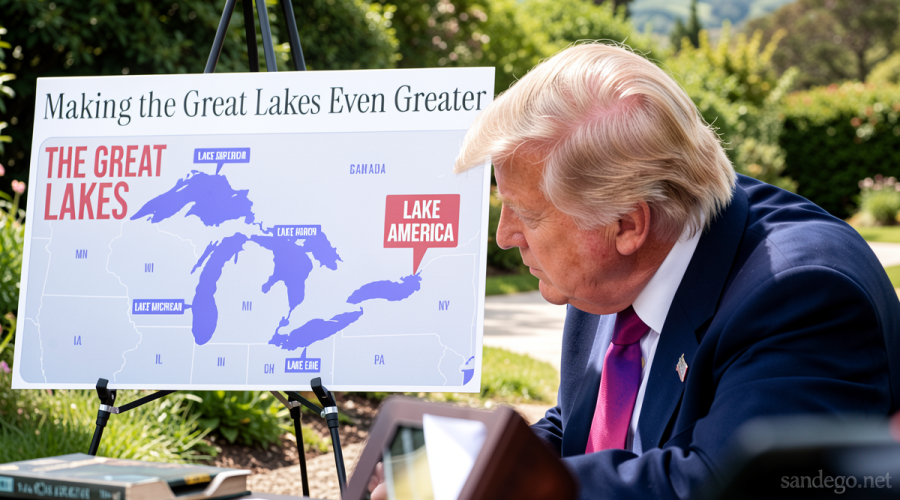
Sandego.net – In a move that has drawn immediate attention from diplomats, cartographers, and ordinary residents along the Great Lakes shoreline, President Donald Trump signed an executive order on Thursday afternoon directing that Lake Ontario be officially redesignated as “Lake America.” The action lands at the height of a bitter trade confrontation between Washington and Ottawa, and it marks yet another step in what observers describe as an increasingly theatrical campaign of pressure aimed at Canada’s government and public.
The Oval Office Announcement
Speaking from the Oval Office, flanked by oversized wall maps depicting the five Great Lakes, Trump framed the renaming as a long-held personal conviction rather than a spur-of-the-moment provocation.
“‘Lake of America’ was something I’ve been thinking about for a long time,” he said. “We have a gulf and we have a lake. Now, all we need is an ocean. So, maybe we’ll have to change the name of the Atlantic and/or the Pacific. Maybe we’ll change them both.”
The president declared the change “effective immediately” and insisted that his administration had already completed every procedural step required to make the new designation official.
“[My staff has] filed all the necessary papers, documents, everything else,” he added, gesturing toward the maps behind him.
Geographic Justification Offered by the White House
A White House aide, speaking to reporters after the announcement, pointed to hydrological data to defend the renaming. The aide noted that the majority of Lake Ontario’s total water volume sits beneath the United States’ border, and that the lake’s deepest points fall within American territory. While Lake Ontario does straddle the border between New York State and the province of Ontario, the bulk of its surface area and its deepest bathymetric readings do indeed lie on the U.S. side of the international boundary. The aide’s argument, in short, was that the lake belongs more to America than to Canada in measurable physical terms.
Cartographers and state-geography officials have historically treated the Great Lakes as shared international waters governed by bilateral treaties dating back to the 1909 Boundary Waters Treaty. Whether a unilateral executive order can override decades of joint-management agreements, or whether it will simply create a parallel nomenclature used in federal documents while Canadian and New York State agencies continue to use the traditional name, remains an open legal question.
Trade War Context and Rhetoric
Asked by reporters why he was directing his most visible provocations at American allies rather than at traditional adversaries, Trump did not soften his language.
“The Canadian officials have treated us very badly. They’re nasty people,” he said.
He went on to describe Canadians as the “worst to deal with on trade,” characterizing them as “entitled.” The remarks came amid a series of tariff disputes, retaliatory duties, and public sparring between the two governments that have pushed bilateral trade relations to their lowest point in decades. Canada, the United States’ largest trading partner by volume, has responded to Washington’s levies with its own countermeasures, and both capitals have exchanged pointed statements in weekly press briefings.
For residents of Buffalo, Rochester, and the broader Finger Lakes region of New York, as well as for communities in southern Ontario, the lake is not an abstraction. It supplies drinking water to millions, anchors commercial and recreational fishing industries, and features in local place names, school curricula, and municipal signage. A federal renaming order does not automatically rewrite street signs or municipal water-treatment facility labels, but it does alter the terminology used in federal environmental reports, shipping regulations, and intergovernmental water-quality agreements.
Broader Implications
The episode underscores a pattern in which the administration has used symbolic, high-visibility gestures—naming changes, tariff announcements delivered with theatrical flair, and pointed personal remarks about allied leaders—to keep pressure on foreign governments while domestic audiences watch. Critics argue that such moves risk eroding the informal goodwill that has historically allowed the two countries to resolve trade frictions through back-channel negotiation. Supporters contend that a firm public posture is necessary to signal that Washington will not absorb economic concessions quietly.
Whether “Lake America” will persist in federal documents, appear on updated nautical charts, or be quietly reverted by a future administration is uncertain. What is certain is that the name change has already become a flashpoint in a trade dispute that both governments say they intend to resolve, though neither has yet indicated a concrete path back to the negotiating table.
This is a developing story and will be updated as Canadian officials and New York State representatives respond to the executive order.
Related Reading
Frequently Asked Questions
What is Trump signs executive order to change?
Trump signs executive order to change is the main topic of this guide. The article explains the context, practical details, and next steps readers should understand.
Why does Trump signs executive order to change matter?
Trump signs executive order to change matters because readers are looking for a useful answer, not just a short summary. Good content should match search intent and help them decide what to do next.