
A Millennium of Coral Data Reveals El Niño Is Growing More Violent
Sandego.net – The swirling ocean-atmosphere pattern known as El Niño is no longer behaving the way it did for centuries. A sweeping new analysis, published this week in the journal Science, demonstrates that the warm-phase episodes of the past four decades have grown roughly 36 percent more intense than their pre-industrial counterparts and approximately 16 percent stronger than those recorded throughout the twentieth century. The finding arrives at a moment of acute relevance: a Super El Niño is currently building in the tropical Pacific and is projected to become the most powerful such event since at least 1950, possibly stretching back further still.
Reading the Ocean’s Memory in Living Stone
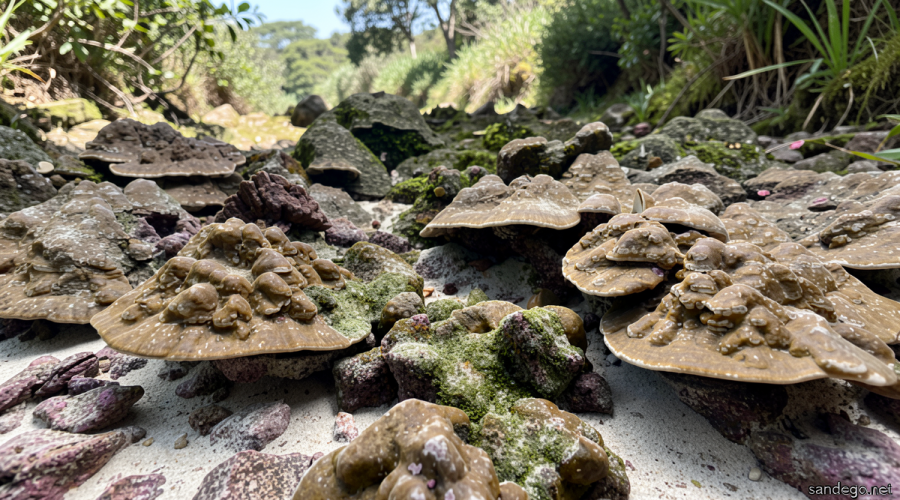
The backbone of the research is a millennium-long climate archive extracted from both living and fossilized corals collected in the Galápagos Islands. Those volcanic archipelagos sit squarely in the eastern tropical Pacific — the precise region where El Niño originates and where its thermal signature is most acute. By measuring the ratios of specific isotopes locked into the calcium-carbonate skeletons of ancient reef cores, the team reconstructed sea-surface temperature variability stretching back roughly 1,000 years.
“The corals preserve a history of the conditions under which they grew in the chemistry of their skeleton, and we’re able to extract that history by measuring the chemistry,” said Julia Cole, lead author of the study and a researcher at the University of Michigan.
Cole’s group paired this biological archive with outputs from twelve cutting-edge climate models. The dual approach was essential: it allowed the authors to separate genuine long-term shifts from the natural oscillations that have always punctuated the El Niño–Southern Oscillation cycle. Once the models accounted for internal variability, the residual signal pointed unmistakably toward an external forcing consistent with anthropogenic warming.
A Break in a Thousand-Year Pattern
The data show that El Niño episodes beginning with the 1982–1983 Super El Niño depart sharply in magnitude from anything visible in the preceding millennium of coral-derived records. The amplitude of the full El Niño–La Niña seesaw is widening, and the cycle is tilting decisively toward the warm pole. In practical terms, that means hotter-than-average sea-surface temperatures across the equatorial Pacific are occurring more frequently and with greater severity, dragging atmospheric circulation patterns with them and reshaping rainfall, drought, and storm tracks on every continent.
“Something is going on now that is highly unusual and very likely due to human-caused climate change,” said Jonathan Overpeck, co-author of the study and dean of the School for Environment and Sustainability at the University of Michigan.
Overpeck and his coauthors emphasized that the El Niño events of the last four decades represent a system that has been fundamentally perturbed. Cole put it plainly: the ocean-atmosphere machine is no longer cycling within its historical envelope.
Attribution Still Requires One More Step
The authors were careful to note that their analysis stops just short of a formal causal attribution. Pinning the recent intensification squarely on greenhouse-gas emissions, rather than on some as-yet-unidentified natural driver, demands additional targeted research. Even so, the weight of evidence in the paper leaves anthropogenic global warming as the most plausible explanation for the observed strengthening. The study thus joins a growing body of independent work pointing to climate-change-driven alterations in El Niño’s frequency, duration, and peak intensity.
Why the Galápagos Matter
For readers unfamiliar with the mechanics, El Niño forms when trade winds weaken along the equator, allowing warm water that normally pools in the western Pacific to slosh eastward. The Galápagos sit at the eastern terminus of that warm-water tongue, making them a natural sensor for the phenomenon’s onset and peak. Kim Cobb, a coral specialist at Brown University who was not part of the new team, called the study’s choice of archive location and method “close to the gold standard.”
“This is a timely and important addition relevant to the question of climate change impacts on El Niño strength,” Cobb said. “While we wait to see just how large the 2026 El Niño will become, this study provides fresh evidence that man-made global warming may be responsible for a portion of its chart-topping size.”
Implications for the Coming Months
The current episode is already outpacing every historical benchmark except the very most extreme events on record. If forecasts hold, the 2026 event will set new thresholds for sea-surface temperature anomalies across the Niño-3.4 region. Downstream consequences are well documented: elevated global mean surface temperatures for the following six to nine months, disrupted monsoon timing across South Asia, heightened wildfire risk in parts of Australia and South America, and increased tropical-cyclone activity in the western Pacific basin. Each additional degree of background warming raises the baseline from which El Niño’s thermal anomaly is measured, effectively amplifying the event’s footprint on global weather.
The coral record assembled by Cole and colleagues will remain a foundational dataset for decades. It gives climate scientists a rare, long-baseline yardstick against which to judge whether future El Niño peaks represent continued anthropogenic amplification or a return to the natural variability that dominated the previous thousand years. As the current Super El Niño matures over the coming weeks, that yardstick will be watched closely by forecasters, policymakers, and communities in the tropics who depend on accurate seasonal outlooks to plan agriculture, water management, and disaster preparedness.
Related Reading
Frequently Asked Questions
What is El Niño events are becoming stronger?
El Niño events are becoming stronger is the main topic of this guide. The article explains the context, practical details, and next steps readers should understand.
Why does El Niño events are becoming stronger matter?
El Niño events are becoming stronger matters because readers are looking for a useful answer, not just a short summary. Good content should match search intent and help them decide what to do next.