
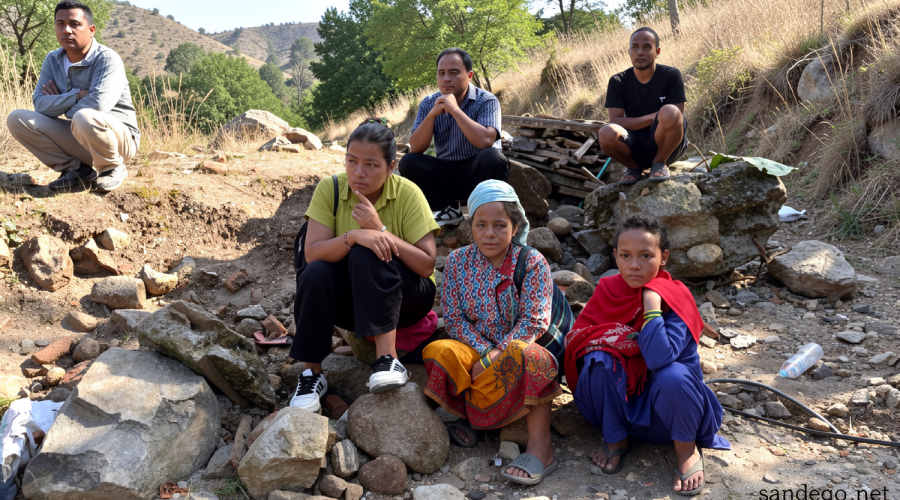
A Global Wait: Families Across Five Continents Brace for News After Nepal-China Flood Catastrophe
Sandego.net – The moment floodwaters tore through a narrow Himalayan valley on Wednesday, the immediate devastation was felt by the farming and ethnic communities crammed along the swollen Trishuli river. But within hours, the catastrophe had become a worldwide ordeal. In living rooms from Delaware to Ottawa, from New York to Auckland, relatives of missing travelers, workers, and pilgrims sat before phones and screens, refreshing feeds and dialing numbers that went unanswered. A physician from Delaware, a New Zealand mother of two children, and three teenagers from the United States and Australia were among those whose whereabouts remained unknown as rescue operations continued into Thursday.
The geography of the disaster explains both its local ferocity and its international reach. The Trishuli river carves through the districts of Rasuwa, Nuwakot, and Dhading, a corridor that has drawn outsiders for decades. Summer and early autumn bring trekkers, rafters, and pilgrims of multiple faiths — Hindu, Buddhist, Jain, and Bonpo devotees who pass through the valley en route to Tibet’s sacred Mount Kailash. Foreign-funded hydropower projects also anchor the region’s economy, meaning the workforce is not exclusively local. When the waters rose, they carried away not only homes but a cross-section of nationalities.
The Borderland Strike
The triggering event was a powerful landslide on the Nepal-China border. The debris flow then surged into Gyirong Port, one of the principal overland crossings between the two countries, burying infrastructure and trapping people on both sides. Hundreds remain unaccounted for within China’s territory as well. Authorities in both nations have withheld the names of confirmed fatalities and missing persons while search-and-rescue teams work through debris and unstable terrain. Social media has become an informal casualty board, crowded with pleas from the Nepali diaspora and from families abroad who cannot reach anyone in the affected zone.
Communities Already on the Edge
The districts now under water hold more than half a million residents by recent census counts. Their populations are ethnically layered — Tamang, Gurung, Newar, and others who have inhabited these valleys for centuries. Agriculture remains the backbone of daily life, though a growing tourism sector has given some families a second income stream. Each summer, hundreds of pilgrims of four different traditions thread through the area toward Mount Kailash, adding seasonal pressure to already fragile infrastructure.
Vulnerability here is not accidental. Rasuwa and neighboring districts have carried historically elevated poverty rates and sit squarely on the front line of climate-driven hazards: forest fires, glacial lake outbursts, and landslides have become recurring threats. Many of the families now submerged had spent the decade since 2015 rebuilding after the earthquake that killed more than 8,000 people across Nepal. Displaced households were resettled on the low-lying banks of the Trishuli — the very ground that Wednesday’s flood consumed.
Families in the Waiting
In Kathmandu, Asmita Dahal has been refreshing her phone since Wednesday morning. Her younger brother, Suman Dahal, 21, works for a tour group that escorts pilgrims to Mount Kailash. He had been preparing to board a bus back to Kathmandu from Timure, a small settlement on the Trishuli’s bank.
“We are worried his bus might have been swept away in the flooding, we just don’t know,” Asmita said. “We are hoping for a miracle.”
The last words her brother spoke to her on Wednesday were: “See you in the morning.”
Thousands of miles away, the anxiety is no less acute. The Nepali diaspora numbers more than 2.1 million people worldwide, and Wednesday’s news sent them scrambling to reach relatives and friends in the affected districts. Pema D. Gurung, who runs a Nepali restaurant in New York, said the flood severed phone and internet connectivity in Rasuwa, leaving him unable to confirm whether his many friends there survived.
“In my mind and in my heart, I’m hoping my friends are alive,” Gurung said.
In Ottawa, Rojina Dhungana woke to reports that her hometown on the Trishuli riverbank had been swept away. Her parents were confirmed safe, but former neighbors and schoolmates had not been accounted for. On social media, the diaspora’s grief and urgency bled into a single, repetitive cry.
“Everybody I knew – my friends, my relatives, my community – everybody was looking, like ‘Help, help, help, this person is missing!'” she said.
Numbers Still Unfolding
The Nepal Tourism Board has confirmed that at least 517 foreign nationals are among those missing within Nepal. Chinese authorities report another 260 unaccounted for on their side of the border. Among the missing are at least 178 Indian nationals, many of whom were on pilgrimage to Mount Kailash, and 53 Ukrainians. The full toll — dead, injured, and still missing — has not been released by either government as rescue operations continue.
What is clear even before final counts are published is that the disaster struck a region where poverty, climate exposure, post-earthquake displacement, and seasonal influxes of outsiders converge. The Trishuli valley, for centuries a corridor of faith and subsistence, now faces a reckoning that will be felt in embassies, hospital wards, and family kitchens on every continent where a Nepali or foreign traveler once called home.
Related Reading
Frequently Asked Questions
What is Around the world people desperately search?
Around the world people desperately search is the main topic of this guide. The article explains the context, practical details, and next steps readers should understand.
Why does Around the world people desperately search matter?
Around the world people desperately search matters because readers are looking for a useful answer, not just a short summary. Good content should match search intent and help them decide what to do next.