Tupac Trial: Prosecutors Rest Their Case
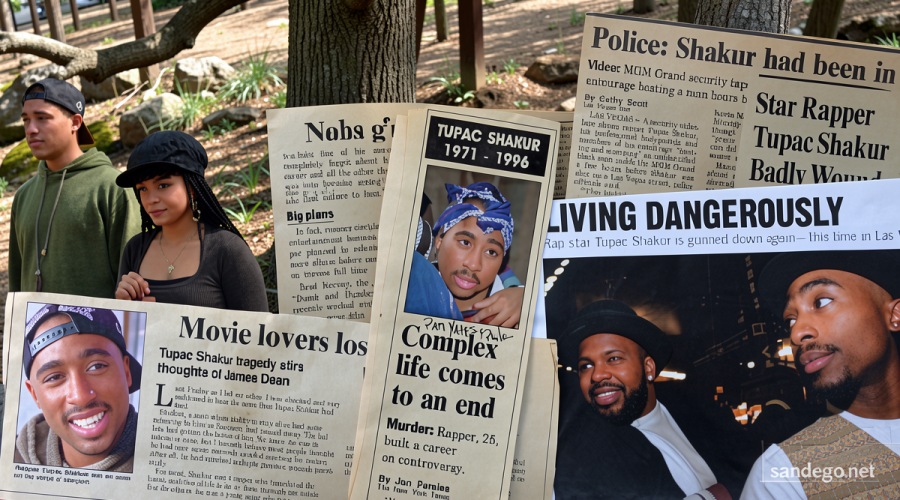
Sandego.net – Prosecutors rest their case in Tupac Shakur’s murder trial after assembling a prosecution built almost entirely from the defendant’s own recorded voice. In a sealed, windowless courtroom in Las Vegas, Clark County District Attorney Marc DiGiacomo and Chief Deputy District Attorney Binu Palal formally closed their case on Wednesday following roughly ten days of testimony from 25 witnesses. The state’s theory: Duane Davis, known on the streets as “Keffe D,” fired the shots that killed the rapper on September 7, 1996.
Rather than relying on a single eyewitness or a forensic exhibit, the state leaned on nearly eight hours of audio captured across four sessions spanning 2008, 2009, and two recordings made in 2017. Each version contained minor inconsistencies, yet every one placed Davis in a vehicle running alongside Shakur’s car that night in Las Vegas.
The Absence of Physical Evidence
Nearly three decades separate the jury from the crime scene, and that temporal gap created a vulnerability no amount of recorded confession can fully close. Neama Rahmani, a former federal prosecutor who now heads the West Coast Trial Lawyers organization, noted that the state has not corroborated Davis’s admissions with independent forensic material.
“The prosecution hasn’t yet been able to corroborate Davis’s confessions with independent evidence because any DNA, fingerprints, and the murder weapon are long gone.”
With no recovered firearm, no biological traces, and no fingerprints tying the defendant to the scene, the prosecution’s foundation rests squarely on the credibility of the recordings — a premise defense counsel will almost certainly probe for weaknesses.
What the Recordings Reveal
Jurors endured hours of audio of uneven quality. Low-frequency static swallowed entire phrases at times; at others, voices erupted with startling volume across the sealed room. Davis, seated before the microphone in each session, watched and listened to a younger version of himself with a blank, unreadable expression.
Two recordings stem from interviews conducted in December 2008 and March 2009 with law-enforcement officers and his attorney, part of a proffer arrangement tied to separate drug charges. In the earlier session, Davis spoke in a notably relaxed, almost playful tone. Then-Los Angeles Police Department Detective Greg Kading had assured him beforehand:
“Nothing you say today will be used against you.”
The state contended that this informal immunity evaporated once Davis began discussing the Shakur killing publicly. Judge Carli Kierny agreed, ruling that both the police interviews and passages from Davis’s 2019 memoir, Compton Street Legend, are admissible at trial.
The Narrative Davis Tells
Across every recording and the memoir, Davis follows a consistent arc. It opens at the MGM Grand, where his nephew Orlando Anderson was kicked to the ground by members of the Death Row Records entourage, including Shakur himself and label chief Marion “Suge” Knight. After that altercation, Davis and fellow South Side Crips members drove to Club 662, a venue Knight owned, hoping to confront the group. They did not find them there. Leaving the club, their vehicle happened to pass Shakur and Knight as the two were driving away.
The confrontation escalated as the two cars ran side by side. Davis says he passed a handgun to the rear seat, where Deandre Smith and his nephew — known as “Baby Lane” — were seated. In the 2008 recording, his voice swelled with the courtroom’s acoustics as he recalled the exchange:
“I gave it to Dre, and Dre was like, ‘No, no, no.’ And Lane’s like, ‘Give it here.’ He popped it to him.”
That passage represented the most complete oral retelling of Davis’s account presented to the jury during the prosecution’s case.
Defense Prepares to Respond
The court adjourned after fewer than sixty minutes of Wednesday testimony. Defense attorney Michael Sanft was scheduled to begin presenting his case Thursday. He indicated plans to call two Las Vegas Metropolitan Police Department officers to press clarifying questions he felt were overlooked during the state’s presentation, along with a detective who participated in the 2009 proffer interviews but had not yet testified.
Asked whether Knight — now serving a prison sentence on unrelated charges — would appear on the stand, Sanft laughed off persistent rumors that he had paid the former hip-hop executive to testify.
Frequently Asked Questions
Why did prosecutors rely on recordings rather than physical evidence? Because nearly 30 years have passed since the September 1996 shooting, the murder weapon, DNA samples, and fingerprints were never recovered. The recorded confessions became the state’s primary evidence.
Were the recordings legally admissible? Yes. Judge Carli Kierny ruled that the 2008 and 2009 police interviews and excerpts from Davis’s 2019 memoir Compton Street Legend could be entered into evidence, rejecting the defense argument that the informal “nothing you say will be used against you” assurance created a binding immunity.
What happens next in the trial? Defense attorney Michael Sanft was set to begin presenting his case the following day, with plans to call two LVMPD officers and a detective connected to the 2009 proffer interviews.