One American Woman, One License, and a Dying Tradition on Jeju’s Western Shore
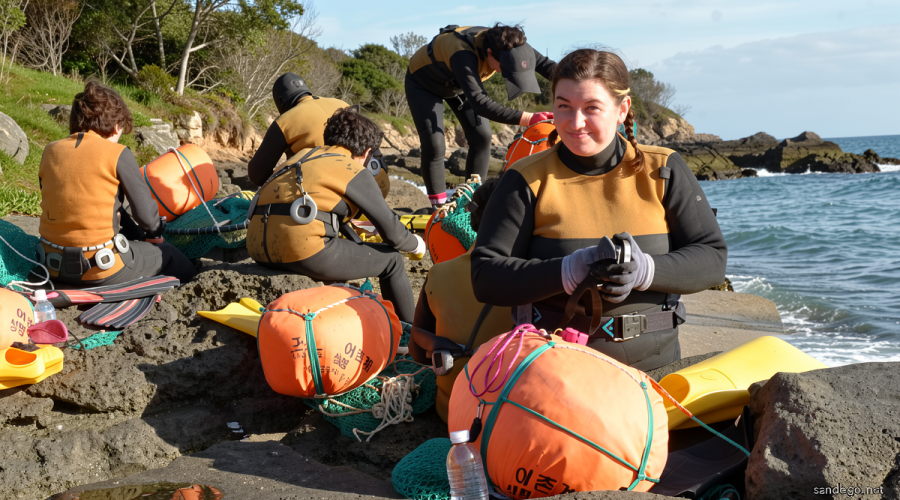
Sandego.net – In a quiet fishing hamlet called Youngrak-ri, tucked along the far western coastline of South Korea’s volcanic island of Jeju, the sound of a baby crying has grown nearly silent. The village once earned its reputation from two things: rich farmland and the rare sighting of dolphins gliding past the breakwater. Today, its most talked-about resident is something no one expected — a 36-year-old American woman who holds the country’s sole foreign haenyeo license, making her the only non-Korean citizen legally permitted to engage in commercial traditional free-diving on Korean waters.
Haenyeo — a term combining hae (sea) and nyeo (women) — are female free divers who descend into cold ocean waters without any breathing apparatus to harvest shellfish, seaweed, and small fish. The practice is centuries old, rooted in Jeju’s maritime culture, and for generations it passed from mother to daughter within tight-knit coastal communities. A license is mandatory for anyone wishing to dive commercially under the traditional method, and local officials confirm that as of this year, Kylie Genter is the only foreigner to possess one.
“I didn’t think I was paving a way… As a foreigner doing this, especially as a person who is not a Korean citizen, it’s a big responsibility.”
Her presence has transformed Youngrak-ri from a sleepy, depopulating outpost into a destination for journalists, cultural researchers, and curious tourists. Kim Chang-sik, the village’s 70-year-old fishery chief who has spent his entire life in the hamlet, describes the influx with visible excitement.
“Our village has the first American haenyeo, so a lot of people have been visiting to interview her!”
From Upstate New York to Jinju: An Unplanned Path
Genter’s trajectory toward the ocean floor was anything but deliberate. After graduating from college and spending time studying abroad in Europe, she turned her attention eastward toward Asia. In 2012 she began searching for English-teaching positions. Japan had been her first choice — she had studied the language during her undergraduate years — but a listing from South Korea that included free housing changed the calculus. She landed a teaching post in Jinju, a historic city in South Gyeongsang province, and stayed for four years.
The cultural shock was considerable, though she found unexpected parallels between her native New York and Korean urban life.
“I think that New York people and Korean people are similar in that there’s not a ton of small talk, and people work hard and play hard, and they’re very kind, but they can kind of have a harder exterior.”
Jinju, she says, forced her to learn Korean quickly. After four years, restlessness set in. She considered relocating to Seoul, partly because her obsession with attending K-pop concerts made the capital feel like a natural next step.
“I was thinking of living in Seoul because I was going to K-pop concerts all the time, so I thought I could save money by living in Seoul. But then there was an opportunity in Jeju that was more interesting and paid more, so I thought, ‘Okay, well, I’ll go for it, Jeju seems cool, I can live there for a little while,’ and that was 10 years ago.”
Jeju: Korea’s Busiest Flight Route and Its Demographic Wound
Jeju sits in South Korea’s southernmost region and has long functioned as the nation’s premier leisure island, occasionally dubbed “Korea’s Hawaii.” The 75-minute hop from Seoul to Jeju is the busiest domestic air route in the world, a testament to how deeply the island is woven into Korean tourism. Yet beneath the resort economy lies a demographic emergency. The town of Daejeong-eup, which encompasses Youngrak-ri, holds just over 21,000 residents, and infant births there have dwindled to near zero. South Korea as a whole posts one of the lowest fertility rates on Earth, and the island is no exception.
“Now, it’s almost impossible to hear a baby crying in this village.”
That silence extends directly into the haenyeo workforce. There is no fixed retirement age for sea women; many continue diving well into their eighties and nineties, limited only by physical stamina. But the pipeline of young replacements has all but dried up. According to the Haenyeo Museum, as of last year, 63 percent of the 2,371 active haenyeo nationwide were aged 70 or older. Only 30 divers — just over one percent of the total — were 39 or younger. Without intervention, the tradition faces functional extinction within a single generation.
The Village’s Quiet Recruitment Drive
Facing that arithmetic, Youngrak-ri’s haenyeo community decided to act. In 2024, village elders spread word through informal networks and word-of-mouth that they were seeking young candidates willing to join their diving cooperative. The message traveled slowly, through the same channels that once carried market prices and weather warnings.
“We are in our 80s and 90s, so we saw the need to bring in new haenyeo,”
says Hong Bok-nyeo, the village’s haenyeo president, describing the decision to open the doors beyond the usual familial lines of succession.
Genter, already settled in the area and immersed in the local rhythm of tides and seasons, answered that call. She began diving in Youngrak-ri, learning the specific techniques of the village’s waters — the breath management, the harvest patterns, the communal rhythms of surfacing and reloading. Her license, once secured, made her a legal participant in a practice that had been, for centuries, exclusively Korean and overwhelmingly female.
What One License Changes
The implications ripple outward. For Youngrak-ri, Genter’s presence is a small but tangible counterweight to depopulation: she draws visitors, she generates conversation, she gives the village a story that transcends its provincial boundaries. For the broader haenyeo community, her existence raises a question that officials have long avoided — whether South Korea might formalize pathways for additional foreign divers, thereby widening the talent pool without diluting the cultural core of the practice. Whether that question will be answered in policy or remain a single-woman anomaly is uncertain. What is certain is that in a village where the cry of an infant has become a rarity, the sound of one American woman surfacing from cold water, hauling a basket of abalone, has become its own kind of lifeline.
Related Reading
Frequently Asked Questions
What is The accidental haenyeo?
The accidental haenyeo is the main topic of this guide. The article explains the context, practical details, and next steps readers should understand.
Why does The accidental haenyeo matter?
The accidental haenyeo matters because readers are looking for a useful answer, not just a short summary. Good content should match search intent and help them decide what to do next.