A Seventeen-Year-Old’s Fight for Life, and the Research Gap Behind It
Sandego.net – Pediatric cancer research receives roughly four cents of every federal research dollar allocated to oncology. Drug companies, meanwhile, routinely deprioritize trials aimed at children’s rare tumors. That funding and industry neglect shapes the daily reality of families like the McMuhans of Portland, Oregon — a household whose youngest daughter, Sabina, has endured five separate relapses of a bone cancer first diagnosed when she was twelve years old.
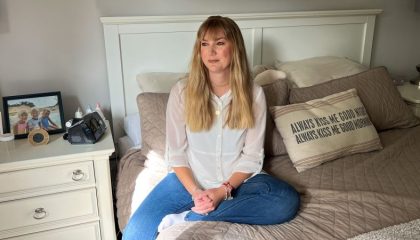
Sabina’s story, shared through a collaboration between the Global Health Reporting Center and the Pulitzer Center, reads less like a medical case file and more like a survival narrative written in fragments: the titanium rod now replacing the bone of her right knee, the beeping IV pole lashed to a child’s trike, the caution bag into which, in her telling, her former life was tossed. What follows is her account, along with that of her father Sean, edited for length and clarity.
The Diagnosis at Twelve
Most twelve-year-olds would have bolted from the examination room the moment a doctor used the word “cancer.” Sabina did not. She sat upright, swallowed, and listened as the physician dismantled the architecture of her childhood in real time. The explanation included poison injected directly into her bloodstream, radiation, and a major surgical resection that would excise the tumor from her right knee and substitute a heavy titanium prosthetic rod in its place.
“You don’t walk out on the plan to save your life. So you sit there and listen as they tell you about the poison they’ll be injecting into your body.”
She watched, through what she describes as blurry eyes, as the life she had known up to that moment was effectively sealed into a bag and set aside. There was, in her words, no other option.
What the Body Forgets
Years later, Sabina admits she retains almost no granular memory of her initial treatment course. Fellow patients in what they call the “cancer club” label the phenomenon ChemoBrain. As she has grown older, however, she has come to understand the gaps differently: medical post-traumatic stress disorder, or MPTSD, in which the nervous system suppresses recall of grueling episodes as a protective mechanism.
The memories that did survive are vivid and scattered. The operating theater for the resection. The absurd, desperate joy of strapping her IV pole to the back of a trike and looping the children’s oncology ward in circles, hoping to sweat out some of the chemotherapy. The particular expression on her parents’ faces, followed by the sweet chime of the completion bell.
“I remember the really high highs as well as the really low lows, and for reasons beyond my understanding, I wouldn’t trade my experience for anything.”
A Father’s Commute
Sean McMahon, Sabina’s father, describes a routine from autumn 2021 that has since become emblematic of the family’s years-long ordeal. He and his wife would text each other a simple “let’s go,” then drive in opposite directions along a dark, maple-strewn road toward Doernbecher Children’s Hospital in Portland. He was coming home from the chemotherapy ward to be with their younger son, Charlie. She was heading in to sit beside Sabina. The drive was six miles — just long enough, he says, to play three or four songs on the car stereo, volume cranked.
Nearly five years into the journey, those brief windows of weakness still catch him off guard. He describes being ground to a halt, reduced to tears and snot, and he chooses to process that collapse alone, behind a steering wheel with the music turned up. His go-to tracks include “Forever Young” by Alphaville, “Before I Walk on Fire” by Sophie B. Hawkins, and “Bigger Than the Whole Sky.”
Five Relapses and a Moving Target
After the initial surgery, radiation, and chemotherapy, Sabina went more than a year without detectable disease. Then the cancer migrated to her lungs — the first of five relapses. Each recurrence has demanded a new round of intervention, a new hospital, a new geography for the family.
Late this spring, the McMuhans traveled to Cleveland for enrollment in a clinical trial. The trial ended almost immediately: aggressive tumors in Sabina’s lungs required urgent chemotherapy to shrink them before any experimental protocol could proceed. The family subsequently relocated to Columbus, Ohio, where Sabina is now receiving care at Nationwide Children’s Hospital. At seventeen, she is preparing to enter her senior year of high school while continuing treatment.
Singing, Advocacy, and the Four-Cent Problem
Cancer has not consumed every dimension of Sabina’s identity. She has completed her first full-length album as a singer-songwriter and is actively preparing for her final year of secondary education. She has also stepped into public advocacy, pressing for greater investment in pediatric oncology research.
The statistics she cites are stark: four cents per federal research dollar flows to childhood cancer studies, a fraction that leaves rare pediatric tumors like osteosarcoma chronically underfunded and commercially unattractive to pharmaceutical developers. For a family that has crossed state lines repeatedly in pursuit of the next treatment option, that gap is not abstract. It is the distance between a trial that might work and one that never gets funded.
“Cancer has taken so much … but it’s also given us a few things.”
What it has given, in the McMuhans’ telling, is a sharpened awareness of what matters, a family bound tighter by shared endurance, and a seventeen-year-old who writes songs between infusions and speaks publicly about a research pipeline that, by every measurable indicator, is starving. The story continues. The next chapter is being written in a hospital room in Columbus, one treatment cycle at a time.
Related Reading
Frequently Asked Questions
What is Cancer has taken so much but it?
Cancer has taken so much but it is the main topic of this guide. The article explains the context, practical details, and next steps readers should understand.
Why does Cancer has taken so much but it matter?
Cancer has taken so much but it matters because readers are looking for a useful answer, not just a short summary. Good content should match search intent and help them decide what to do next.