Trump’s New Target: Iran’s Kharg Island Oil Hub
Sandego.net – On Thursday, U.S. President Donald Trump reiterated his intent to seize control of Iran’s Kharg Island and other strategic oil facilities, intensifying pressure on the nation amid stalled peace negotiations. The island, located off Iran’s coast, serves as a pivotal node in the country’s energy infrastructure, handling approximately 90% of its crude oil exports. Trump’s remarks, posted on Truth Social, drew comparisons to his past strategies in Venezuela, where the U.S. exerted economic pressure to secure control over key industries.
Kharg Island: A Strategic Economic Asset
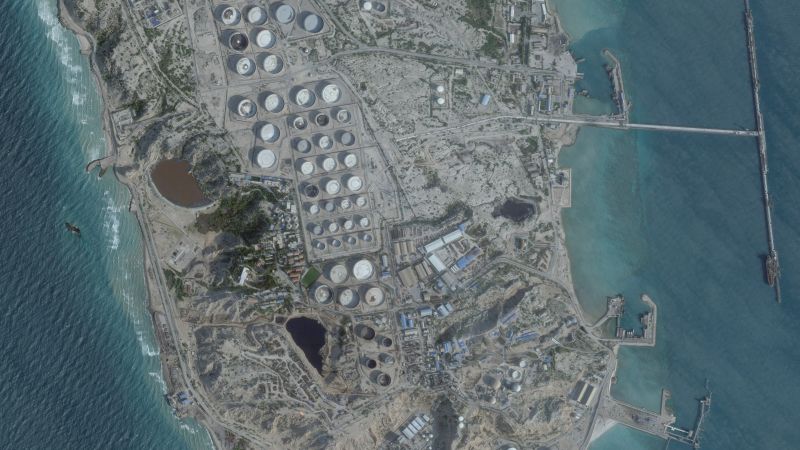
Kharg Island is a small, five-mile-long landmass that functions as a critical hub for Iran’s oil supply chain. U.S. officials have described it as the “nexus” for the nation’s energy exports, with its deep-water jetties enabling supertankers to offload oil efficiently. The island’s strategic position in the Persian Gulf has made it a focal point for both economic and military considerations. A declassified CIA report from 1984, shared online, emphasized the island’s role as “the most vital component in Iran’s oil system,” stating that its uninterrupted operation is essential for the country’s financial stability.
“…we will be taking Kharg Island, and other oil infrastructure points, and assume total control of their Oil and Gas Markets, much like we have with Venezuela.”
While Trump’s latest statements signal a heightened threat, they align with his earlier discussions about targeting the island. The U.S. has already conducted multiple strikes on Kharg, including attacks on its airport facilities, as documented by CNN in a geolocated video. These actions, though not directly targeting oil infrastructure, have demonstrated the potential for escalation. The White House has previously hinted at the possibility of military intervention, suggesting that such a move could destabilize Iran’s economy and weaken its Islamic Revolutionary Guard Corps.
The Cost of Seizure: Economic and Military Implications
Iran’s economic reliance on Kharg Island means its capture could have severe repercussions. The island boasts storage capacity for roughly 30 million barrels of oil, according to Reuters data cited in March. This volume underscores its role as a central artery for Iran’s oil trade, which is a cornerstone of its economy. Analysts note that while alternative export routes, such as the Jask terminal on the Gulf of Oman, have been developed, they remain underutilized and untested at scale. The International Energy Agency (IEA) confirmed that these routes, though available, lack the infrastructure to replace Kharg’s current role fully.
Trump’s rhetoric reflects a broader strategy of leveraging economic pressure to force Iran into compliance. His March 2026 declaration that the U.S. had bombed “every military target” on the island, while avoiding direct strikes on oil facilities, highlights the delicate balance between disruption and control. Israeli opposition leader Yair Lapid once warned that destroying the terminal would “cripple Iran’s economy and topple the regime,” a sentiment echoed by U.S. officials who view the island as a linchpin of Iran’s energy dominance.
A Long-Standing Threat: From Rhetoric to Action
Trump’s interest in Kharg Island is not new. As early as 1988, he expressed intentions to invade the island, telling The Guardian that a single attack on U.S. personnel or vessels would prompt immediate action. “One bullet shot at one of our men or ships and I’d do a number on Kharg Island. I’d go in and take it,” he remarked during an interview. This historical context adds weight to his recent threats, suggesting a consistent approach to pressuring Iran through energy disruption.
Recent months have seen Iran fortifying Kharg in preparation for a potential U.S. operation. Multiple sources familiar with intelligence reports confirm that the country has deployed additional military assets, including shoulder-fired missile systems (MANPADs), to defend the island. The strategic positioning of these defenses indicates a readiness to counter an invasion, even as regional mediators advocate for diplomacy to avoid further conflict. The U.S. military has also been working on contingency plans, though these have been delayed due to concerns over operational risks and the need for sustained troop commitment.
Despite the escalatory tone, the White House acknowledges the complexity of seizing the island. While some officials see it as a viable option to cripple Iran’s economy, others caution against the logistical challenges. The Pentagon’s recent assessments suggest that capturing Kharg would require a significant military effort, raising questions about the feasibility of such an operation. Nevertheless, the possibility of targeting the island remains a key element of U.S. strategy in the region.
Regional Dynamics and the Path Forward
The ongoing standoff between the U.S. and Iran has drawn attention from regional actors, who have sought to mediate peace talks. However, Trump’s latest remarks challenge this diplomatic approach, framing the island as a necessary target to assert control over Iran’s oil markets. The U.S. has previously struck military installations on Kharg, with the strikes in early April reportedly damaging maritime infrastructure but sparing oil facilities, according to a U.S. official. Iran’s semi-official Mehr News Agency downplayed the impact, stating that the island’s key structures remained intact.
As the situation evolves, the strategic importance of Kharg Island continues to be a point of contention. The island’s size, comparable to a third of Manhattan, and its deep-water access make it a formidable asset for Iran. Yet, its vulnerability to U.S. strikes, combined with the nation’s reliance on its oil exports, positions it as a high-value target. Whether the U.S. will act decisively or continue to use the island as a bargaining chip remains to be seen, with the broader conflict over Iran’s energy sovereignty hanging in the balance.
Trump’s statements, while provocative, are part of a larger pattern of using oil infrastructure as leverage. The president has consistently emphasized the need to disrupt Iran’s economic capabilities, a theme that has shaped his foreign policy since the 1980s. The recent focus on Kharg Island reflects this approach, as the U.S. seeks to force Iran into a position where it must negotiate or risk losing its economic foothold. For now, the island stands as a symbol of the tensions between the two nations, with the potential for a major escalation looming as the peace talks remain deadlocked.
In the coming weeks, the U.S. and Iran will likely continue to test each other’s resolve. Whether through military strikes, economic sanctions, or diplomatic overtures, the struggle over Kharg Island highlights the broader conflict over energy control in the Middle East. As Trump’s rhetoric intensifies, the island’s fate—and the economic consequences for Iran—remains a focal point of international attention.