Strait of Hormuz: Iran’s Grip on the World’s Most Critical Oil Chokepoint Is Slipping
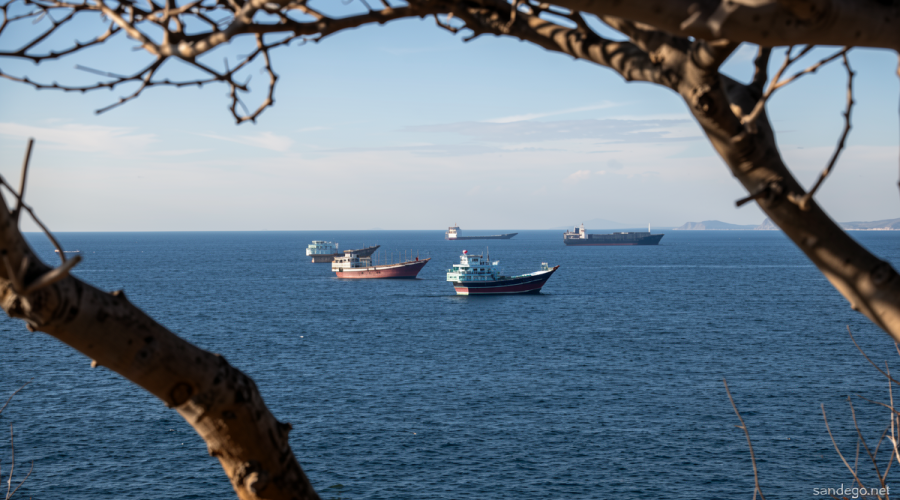
Sandego.net – The narrow waterway linking the Persian Gulf to the open Arabian Sea has long been the single most consequential artery in global energy logistics. Roughly one-fifth of the world’s daily oil consumption funnels through its roughly 33-mile-wide corridor, making any disruption there an immediate shock to markets, shipping insurance rates, and national security calculations across Asia, Europe, and the Americas. Now, amid an active military confrontation between Iran and the United States, the balance of power inside that corridor is shifting in ways that contradict Tehran’s public posture.
For months, both Washington and Tehran have issued competing claims about who commands the strait. The rhetoric has muddied the picture for traders, insurers, and policymakers. Yet the operational data emerging over the past fortnight points in one direction: American naval patrols are asserting dominance, while Iran’s ability to dictate terms of passage is eroding rapidly.
The Omani Corridor Becomes the Default
Shipping analytics firm Kpler, which monitors vessel movements through transponder signals and satellite imagery, reports that more than 80 percent of liquid-cargo transits through the strait over the last two weeks have followed the Omani route — a shipping channel authorized by the United Nations that Iran has consistently and vocally opposed. A substantial share of the remainder were so-called “dark” transits, vessels with transponders switched off, which Kpler’s satellite cross-referencing suggests also threaded the Omani corridor rather than the Iranian-preferred lane along the north coast of Oman.
The contrast with just four weeks ago is stark. At that time, Kpler recorded virtually zero traffic along the Omani route. The sudden inversion has practical consequences: with ships bypassing the Iranian lane, Tehran has been unable to impose the tolls it collected on passing tankers during the spring. The expiration this week of the Memorandum of Understanding between Washington and Tehran theoretically reopened the door for Iran to resume toll collection. In practice, no such charges have materialized.
“Iran’s request to collect tolls is something that most Middle East folks don’t want to do and haven’t been doing,” said Dan Pickering, founder and chief investment officer at Pickering Energy Partners. “So the Oman route absolutely makes the most sense.”
Dark Ships and the Limits of Tracking
To minimize exposure to Iranian missile and drone strikes, operators have been switching off automatic identification system transponders — sometimes for weeks at a stretch. This “dark traffic” has evaded several conventional data-tracking platforms. Satellite imagery can still pick up individual vessels, but the aggregate picture becomes fragmented and harder to verify through traditional AIS-based methods.
The United States, however, fields substantial naval and aerial surveillance assets in the theater. Energy Secretary Chris Wright stated last week that combined oil transits through the strait and rerouted around the waterway totaled approximately 15 million barrels per day over a seven-day window. That figure sits considerably closer to the roughly 20-million-barrel daily average that characterized pre-war flows than most conventional shipping estimates had previously indicated.
Those numbers prompted President Donald Trump to declare on Monday that the United States exercises “total control over the strait” — a formulation he has repeated with frequency throughout the conflict. Whether that characterization holds up under scrutiny is another question. Iran continues to launch attacks on vessels, and actual oil throughput remains well below pre-war norms. Full American command of the waterway, in the operational sense, has not been demonstrated.
“If their goal is to be ‘in charge,’ then I’d say they were never completely in control to start with,” Pickering observed. “It feels like their goal is deterrence, in order to be validated as in-control. I think they are still deterring.”
Chartering Workarounds and Gulf Logistics
Producers in Kuwait, Saudi Arabia, and the United Arab Emirates have adopted a two-leg shipping strategy. They charter Very Large Crude Carriers — the largest class of oil tanker, each capable of carrying roughly two million barrels — to transit out of the Persian Gulf through the strait under US naval escort. Once clear of the danger zone, in the Gulf of Oman, the cargo is transferred to customer-owned tankers for the final leg to destination terminals. Andy Lipow, president of Lipow Oil Associates, described the arrangement as a practical hedge against continued Iranian aggression.
The result is a shipping pattern that looks, from a data standpoint, far messier than normal. Vessels vanish from AIS feeds for extended periods, reappear in different positions, and sometimes cannot be matched to a single continuous voyage. Analysts must triangulate from satellite passes, port calls, and cargo manifests to reconstruct the true volume of oil moving through the corridor.
Diplomatic Undercurrents and Uncertainty
Complicating the picture further, Oman and Iran are reportedly conducting bilateral talks aimed at restoring freedom of navigation through the strait — discussions conducted without American participation, to Trump’s evident frustration. The outcome of those negotiations, and whether they will alter transit patterns or reassert Iranian leverage over the waterway, remains unknown.
“I would take all the information and headlines ‘under advisement,'” Lipow cautioned. “But it is fair to say that Iran has partially lost control of the strait.”
Homayoun Falakshahi, head of crude oil analysis at Kpler, framed the shift in operational terms: “It increasingly looks like Iran has at least partially lost control of the strait.” That assessment carries weight given the firm’s direct observation of vessel routing over multiple weeks.
What emerges from the fog of competing claims is not a clean victory for either side. The United States has demonstrably increased its ability to escort tankers and monitor flows. Iran retains the capacity to strike, to disrupt, and to complicate insurance and scheduling for any vessel that transits its preferred lane. The strait, for now, exists in a contested middle state — neither fully under Tehran’s command nor wholly under Washington’s. For the roughly 20 million barrels of oil that historically moved through this corridor every day, that ambiguity translates directly into elevated freight rates, longer voyage times, and persistent risk premiums that ripple through every downstream energy market.
Related Reading
Frequently Asked Questions
What is Iran has lost significant control?
Iran has lost significant control is the main topic of this guide. The article explains the context, practical details, and next steps readers should understand.
Why does Iran has lost significant control matter?
Iran has lost significant control matters because readers are looking for a useful answer, not just a short summary. Good content should match search intent and help them decide what to do next.